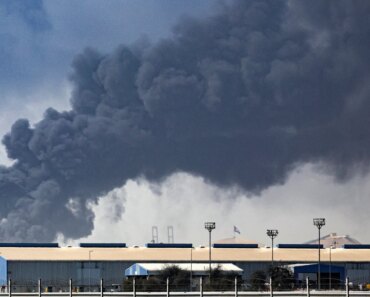
A plume of smoke rises from the Jebel Ali port following an Iranian attack in Dubai on March 1, 2026.
Fadel Senna | AFP | fake images
At least 11 countries have been attacked by Iran in retaliation for continued US and Israeli attacks, but no country other than Israel has been hit harder than the Emirates.
The United Arab Emirates says it has intercepted more than 90% of missile and drone threats coming from Iran. As of March 12, the 13th day of the war, official counts from the UAE Ministry of Defense show that air defenses intercepted 268 ballistic missiles, 15 cruise missiles and 1,514 drones, with six killed and 131 wounded.
The amount of firepower being sent to the Emirates is significantly greater than that of its Gulf neighbors and almost as much as that of Israel, which has faced more than 1,000 missiles and drones in the last two weeks from Iran. Attacks against neighbors Qatar, Saudi Arabia and Bahrain continue to number in the hundreds.
Despite the interceptions, Iran’s attacks have significantly impacted life in the Emirates. Residents of Dubai and Abu Dhabi frequently hear loud explosions overhead due to daily interceptions, and missile alarms ring on phones at all hours.
Airports in both Dubai and Abu Dhabi, residential buildings, hotels in both Emirates, the Dubai International Financial Centre, the Jebel Ali port and the US consulate in Dubai have been attacked, despite the Iranian government telling CNBC that its attacks against Gulf neighbors are limited to US bases in the region.
For Iran, the United Arab Emirates is a prime location where attacks can simultaneously pressure Washington, disrupt global energy flows, disrupt international finance and business, and generate global attention.
Iran can inflict maximum regional and global pain, testing a state that has positioned itself as the Gulf’s safest bridge between East and West, and the future of the region in finance, logistics, aviation and technology.
Strategic alliance
The United Arab Emirates was one of the first places US President Donald Trump visited in his second term last May during a trip to the Gulf states.
The United States had already designated the country as a major defense partner in 2024, deepening coordination not only on defense but also on technology and investment in artificial intelligence. The partnership leaves little doubt about the UAE’s position when it comes to regional security.
On March 7, Al Dhafra air base was the target of Iranian drone and missile attacks.
The base, located about 32 km (20 miles) south of Abu Dhabi, the capital of the United Arab Emirates, hosts the United States 380th Air Expeditionary Wing along with French forces. It serves as a key regional center for air operations and intelligence gathering, and is home to about 3,500 U.S. troops.
“There is no good answer as to why the United Arab Emirates has been attacked more intensely than any other country in the neighborhood,” Abdulkhaleq Abdulla, an Emirati academic and political scientist, told CNBC on Sunday.
The real story, he added, is “how well the UAE managed to defend itself against these daily missiles and drones in their third week; it seems the country has been preparing for this type of attack all along.”
The Iranian regime claimed that they were only targeting US bases in the region, before beginning to attack US civilian infrastructure and financial institutions in the region.
Iranian President Masoud Pezeshkian has demanded the closure of US bases in the Gulf. Iran’s new supreme leader, Mojtaba Khamenei, has also said these bases must be closed or they will be “attacked.”
“There is no respect for progress”
The United Arab Emirates has long prided itself on being a tolerant nation.
While many locals are deeply religious, they welcome foreigners with open arms. About 90% of the country’s nearly 11 million residents are expatriates.
The UAE’s reputation for being open, prosperous and socially flexible by regional standards is more progressive than many of its neighbors, including Iran, Kuwait and Saudi Arabia, where alcohol is banned and women’s clothing remains a major concern.

“This is the global center of business, it is a reflection of what life should be and what success should be, what prosperity should be, what positivity should be, this is this place,” Mohamed Alabbar, founder of Emaar Properties, told CNBC’s Dan Murphy in Dubai when asked why the United Arab Emirates has been such a target for Iranian attacks.
Despite the government’s efforts to maintain a sense of “business as usual,” several major international banks pulled employees from their Dubai offices this week as Iran said it would attack economic hubs and financial institutions linked to the United States across the Middle East.
Last week, two consecutive attacks by Iran targeted the Dubai International Financial Center. The Dubai media office confirmed the incidents but said there had been no injuries.
Banks and American companies based in the financial center allowed their staff to work from home at the start of the war, but many ordered it after last week’s attacks. Both Abu Dhabi and Dubai are home to regional hubs of tech giants, and many of them are specifically named as targets by Iran’s Islamic Revolutionary Guard Corps, including Alphabet Google, Oracle and IBM.
Energy infrastructure
The United Arab Emirates also hopes to position itself as a major hub for AI as the region seeks to diversify its economy away from oil. Questions have been raised about the region’s attractiveness as a location for investment by big tech companies after Iran targeted a Amazon data center in the country, disrupting cloud services.
Abu Dhabi National Oil Company’s Ruwais refinery, the largest in the Middle East, was closed as a precaution after a drone attack caused a fire, while operators in Fujairah temporarily suspended some terminal activities amid the hostilities.

Iran hopes to wreak havoc on regional supply chains and, with the effective closure of the Strait of Hormuz, disrupt energy exports from major Gulf producers.
The attack on energy infrastructure is not new. Abu Dhabi was attacked by the Houthis in 2019, but this direct attack on Ruwais shows the Islamic Republic’s deviation from attacking targets linked only to the United States.