The energy price shock that followed Russia’s invasion of Ukraine four years ago is fresh on the minds of European policymakers as the conflict in Iran once again drives up oil and gas prices. Experts, however, believe this time could be different.
Fears of a full-blown energy crisis on that scale – which saw oil soar above $120 a barrel in June 2022, gas prices soar, household energy bills soar and eurozone inflation hit a record 9% – may still be overblown, according to investment strategists.
Brent CrudeThe global oil benchmark has retreated from nearly $120 a barrel seen earlier in the week when the International Energy Agency agreed Wednesday to release a record 400 million barrels of oil from its emergency reserves. European natural gas prices, as measured by the Dutch futures benchmark TTF, also retreated from a three-year high of 63.77 euros per megawatt-hour and were last seen below 50 euros per MWh on Wednesday.
“Eerily familiar”
James Smith, UK developed markets economist at ING, said that while the initial reaction in energy prices looks “eerily familiar” to the start of the Ukraine invasion, the global economic outlook looks very different from the shock of 2022.
“The 2022 energy crisis landed in a global economy that was ripe for inflation to take off. Supply chains were fractured, labor markets were strained, and fiscal policy was fueling the fire. All of that, to varying degrees, is less true today,” Smith said in a note.

Brent Crude.
The impact on Europe’s inflation trajectory depends on the duration of the conflict, analysts say.
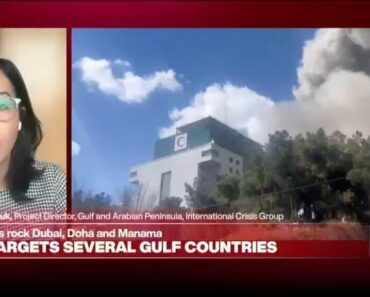
The ongoing shutdown of Qatari production of liquefied natural gas (LNG), which accounts for almost a fifth of global LNG supply, and attacks on ships in and near the critical Strait of Hormuz could disrupt oil and gas reserves in Europe for longer.
Qatar has become a key source of LNG supplies to Europe, which has reduced its dependence on Russian gas pipeline supplies since the invasion of Ukraine.
Michael Lewis, CEO of a German multinational energy supply company unipersaid the company has “turned off” Russian gas since the invasion of Ukraine, diversifying its sources through LNG and pipelines from Norway, the United States, Canada, Australia and Azerbaijan.
“We didn’t want to repeat the challenges of the past, which was relying on a single source, namely Gazprom,” Lewis told CNBC’s “Squawk Box Europe” program on Wednesday.

But he admitted that Europe does not produce the volume of gas it needs to meet its energy needs.
“What we need to do is have more long-term contracts. After the removal of Russian gas from our portfolio, we have to buy more gas on the spot market… That’s why we are rebuilding the portfolio to include more long-term gas contracts in the portfolio, which protects us from some of these price changes.”
Inflation concerns
Smith said a scenario in which energy supplies normalize after four weeks, lowering energy prices in the second quarter, could boost eurozone inflation from its current level of 1.9% to 2.5% in the second quarter. Meanwhile, inflation could reach 3% in the United Kingdom and the United States.
That would be “enough to delay, but not derail,” further rate cuts from the Federal Reserve and the Bank of England, but “not enough to knock the ECB out of its ‘good place,'” Smith added.
10-year British Gilts.
Government bond yields in the United Kingdom and Germany rose as investors revised their bets on the interest rate policies of the Bank of England and the European Central Bank. Madis Muller, a member of the European Central Bank’s governing council, admitted that the likelihood of a rate hike has increased, according to a Bloomberg report on Tuesday.
Strong moves in bond yields underscore market uncertainty, in line with huge swings in oil and gas since the conflict began, while analysts say persistently high and longer energy prices will drive central banks’ policy responses.
Geoff Yu, senior EMEA market strategist at BNY, said that, in the short term, the ECB’s rate cuts will likely have to be phased out. But he added that there is “too much uncertainty” to provide guidance beyond the next three months.
“Markets pricing in two increases seems too excessive, but it is important to manage expectations and pivot tactically to anchor inflation expectations,” Yu told CNBC by email. “Europe needs to ensure that the 2022-2023 period is not repeated.”
He said this time the continent is much less exposed to a sudden tightening of financial conditions, as equity positioning is not as concentrated.

“First, prices are still a fraction of their 2022 highs. Second, European energy resilience is now much stronger thanks to supply diversification, so there is no need for an overreaction. Third, the state of the cycle is different, as there is no post-Covid demand surge to speak of,” Yu said.
‘A complicated cocktail’
Peter Oppenheimer, chief global equity strategist at Goldman Sachs, said the broader market environment leaves Europe facing a “complicated cocktail” as investor sentiment around growth and inflation recalibrates almost “hour by hour.”
“For Europe as a whole, the combination of rising oil prices and a weakening euro – at least the situation we’ve seen in the last two weeks – is actually a positive net benefit for earnings,” Oppenheimer told CNBC’s “Squawk Box Europe” on Tuesday. “Of course, to the extent that that combination leads to a deterioration in the mix of growth and inflation, that would be a net negative.”
“We’ve seen a massive rise in oil prices, huge uncertainty. If that were to continue, I think it would inevitably have the effect of lowering growth expectations to the point where stocks correct.”