Most of the costs have not been budgeted for, researchers say, meaning the Pentagon will soon have to request more money.
The United States-Israeli war on Iran is estimated to have cost Washington $3.7bn in its first 100 hours so far, or about $900m a day, according to new research, driven largely by massive munitions spending.
An analysis by the Washington-based think tank Center for Strategic and International Studies (CSIS) underscored the huge cost of the war, which entered its seventh day on Friday, as the US attacked Iran with stealth bombers and advanced weapons systems.
Recommended stories
List of 4 itemsEnd of list
Researchers Mark Kancian and Chris Park estimate that only a small amount of the war’s estimated $3.7bn cost in the first 100 hours – or $891.4m per day – has already been budgeted for, but most of the costs – $3.5bn – are not.
That means the Pentagon will need to request more money soon to cover unbudgeted spending, he said, which is likely to prove a political challenge for the Trump administration and “a focal point for opposition to the war.”
Domestic cost-of-living concerns, inflation, and the knock-on effect of rising gas prices now due to the conflict are likely to further reduce support among US citizens for the war. This is dividing Trump’s “America First” base, who promised not to enter “foreign wars” during his presidential campaigns.
The researchers said the US Department of Defense released limited details on its operations, including Congressional Budget Office (CBO) estimates of each unit’s operations and support costs, adjusting for inflation and unit size and adding 10 percent for “high operational tempo” costs.
Their analysis stated that the US had expended more than 2,000 rounds of munitions of various types in the first 100 hours of the war and estimated that it would cost $3.1bn to replenish the munitions stockpile on a one-of-a-kind basis, with costs rising to $758.1m per day.
Unbudgeted costs ‘substantial’
United States Defense Secretary Pete Hegseth has said that US bombing of Iran will “escalate dramatically”, with “more fighter squadrons … more defensive capabilities” and “more frequent bomber pulses”.
The authors of the report said that after the intense initial period of the conflict, air operations generally settled down to a less frenetic pace, “however, the unbudgeted costs here are substantial”.
This differs from recent US operations leading to the kidnapping of Nicolas Maduro in Venezuela, where most of the costs were already budgeted.
“That means (the Defense Department) will require additional funding at some point because the level of budget cuts required to fund this conflict internally will be politically and operationally difficult,” the report said.
It said the Trump administration could decide to ask for supplemental appropriations to cover any unexpected costs for the war and across the government, as the George W. Bush administration did at the start of the wars in Iraq and Afghanistan.
“The political challenge to the administration is that any fiscal action will become a focal point for opposition to the war,” it said.
Human cost
War already has a huge human cost.
More than 1,332 people have been killed in Iran since US and Israeli bombing began on Saturday, according to the Iranian Red Crescent, with at least 181 children among the dead, UNICEF said.
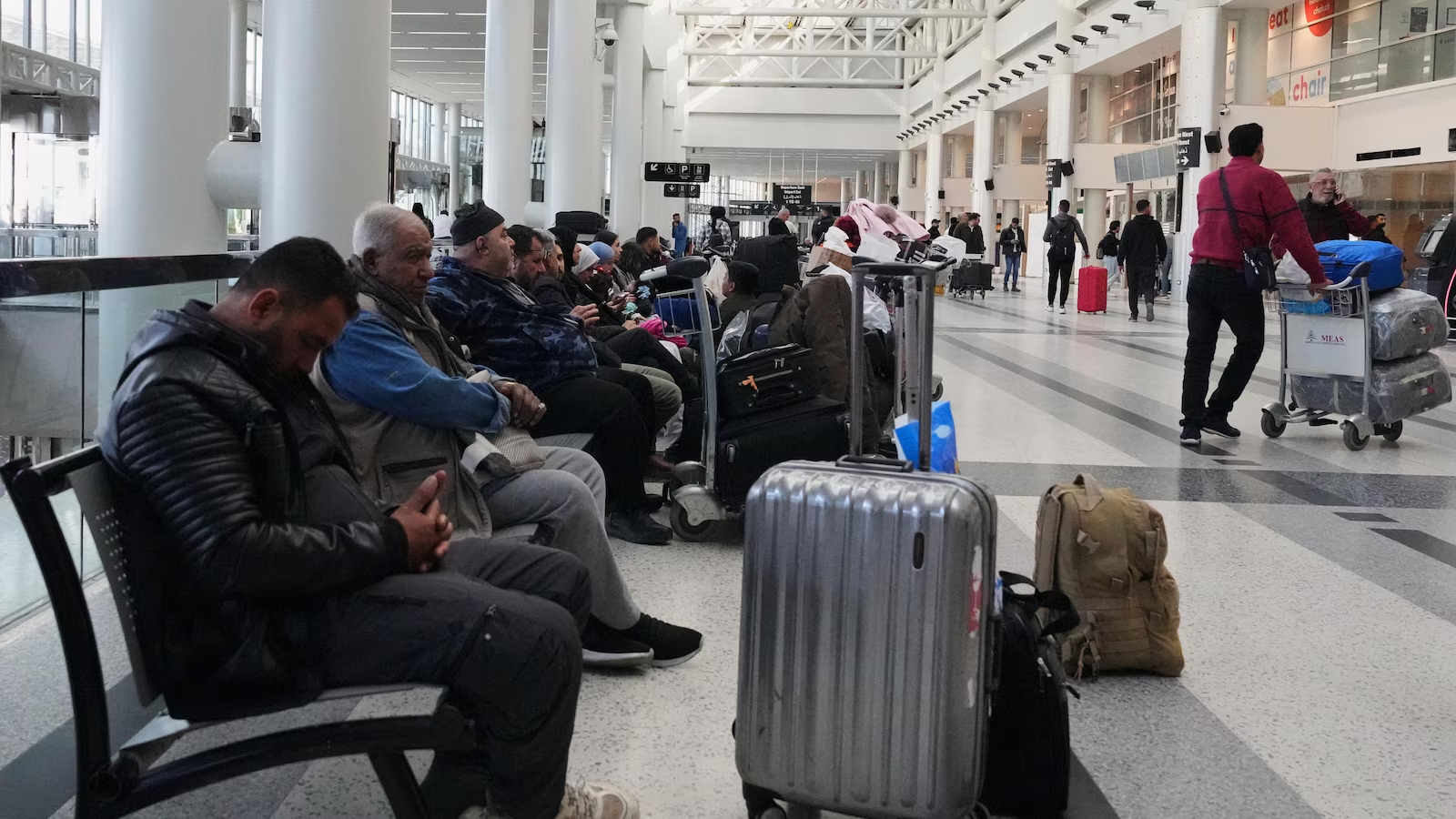
In Lebanon, the death toll from Israeli strikes this week rose to at least 123, Lebanon’s public health ministry said, as a new wave of strikes hit the country on one of the front lines in the wider war.
At least six US soldiers have died in the conflict, while 11 in Israel have also been killed. There have been nine deaths so far in the Gulf Arab countries.
(tags to translate)news