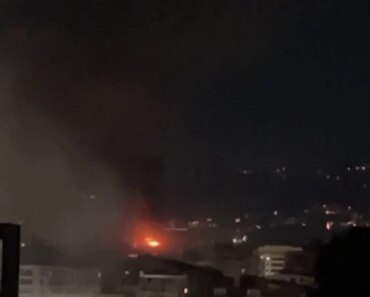
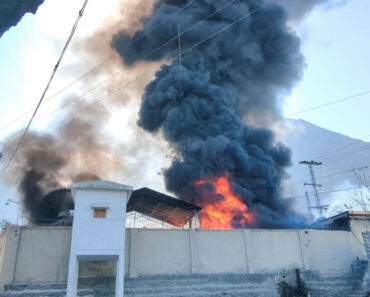
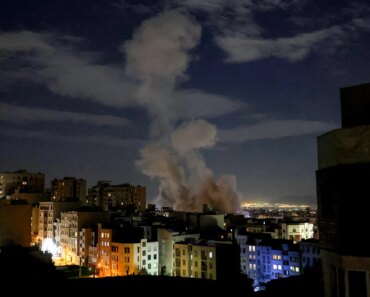
Donald Trump attempted to counter a simmering anti-Israel backlash in Congress and among his own Maga supporters on Tuesday by denying suggestions that he had been forced to attack Iran because Israel had already decided to do so.
Amid growing criticism among opponents and allies alike, Trump rejected claims that he had attacked Iran only because Israel had forced his hand, a suspicion fueled by comments made by Secretary of State Marco Rubio.
Asked if Israel had pressured him to launch military action, Trump told reporters: “No. It could have forced them to act.
“We were negotiating with these lunatics and in my opinion they were going to attack first. They were going to attack. If we didn’t, they would attack first. I felt strongly about it.”
Senate Democrats reacted angrily after Rubio suggested on a visit to the Capitol that Saturday’s attacks were driven by the need to preempt Iranian retaliation against American interests in response to Israeli attacks that Washington knew were coming.
Rubio’s comments – made after a briefing with CIA Director John Ratcliffe and General Dan Caine, chairman of the Joint Chiefs of Staff of the US military – fueled suspicions by some on both the left and right of the political spectrum that Israel’s interests, rather than those of the United States, dictated the decision to resort to open war.
“We knew there was going to be Israeli action,” he told reporters on Monday. “We knew that would precipitate an attack on American forces, and we knew that if we didn’t preemptively pursue them before they launched those attacks, we would suffer more casualties.”
That reasoning has sparked anger among Democrats, as well as segments of Donald Trump’s base, who view the attack on Iran – and specifically its timing – as at odds with his previously proclaimed “America First” foreign policy goals.
Democrats seized on Rubio’s explanation as an argument for upcoming votes on war powers resolutions, which have come before the Senate and House of Representatives this week to affirm the constitutional principle that a president must consult Congress before waging war.
“There was no imminent threat to the United States of America from the Iranians. There was a threat to Israel. If we equate a threat to Israel with the equivalent of an imminent threat to the United States, then we are in uncharted territory,” said Mark Warner, the ranking Democrat on the Senate intelligence committee.
“Are we now such a weakened nation that Israel decides when we go to war?” said Jeff Merkley, a Democrat from Oregon, in a speech on the Senate floor.
Even Chuck Schumer, leader of the Senate Democrats and one of Israel’s staunchest supporters in Congress, expressed doubts. He described the explanations as “completely and totally insufficient.”
“In fact, at least for me, that briefing raised a lot more questions than it answered,” he said.
Growing concerns about Israel’s role in the White House’s decision to go to war could further change perceptions about the country’s relationship with the United States, based on criticism that has emerged following the long war in Gaza. Opinion polls have shown a sharp drop in support among Americans following the Israeli military offensive in Gaza, which killed some 70,000 Palestinians and was launched in response to the murderous Hamas attack in October 2023 that killed 1,200 people, mainly civilians, on the Israeli side.
Trump has provided fluid reasoning for why he ordered strikes last Saturday, in conjunction with Israeli strikes, one of which killed Iran’s most powerful figure, Supreme Leader Ayatollah Ali Khamenei. He has also sent mixed signals about whether he is willing to deploy U.S. forces as “boots on the ground,” a decision that would almost certainly further inflame domestic criticism.
In his opening statement Saturday, he said the goal was “to defend the American people by eliminating imminent threats from the Iranian regime.”
But some of the president’s most influential people on social media seized on Rubio’s comments to question that justification.
“Rubio’s comments are a record-breaking moment,” wrote Mike Cernovich, a prominent pro-Trump social media influencer. “He said what most assumed was the case. For him to say (this) out loud… it’s a sea change in foreign policy. There will be massive calls to back off.”
“So it tells us flat out that we are in a war with Iran because Israel forced us,” wrote Matt Walsh of the right-wing Daily Wire magazine. “This is basically the worst thing I could have said.”
Speaking on his War Room podcast, Steve Bannon, a former Trump White House aide, said: “If we knew Israel would attack and Iran would retaliate against us, where was the coordination? We need a strategic explanation.”
The belief that the attack on Iran is primarily an Israeli interest has been compounded by comments from Benjamin Netanyahu, Israel’s prime minister, who has visited Trump on numerous occasions in recent months to press for action against Tehran’s theocracy, most recently last month.
“This coalition of forces allows us to do what I have longed to do for 40 years: hit the terrorist regime to the hip,” he said Sunday. “This is what I promised and this is what we will do.”
Referring to the first four American victims of Iran’s retaliation against the attacks, conservative journalist Megyn Kelly said in her online broadcast: “My own opinion is that no one should have to die for a foreign country.
“I don’t think those four service members died for the United States, I think they died for Iran or Israel… This clearly sounds like Israel’s war to me. It would perfectly explain why President Trump is having such a hard time explaining why we’re doing this.”