An exoplanet so light it would float on water if it had a big enough ocean continues to frustrate astronomers by hiding its closest secrets with a layer of haze thicker than ever seen on a planet before.
The haze is so thick that not even the sight of The James Webb Space Telescope (JWST) may penetrate it, leaving the mystery of how this ultra-low-density world and its sibling planets all formed unsolved for now.
The article continues below
Kepler-51d is a member of a four-planet system orbiting a young Sun-like star 2,615 light years away. They were discovered by NASA The Kepler space telescopewho observed the planets transiting their star. From the amount of the star’s light blocked during the transits, astronomers deduced the sizes of the worlds, and from variations in the timing of transits—the way each planet’s gravity pulls and pushes on the other planets, varying precisely when they are seen to pass—their masses were measured. Planets 51b, c and d have 7.1, 9 and 9.7 times the earth’s radiusrespectively, making them roughly the same size as Saturn.
However, planets b, c and d have masses only 3.7, 5.6 and 5.6 times that of Earth. Saturn, on the other hand, has a mass 95 times that of Earth. So these worlds are the same size as Saturn, but much (much) less massive. (The fourth planet in the system, e, was only discovered in 2024 and its mass and radius have not yet been measured with any degree of accuracy.)
It is remarkable that the densities of planets 51b, c and d have more in common with cotton candy (or candy floss as we call it in the UK!) than with the planets we are more familiar with.
As such, Kepler-51d and its other ultra-low-density worlds are completely alien to the planets in our own the solar system. Take the gas giants Jupiter or Saturn, for example, which has large, dense and well-defined cores that alone are ten times more massive than Earth. These cores formed first, and then their gravitational pull pulled masses of gas from the planet-forming disk that surrounded the Sun 4.5 billion years ago.
In contrast, the ultra-low-density worlds of Kepler-51 “have tiny cores and huge atmospheres that give them a cotton candy-like density,” Libby-Roberts said. It is not clear how these small cores could have accumulated relatively large amounts of gas.
So in search of answers, when Libby-Roberts was at Penn State University, she led a team in 2020 to observe the Kepler-51 system spectroscopically using The Hubble Space Telescope‘s Wide-Field Camera 3. The aim was to look for signs of the chemical composition of the atmosphere around the planets, which could provide clues about how far from the star these worlds formed, and how they later became so faint. Given their low density, they are undoubtedly rich in hydrogen and helium, the two lightest and most common elements in the universe, but the various trace gases found in their atmospheres can tell us more about their origins.
Still, Hubble found no sign of any chemistry, leading Libby-Roberts and her colleagues to suspect that there might be a featureless haze flooding the atmospheres of the planets.
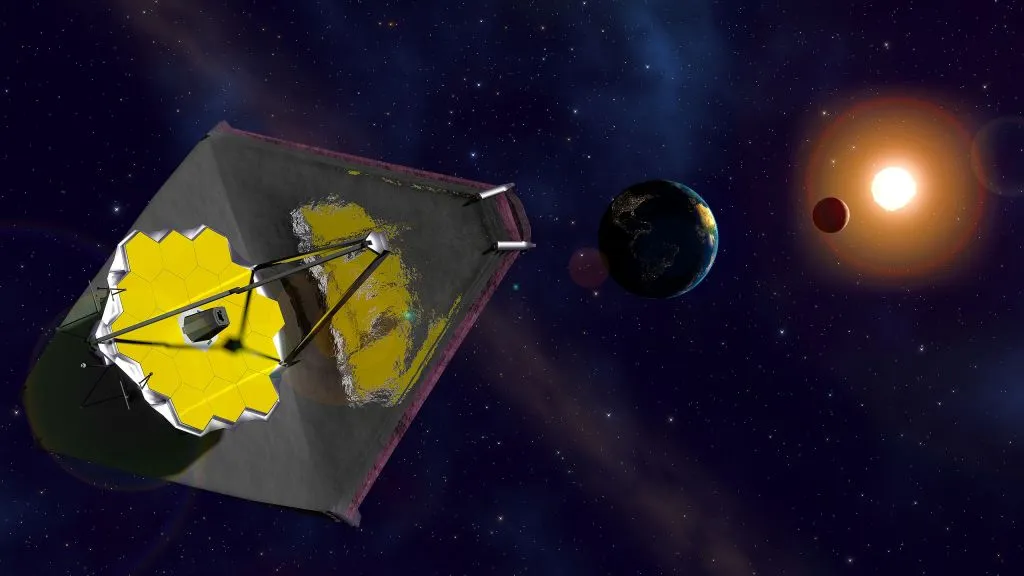
Now Libby-Roberts has returned to the Kepler-51 system, using JWST’s Near Infrared Spectrometer (NIRSpec) to try to probe harder into the atmosphere of Kepler-51d in hopes of discovering its chemical composition.
They aimed to achieve this via transit spectroscopy. As Kepler-51d passes its star, some of the star’s light filters through the planet’s atmosphere. Any molecules present may absorb certain wavelengths of the star’s light, which should appear in the star’s spectrum as absorption lines.
“A star’s light is filtered through the atmosphere of the planet before it reaches our telescopes,” Libby-Roberts said. “If we look across a range of wavelengths, across a spectrum, we get a kind of fingerprint of the planet’s atmosphere that reveals its composition.”
Yet the spectrum still showed no sign of the chemistry of 51d’s atmosphere, meaning that the haze present must be the thickest ever encountered on an exoplanet if even NIRSpec, which operates at longer wavelengths than Hubble, cannot see through it.
“It seems very similar to the haze we see on Saturn’s largest moon Titaniumwhich has hydrocarbons like methane, but on a much larger scale,” said co-researcher Suvrath Mahadevan of Penn State. “Kepler-51d appears to have a huge amount of haze, almost the radius of the Earth.”
There are currently no planet formation models that can explain how low-density worlds can form, especially so close to their star – if 51b, c and d were transported to our solar system they would all be packed into a region well inside the orbit of Venus.
“It’s possible that (51d) formed further away and moved inward, but we’re still left with a ton of questions about how this planet — and the other planets in this system — formed,” Libby-Roberts said. “What is it about this system that created these three really strange planets, a combination of extremes that we haven’t seen anywhere else?”
It is possible that we see these planets in a transitional phase. The system is half a billion years old, so young compared to our 4.5 billion year old solar system. As a young star, Kepler-51 is still quite active, and its stellar wind will remove the outer gases from the ultra-low-density planets. Perhaps if we came back in a billion years, much of each planet’s gas would have been cut away, leaving behind a small core.
Some answers may still come. A separate team is conducting NIRSpec observations of Kepler-51b to try to find evidence of the composition of its atmosphere. They may instead find that it is also shrouded in haze, but if they succeed, the clues these observations provide may also apply to 51c and d.
Measurements of Kepler-51d are then reported in the March 16 issue of The Astronomical Journal.