The war in the Middle East sparked by the joint US-Israeli attack on Iran expanded dramatically on Monday, with casualties and destruction reported in at least nine countries in less than 10 hours.
Israeli and American warplanes launched a new wave of strikes across Iran, where the Iranian Red Crescent Society said more than 500 people have been killed since the conflict began. Israel also launched an intense wave of attacks on Lebanon after Hezbollah attacked northern Israel in retaliation for Saturday’s Israeli attack that killed Iran’s supreme leader, Ayatollah Ali Khamenei.
Iranian attacks on oil infrastructure and other targets were reported across a 2,000-kilometre stretch of the region, with damage inflicted from the Gulf of Oman, where an unmanned ship carrying a bomb exploded against an oil tanker, to Cyprus, targeting a British military base.
The US military said Kuwait’s air defenses had mistakenly shot down three US F-15E fighters during an Iranian attack. All six crew members were recovered safely. Video showed one of the planes spiraling out of the sky, with an engine on fire, until it hit the ground and exploded in a fireball.
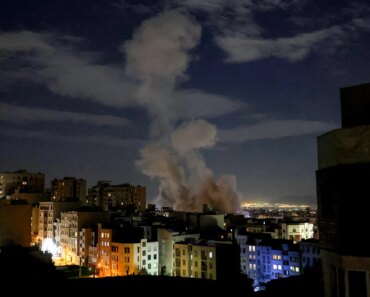
Black smoke rose around the US embassy in Kuwait, where there was a heavy presence of security officers, ambulances and fire trucks. Strong explosions occurred in Dubai and Samha, in the United Arab Emirates, and in Doha, the capital of Qatar. Saudi Arabia shut down its largest refinery after drone strikes sparked a fire there, one of several oil facilities that became targets.
In the first attack to hit US allies in Europe, a drone attacked the British Akrotiri air base in Cyprus overnight. Britain and Cyprus said damage was limited and there were no casualties.
The effort to overthrow Iran’s leadership is the United States’ biggest foreign policy gamble in decades.
US President Donald Trump reiterated his calls for the Iranians to rise up and overthrow their leaders, saying the air campaign could last weeks. Inside Iran, where residents have blocked roads to flee cities as bombs fell, there was uncertainty about the future and emotions ranging from apprehension to euphoria.
The Iranian Red Crescent put the death toll in Iran at 555 and said more than 130 cities across the country had been attacked. Israeli officials said their attacks on Monday targeted command and control centers and senior leaders of the ruling regime. In Israel, 11 people have been killed and 31 in Lebanon, according to authorities.
European allies distanced themselves from Trump’s initial decision to go to war, saying it did not meet the legal threshold to confront an imminent threat. But they have since said they would participate to help suppress Iran’s ability to retaliate after Tehran attacked its allies.
A senior White House official told Reuters that Washington would at some point talk to Tehran, but not yet.
“President Trump said that potential new leaders in Iran have indicated they want to talk and will eventually talk. For now, Operation Epic Fury continues unabated,” the official said.
It was unclear what the long-term prospects were for Iran to rebuild its leadership and replace the 86-year-old Khamenei.
Iran’s president-elect Masoud Pezeshkian said on Sunday that a leadership council consisting of himself, the head of the judiciary and a member of the powerful guardian council had temporarily assumed the duties of the supreme leader.
In a post on
“Iran, unlike the United States, has prepared for a long war,” he posted.
In Jerusalem, booms shook windows as missiles launched by Iran toward central Israel were intercepted.
An Israeli military spokesman said there had been fewer overnight attacks on Israel since Sunday, which he attributed to Israeli strikes degrading Iran’s military capabilities. Hezbollah had made “a big mistake” by “joining the Iran war,” he said.
US officials said B-2 strategic bombers had attacked Iranian missile launch sites.
Shipments through the Strait of Hormuz – where about a fifth of the world’s oil trade passes along the Iranian coast – have been halted after threats from Iran and attacks on oil tankers. Oil prices rose by double-digit percentage points when trading opened on Monday and stock markets fell.
Iran’s Revolutionary Guard said on Sunday it had attacked three American and British oil tankers in the Gulf and Strait of Hormuz, as well as attacking military bases in Kuwait and Bahrain with drones and missiles. Maritime data showed that hundreds of vessels, including oil and gas tankers, dropped anchor in nearby waters.
Global air travel was also severely affected as airstrikes kept major airports in the Middle East closed.
The U.N. nuclear watchdog had no indication that Israeli and U.S. strikes on Iran had hit any nuclear facilities, International Atomic Energy Agency chief Rafael Grossi said Monday, even though Iran’s envoy claimed one had been targeted a day earlier.
Iran’s nuclear program is one of the reasons Israel and the United States have given for the attacks, claiming that Iran was getting too close to eventually being able to make a nuclear bomb.
However, what remains of Iran’s atomic facilities after the two armies attacked them in June appears to have been largely spared from this campaign so far.
“We have no indication that any of the nuclear facilities… have been damaged or hit,” Grossi said in a statement to a meeting of his agency’s 35-nation board of governors.