Each atom is a coiled source of power. But some atoms give more power than others. The radioactive elements that power nuclear reactors can be coaxed into generating so much power that Lewis Strauss, then head of the US Atomic Energy Commission, predicted in the mid-1950s that electricity would soon be “too cheap to measure.”
Civilian nuclear power did not live up to the utopian hype, but it did succeed in creating a lot of waste. This residue is not the glowing green sludge of popular imagination, although it is dangerous: some components of spent fuel remain thermally hot for years and radioactive for millennia.
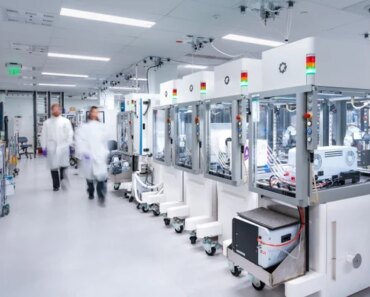
For some countries, this pulsating energy is a potential resource. Project Omega, a Rhode Island-based startup that came out of stealth mode in February, wants to take that trash and make it new again.
On supporting science journalism
If you like this article, please consider supporting our award-winning journalism by subscribes. By purchasing a subscription, you help secure the future of impactful stories about the discoveries and ideas that shape our world today.
“What we do today is take the spent fuel out of the reactor, put it in a pool of water for a few years just to let it cool, and then put it on a concrete pad next to the reactor,” says Stafford Sheehan, Project Omega’s founder and CEO. He wants to move the waste from the concrete pad into a bath of hot salts, extract the useful elements and feed them back into nuclear reactors—or into other technology like long-lived sensors that power military satellites.
Extraction of this nuclear waste is particularly attractive for military applications. Vehicle convoys, for example, are vulnerable targets. Radioactivity could power them, no refueling required. Remote outposts can use advanced reactors running on reprocessed fuel. The federal government wants to increase the country’s, and the military’s, nuclear capability. But it lacks the infrastructure to recycle its output.
Vehicle convoys are vulnerable targets. Radioactivity could power them, no refueling required.
Sheehan wants to seize the opening. “Nuclear power is having a moment,” he declares: In May 2025, President Donald Trump signed executive orders encouraging the development of advanced reactors, even directing the Defense Department to build one at a domestic military base. But as things are now, their waste, and the energy locked within it, will be buried. “It’s a completely lost opportunity,” Sheehan says.
Other countries take advantage of it. France, China and Russia reprocess their nuclear fallout using an acid-based method to filter out useful elements.
The US abstained, mainly due to proliferation concerns. Standard reprocessing of radioactive waste produces a stream of pure plutonium. Plutonium is the magic bean of nuclear weapons. Making more of it increases the risk of proliferation, something the US has been fighting against for decades. “We argued to various partners — allies — that because we don’t recycle, you don’t have to recycle,” says Jenifer Shafer, a former Department of Energy employee now at the Colorado School of Mines. “It put us in a position where, from a political standpoint, we maybe tied our hands a little bit.”
Yet the US still needs non-plutonium radioactive elements, such as specialized isotopes for medical use and fuel for its own reactors, so it often buys the fruits of foreign labor. “We have acquired many of these isotopes from Russia,” says Shafer. This dependence is a strategic bottleneck: If Moscow turns off the faucet, vital American hardware will never leave the ground. Project Omega proposes an internal supply of recycled material – without the same plutonium risk – that would make the US more self-sufficient without being hypocritical.
Project Omega plans to use a different process: a molten salt reaction. The company heats a salt such as lithium chloride until it liquefies, then mixes it with the waste, a toxic cocktail of metal oxides of radioactive elements. A chemical process transforms them into pure metals. These metals go into another molten salt bath to extract uranium, and then the final processes in the hot tub with salt water extract other elements. The company’s approach is a cross between an aluminum smelter and an oil refinery. It still produces plutonium, but the element remains chemically trapped in a messy soup of other materials — not so useful to anyone trying to sneak a nuclear bomb.
It is not easy work. The end product is more unruly than the production of plutonium-uranium reduction extraction, the standard acid method. The process also generates oxygen, which corrodes equipment. But Shafer suggests that R&D dollars can solve both problems. Slowing the flow of waste reduces the need to call on Russia for radioactive material and allows civilians and the military to get the most bang for their uranium buck.
Once revived, the waste comes in a few forms. The rest of the uranium can go back into reactors. The smaller isotopes, in Project Omega’s vision, could power small devices. “Think of an iPhone that never dies,” Sheehan says, a little grandly.
The Pentagon may have a different kind of always-on in mind. Plans in the works may require isotopes to power sensors in space, autonomous drones that can stay aloft for months and computers to process intelligence data. For soldiers disconnected from the grid, power would be one less problem to worry about.
To make it work, Project Omega wants government cooperation. It makes progress; the company recently received an award letter from the Defense Advanced Research Projects Agency. And for now, the “hot” work is happening through a partnership with DOE’s Pacific Northwest National Laboratory.
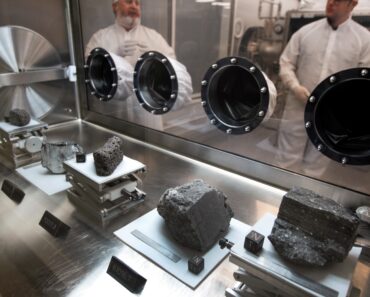
Project Omega recently built a microprocessor power source using the isotope strontium-90 in conjunction with a national laboratory, where government researchers inserted the device’s actual heat source. The microprocessor worked. And no green sludge leaked out.