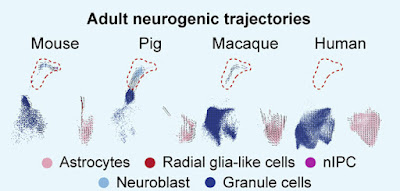
modified from Franjic et al. (2022). Cross-species comparison reveals transcriptomic signatures of neurogenesis in the adult mouse, pig and monkey hippocampus — but not human.
Does the adult brain generate new neurons throughout life? The prevailing belief for most of the 20th century was that no new neurons are born in the mammalian brain when development ceases. A series of studies in the 1960s showed otherwise, but these were ignored until the 1990s. A now-historic paper from 2000 heralded the death of a dogma: adult neurogenesis is here to stay, even in humans. Thousands of animal studies (mostly rodents) showed that new neurons are born in the dentate gyrus region of the adult hippocampus, and they can play an important role in learning and memory.
Recently, several papers have questioned whether adult humans really generate new neurons in the hippocampus (Sorrells et al, 2018, 2021; Franjic et al, 2022). One such paper examined the morphology of dentate gyrus cells taken from post-mortem brains and from tissue surgically removed from epilepsy patients, with ages ranging from prenatal to elderly (Sorrells et al, 2018). The presence of stem cells and young neurons was determined using immunohistochemistry (selective staining methods, visible in green and yellow below).
– click on the images for a larger view –

modified from Fig. 2a (Sorrells et al, 2018). Human dentate gyrus (DG) proliferation declines sharply in infancy.

modified from Fig 3d (Sorrells et al, 2018). The number of young neurons declines in the human DG from infancy to childhood.
The paper’s title succinctly summarized the findings: “Human hippocampal neurogenesis declines sharply in children to undetectable levels in adults.” Immature neurons were rare in the 7-year-old and 13-year-old samples, and completely absent in adults.
Despite these seemingly convincing results, criticism has identified shortcomings in the way post-mortem human brain samples are typically processed, as well as other technical issues that affect immunostaining of neurogenic markers (Moreno-Jiménez et al., 2021).
Transcriptomics to the rescue?
The most recent study used a different methodology: single-core RNA sequencing (snRNA-seq) of neurogenic markers in adult hippocampal subregions (Franjic et al., 2022). In a technical tour de force, the authors microdissected samples from five hippocampal subregions from the brains of pigs, macaque monkeys and humans. Single brain cell nuclei were isolated according to an incredibly complex protocol, followed by cellular barcoding, cDNA amplification, sequencing libraries, single nuclei expression quantification and hierarchical tree construction. The aim was to create a taxonomy of cell types categorized by gene expression.
– click on the image for a larger view –
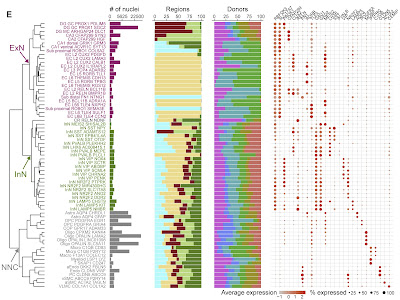
Fig. 1 (Franjic et al., 2022). Cell type diversity in the human hippocampal-entorhinal system revealed by snRNA-seq. (E) Dendrogram showing the hierarchical taxonomy across all cell subtypes.
As a cognitive neuroscientist, this level of cellular diversity is astounding and humbling. If you ever feel like you’re learning a lot about how the brain works from fMRI, take a look at the dendrogram above.
Iterative clustering identified 69 transcriptomically distinct cell clusters across all donors that were organized into a dendrogrammatic taxonomy reflecting their unique gene expression patterns.
“snRNA-seq reveals a neurogenic pathway in macaque, pig and mouse DG that is virtually absent in humans“
By using more comprehensive and less controversial methods than previous studies, and Incorporating cross-species comparisons, Franjic and colleagues observed no evidence of neurogenesis in the hippocampus of adult humans. A preview paper concluded that neurogenesis in humans is unlikely (Nano & Bhaduri, 2022).
These results do not negate or diminish the excellent and informative work on neurogenesis in rodents, but they do suggest that the human hippocampus relies on other forms of neuroplasticity for learning and memory.
References
Journal of Neuroscience 41(12):2554-65.

Must-See Experiment from the Snyder Lab (2014)!