While large institutional flows dominate the total volume of stablecoins, low-value transfers make up the majority of stablecoin transactions on BNB Chain, which has overtaken other blockchains in terms of transaction volume to become one of the leaders in the sector.
Related reading
The BNB chain leads the global Stablecoin transaction by account
As stablecoin activity continues to grow, BNB Chain has emerged as one of the leading networks in this sector, positioning itself ahead of competitors such as Ethereum, Tron and Solana in terms of transaction share, especially for lower-cost transfers that dominate emerging markets and retail use.
The latest data shows that BNB Chain is the leader in the number of transactions in the stablecoin sector, handling about 40% of global transactions and holding only 5% of the total stablecoin supply.
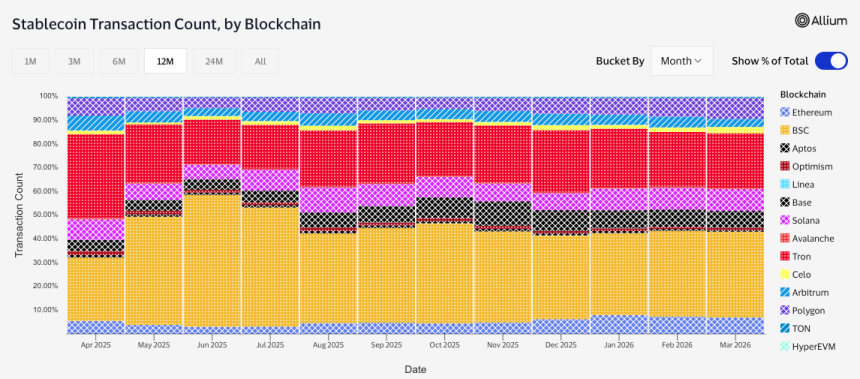
This figure shows the high transaction speed achieved by the low fees and fast block times achieved by recent improvements and active DeFi protocols such as PancakeSwap and Venus.
On-chain data platform Dune also revealed that BNB Chain is currently the leader in unique stablecoin senders among all blockchains. The data shows that the network saw 15.1 million unique senders in February alone, surpassing Tron’s 8.8 million, Ethereum’s 5.4 million, Solana’s 4.8 million, Arbitrum’s 2.5 million, and Base’s 2.1 million.
This shows that in terms of daily stablecoin activity such as trading, payments and money transfers, BNB Chain is currently the most active network for users.
While Ethereum remains the dominant chain for stablecoins, the BNB chain leads the way in stablecoin annual growth, with BNB Smart Chain (BSC) up 133% year-to-date (YoY), as reported by NewsBTC.
Additionally, it doubled stablecoin’s market cap to $14 billion at its peak in 2025, and also recorded the highest number of daily active users on any blockchain. Recently, it also recorded $21.7 billion in stablecoin transactions per day, marking a yearly peak.
‘The Normies’ Lead the Rise of Stablecoin Transactions
Forbes recently noted the key role of fiat tokens in the crisis economy, asserting that stablecoins have subtly become parallel currencies in developing countries where local currencies are not a reliable store of value.
The Orbital Stablecoin Premium/Discount Index for Q4 2025, cited by Forbes, shows the difference between what people pay for digital dollars and what they are worth, with an average purchase premium of 16.35% in regions such as the Middle East and North Africa.
Small stablecoin transactions under $10,000 will grow exponentially from 316 million to 3.2 billion in 2025. “Most of this growth has come from emerging markets, where transaction fees on chains like BNB Chain or Polygon are less than $0.05 cheaper than a bus ticket to the nearest bank,” the news outlet said.
It is worth noting that 82% of stablecoin transactions on the BNB chain are below $1,000, while 99% of them are below $10,000, with an average transaction value of $0.050. According to the report, two-thirds of traders’ stablecoin payments come from exchange accounts, and more than 50% of crypto users in emerging markets are logged in via Binance or OKX.
Related reading
Nina, BNB Chain’s Director of Development, told Forbes that the chain’s large transaction volume relative to its small share of total value accurately reflects its user base: “Norms.”
“Our audience is not all occupied institutions, but a large number of small payments and retail users,” he said.

Featured image from Unsplash.com, Chart from TradingView.com