Physical presence and the discipline of attention
Tabitha Millett’s artistic practice occupies a unique position within contemporary abstract art, shaped by a commitment to material presence and a rigorous approach to form. Working from her studio in Cambridge, she developed a body of work that prioritized tactile engagement and visual restraint over narrative or symbolic excess. Her paintings and constructed surfaces demand sustained viewing rather than immediate interpretation, positioning attention itself as an active component of meaning. This emphasis on direct contact reflects a philosophy rooted in making, where the physical act of working with materials is inseparable from the conceptual framework of the finished product. In the wider realm of art, her work stands out for its refusal to perform or persuade, instead asserting its meaning through clarity, balance and controlled intensity.
Central to Millett’s approach is a keen sensitivity to material agency. Paint, aggregate and surface are not seen as passive carriers of the image, but as collaborators in the construction of each work. The resistance of dense pigments, the friction created by adding marble dust or limestone chips, and the way light plays in matte and glossy finishes all influence compositional decisions. This focus on contrast and movement creates subtle visual tension that gradually unfolds and deserves closer inspection. Rather than overwhelming the viewer, the work establishes a rhythmic rhythm that encourages slow engagement, thereby highlighting the perception itself. The absence of decorative excess heightens awareness of every formal decision, reinforcing the idea that simplicity can be a pathway to depth.
Such disciplined cuts do not equate to austerity. Millett’s surfaces retain a quiet expressiveness, shaped by the pressure of the hand and the accumulation of the layering process. Lines may seem superfluous, but they carry evidence of time, touch and modification. The resulting composition balances solidity and sensitivity, suggesting that the structure is well thought out without feeling rigid. Through this balance, her work confirms the belief that meaning can emerge from the careful orchestration of limited elements. What remains is an art that neither guides nor explains, but is confident in its own material logic.
Tabitha Millett: Abstraction Shaped by Order and Precision
Tabitha Millett’s visual language is one of unwavering commitment to order, precision and balance. These qualities reflect not only aesthetic choices but also temperament in harmony with clarity and structure. Her abstract works often rely on arcs, planes and intervals, carefully arranged to create a sense of internal coherence that is both firm and open. The influence of Minimalism, Brutalist design, architecture and Bauhaus ideas is evident, but they are absorbed into personal vocabularies rather than overtly cited. The result is a work that feels rooted in historical dialogue while remaining distinctly contemporary in restraint and focus.
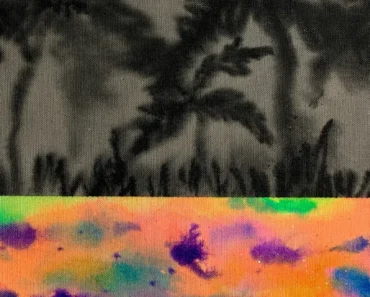
A defining feature of her practice is the orchestration of contrasts. Millett often sets dense, light-absorbing black surfaces in luminous fields of hand-mixed colors, creating a visual push-and-pull effect that animates the composition. The black she uses is carefully designed to absorb as much light as possible, creating the impression of depth or void space, while the surrounding colors shimmer with intensity. The colors are no accident; each palette is hand-mixed, often combined with polymers that thicken the paint and alter its interaction with light. The interplay between absorption and reflection creates a dynamic equilibrium in which forms appear anchored and suspended at the same time.
Precision does not eliminate the physical presence in her work. Lines often exhibit subtle variations, revealing the temporal nature of their making, while geometric elements reflect more architectural stability. This oscillation between gesture and construction introduces a quiet dynamism that resists static interpretation. Order becomes a framework within which change can occur, allowing work to remain responsive rather than closed. Through this balance, Millett shows how rigorous abstraction can remain warm and responsive, providing an experience that is both rigorous and quiet.
Academic foundation and growing public influence
Millett’s artistic practice is closely linked to her academic career, with the two informing each other through a shared focus on creativity, process, and critical reflection. She holds a degree in Fine Art, followed by postgraduate study at the University of Cambridge and doctoral research at University College London. These scholarly foundations enable a practice that is both reflective and materially grounded. She is currently Associate Professor of Arts, Creativity and Education at the University of Cambridge, working in an environment that values inquiry and experimentation. Her dual roles as artist and scholar enable her to continually engage with issues of making, learning, and visual literacy.
Beyond the studio and university, Millett’s work maintains an active public profile. Her paintings are on constant rotation at the Clarendon Gallery, which operates 90 galleries across the UK, ensuring wide visibility and engagement with diverse audiences. Internationally, her work with Tappan Gallery in Los Angeles expanded her reach into the United States, placing her work within the global context of contemporary abstraction. Exhibitions and sales also took place in France and Germany, reflecting strong international interest in her restrained yet striking visual language.
Despite her extensive gallery presentation, Millett maintains a direct connection to the environment in which she works. Visitors are welcome to arrange a tour of Cambridge’s studio to view current and ongoing works, which emphasizes her emphasis on process transparency and dialogue. She is also open to commissions and collaborative projects, with previous examples available through her field work. This openness underscores an approach that values participation over exclusivity, inviting collectors, collaborators, and viewers to participate in the ongoing life of the work rather than presenting it as a fixed or distant object.
Tabitha Millett: Recognition, Restraint and Contemporary Significance
Recognition of Millett’s work has grown steadily alongside her practice, characterized by institutional recognition and continued public interest. In 2016, she received the Soho Art Prize, an honor that highlighted her contribution to contemporary visual culture. This recognition is consistent with a career built on consistency rather than spectacle, where progress is measured by depth and refinement rather than rapid stylistic shifts. The presence of her work in private and public collections reflects her appreciation for abstraction that is thoughtful, composed, and materially focused.
The contemporary significance of her practice lies in its resistance to excess and distraction. In a visual environment filled with images, Millett’s paintings argue for the value of focus and restraint. They propose that intensity is achieved not through accumulation but through careful subtraction, in which each element earns its place. This approach resonates with current conversations around sustainability, attention, and production ethics, even if these themes are not explicitly stated. The work’s clarity prompts reflections on how form, material and time intersect in the act of looking.
By combining roles as artist, educator, and researcher, Millett contributes to an ongoing conversation about what abstraction can offer today. Her work demonstrates that minimal means do not necessarily produce minimal impact, and that rigor can coexist with sensitivity. By maintaining a practice rooted in material exploration and disciplined form, she continues to shape a body of work that is understatedly confident and thoughtful. The significance of her contribution lies in this balance, in which restraint becomes a source of expressive power rather than limitation.