Forecasters predict a potentially supercharged El Niño is coming this summer, and it could push temperatures across the globe to unprecedented extremes.
Last week, the National Oceanic and Atmospheric Administration’s (NOAA) Climate Prediction Center announced that there is a 62% chance of El Niño appearing between June and August. In other words, El Niño is more likely than not this year.
The article continues below
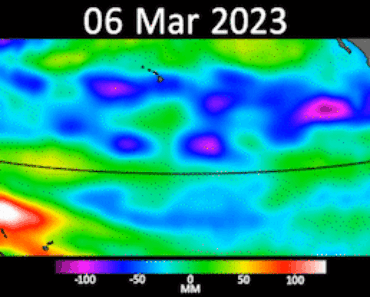
The tropical Pacific is currently in the middle La Niñathe cold phase of ENSO, when the sea surface temperature falls at least 0.9 degrees Fahrenheit (0.5 degrees Celsius) below the long-term average. La Niña is expected to end in the coming weeks as the ocean warms, according to the latest announcement from the Climate Prediction Center. El Niño will then occur if the sea surface temperature reaches and remains at least 0.9 F above the long-term average.
If El Niño emerges as expected, it could intensify into a “super El Niño,” AccuWeather reported. A super El Niño occurs when the sea surface temperature reaches at least 3.6 F (2 C) above the long-term average.
“The intensity is uncertain, but there is potential for a moderate to possible strong El Niño this fall into winter,” Paul Pasteloksaid a meteorologist and lead U.S. long-range forecaster at AccuWeather, according to the weather website.
Accuweather’s forecasters estimate that there is a 15% chance of a super El Niño developing by the end of the hurricane season in November. Meanwhile, NOAA’s Climate Prediction Center gives a 1-in-3 chance of a strong El Niño between October and December, but describes the potential strength as “highly uncertain.”
El Niño tends to strengthen hurricane activity over the central and eastern Pacific while suppressing hurricanes in the Atlantic, typically leading to a less active hurricane season overall.
The ENSO cycle triggering a warm El Niño and then a cold La Niña every two to seven years on average. However, they are not always on time. Likewise, while each phase tends to last around nine to 12 months, the duration varies.
El Nino is coming. This would increase our forecast for global temperatures in 2026 (although still unlikely to surpass 2024 as the warmest year), and make 2027 very likely to be the warmest year on record given the historical lag b/w ENSO and surface temperature. pic.twitter.com/agqcicaYIaMarch 6, 2026
Earth was last in El Niño between May 2023 and March 2024. On that occasion, El Niño came close to being a super El Niño, but while sea surface temperatures broke the 3.6 F threshold, they did not stay above the threshold long enough to qualify. The last super El Niño occurred in 2015-2016.
The last El Niño contributed record-breaking heat in 2023 and 2024, with 2024 currently the warmest year on record. If El Niño emerges in 2026, the year will be warmer, but it’s unlikely to be as warm as 2024 – after all, we started the year in La Niña. However, global temperatures in 2027 could be pushed to record highs, according to a post on social media platform X by Zeke Hausfara climate scientist and energy system analyst.
“El Nino is coming,” Hausfather wrote. “This will increase our forecast for global temperatures in 2026 (although still unlikely to surpass 2024 as the warmest year), and make 2027 very likely to be the warmest year on record given the historical lag b/w ENSO and surface temperature.”
It is important to remember that a number of factors influence the weather and climate. The planet is already warming due to climate change and will continue to do so, regardless what ENSO does.