Spain has denied the United States permission to use jointly operated military bases on its territory to attack Iran, while Madrid intensified its criticism of the “unjustified and dangerous military intervention.”
Spain’s Socialist Prime Minister Pedro Sánchez has explicitly condemned the “unilateral military action” of the United States and Israel against Iran, warning that it is contributing to “a more hostile and uncertain international order.” The rebukes have been reinforced by his government’s refusal to allow the United States to use bases in Rota and Morón for continued attacks against Iran.
José Manuel Albares, Spain’s foreign minister, said Monday that while the government wanted “democracy, freedom and fundamental rights for the Iranian people,” there was no way it would allow its bases to be used in the ongoing military action.
“I want to be very clear and very plain,” he told Telecinco. “The bases are not being used – nor will they be used – for anything that is not in the agreement (with the United States), nor for anything that is not covered by the UN charter.”
Defense Minister Margarita Robles was equally emphatic in stating that none of the bases had been used in the US military operation. “There is an agreement with the United States on these bases, but we understand that the agreement is that the operations must comply with international legal frameworks and that there must be international support for them,” he told reporters.
Maps compiled by flight tracking website Flightradar24 showed that 15 American aircraft have left Rota and Morón since the United States and Israel began their attacks over the weekend. At least seven of the planes were shown to have landed at Ramstein Air Base in Germany.
U.S. defense officials declined to comment on the reasons for the departures.
On Saturday, Sánchez said Donald Trump and Benjamin Netanyahu’s offensive was making the world less stable and called for a lasting political solution to the conflict.
He returned to the topic in a speech in Barcelona on Sunday. “Today, more than ever, it is vital to remember that you can be against a hateful regime – as Spanish society as a whole is when it comes to the Iranian regime – and, at the same time, against an unjustified and dangerous military intervention that is outside international law,” he stated.
Sánchez’s forceful condemnations are unlikely to endear him to Trump, who last year lashed out at Spain for refusing to accept NATO’s proposal that member states increase their defense spending to 5% of their GDP. But the Spanish president’s comments are in keeping with his status as one of Europe’s most outspoken leaders. Sánchez has been among the staunchest European critics of both Israel’s war in Gaza and the EU’s response to it.
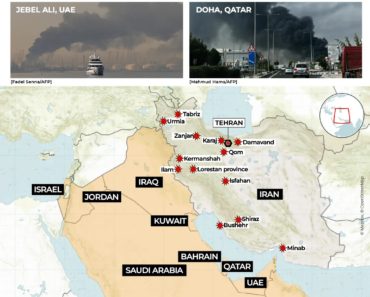
Other European leaders have tried to hedge their bets on Trump’s latest attempt to secure regime change abroad. UK Prime Minister Keir Starmer initially did not allow US forces to use Diego Garcia or any UK air bases due to questions about the legality of the attacks. But it changed its position on Sunday after Iran launched a wave of retaliatory missile and drone strikes against targets across the Middle East, one of which hit a UK air base in Cyprus.
In a joint statement with France and Germany published earlier on Sunday, the UK said: “We will take action to defend our interests and those of our allies in the region, potentially enabling necessary and proportionate defensive actions to destroy Iran’s ability to fire missiles and drones at their source.”
Trump reacted to the change of heart by saying the UK had taken “too long” to allow US forces to use its bases.
German Chancellor Friedrich Merz, who is scheduled to meet Trump in Washington on Tuesday, said he appreciated the “dilemma” over how to respond to Iran’s pursuit of nuclear weapons and oppression of its own people.
He added: “So we are not going to lecture our partners about their military attacks against Iran… Despite all the doubts, we share many of their objectives.”
European Commission President Ursula von der Leyen called for a lasting “diplomatic” solution to the crisis in Iran, adding that the bloc would work hard to prepare “for the consequences of these recent events.”