Molecular vibrations can “catapulate” electrons across solar materials in quadrillionths of a second – much faster than previously thought, a new study shows.
The findings could help researchers find more efficient ways to convert solar energy into electricity, according to the study, which was published March 5 in the journal Nature communication.
The article continues below
Organic molecules go into solar energy
Organic solar cells use carbon-based molecules, instead of silicon, to convert sunlight into electricity. In theory, organic solar cells can provide that electricity at a lower cost than conventional solar cells, but they are much less efficient.
In a typical organic solar cell, an electron donor and an electron acceptor are sandwiched between two conducting electrodes. When light hits the cell, it generates a “exciton,” an electron-hole pair. Excitons split at the donor-acceptor interface, generating electricity.
To see it happen on this time scale within a single molecular vibration is extraordinary
Pratyush Ghosh, researcher at the University of Cambridge
To achieve rapid charge transfer at the interface and limit energy loss, the donor and acceptor molecules usually have strong electronic coupling, or overlap between their electronic states, allowing charges to move easily between the molecules. They also often have a large energy difference between them, but this limits the voltage available from the device.
In the new study, researchers observed ultrafast charge transfer at a junction between the electron donor and the electron acceptor in an organic solar cell, without having to comply with any of these constraints. The team used a short laser pulse to excite the electron donor, a polymer called TS-P3, and then used another laser to measure how the system changed during charge transfer.
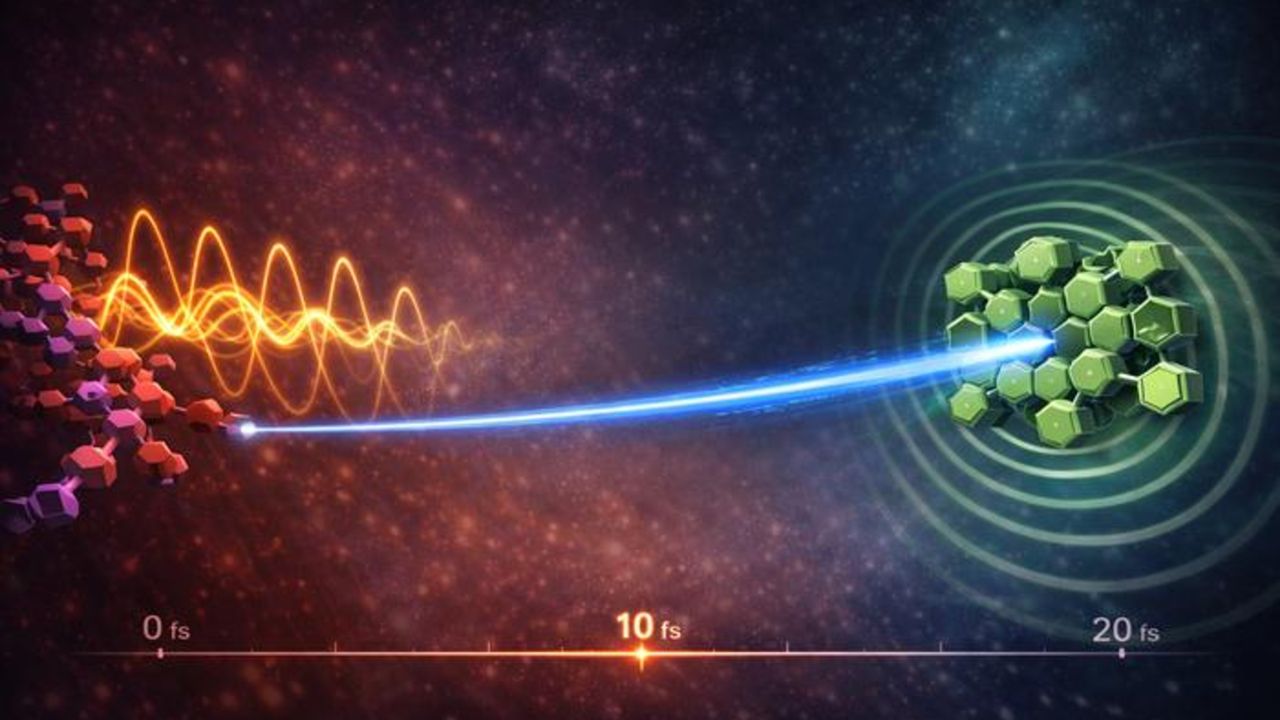
This charge transfer occurred in 18 femtoseconds – about as fast as a single molecule vibrates. A few other systems without strong driving forces show charge transfer over 100 to 200 femtoseconds, but most take ten to a thousand times that time.
“To see it happen on this time scale within a single molecular vibration is extraordinary,” Ghosh said in the statement.
A “molecular catapult”
The similar time scale was not a coincidence. In a second set of laser experiments, the team found that vibrations in the polymer donor molecule launched an electron across the junction to an acceptor molecule. When the electron arrived, it set off overlapping vibrations in the acceptor molecule. This overlap allowed charge transfer to occur much faster than expected, and without the need for strong coupling or a large energy difference.
“Instead of drifting randomly, the electron is launched in one coherent burst,” Ghosh said in the statement. “The vibration works like a molecular catapult. The vibrations don’t just follow the process, they actively drive it.”
The findings help explain the processes that control the rate of charge transfer and establish new strategies for designing more efficient organic solar cells and materials, the researchers wrote in the study.
“Instead of trying to suppress molecular motion, we can now design materials that use it – turning vibration from a constraint into a tool,” co-author of the study Akshay Raoa physicist at Cambridge, said in the statement.
Ghosh, P., Royakkers, J., Londi, G., Giannini, S., Arul, R., Gillett, A. J., Keene, S. T., Zelewski, S. J., Beljonne, D., Bronstein, H., & Rao, A. (2026). Vibronic-assisted subcycle charge transfer at a non-fullerene-acceptor heterojunction. Nature communication, 17(1). https://doi.org/10.1038/s41467-026-70292-8