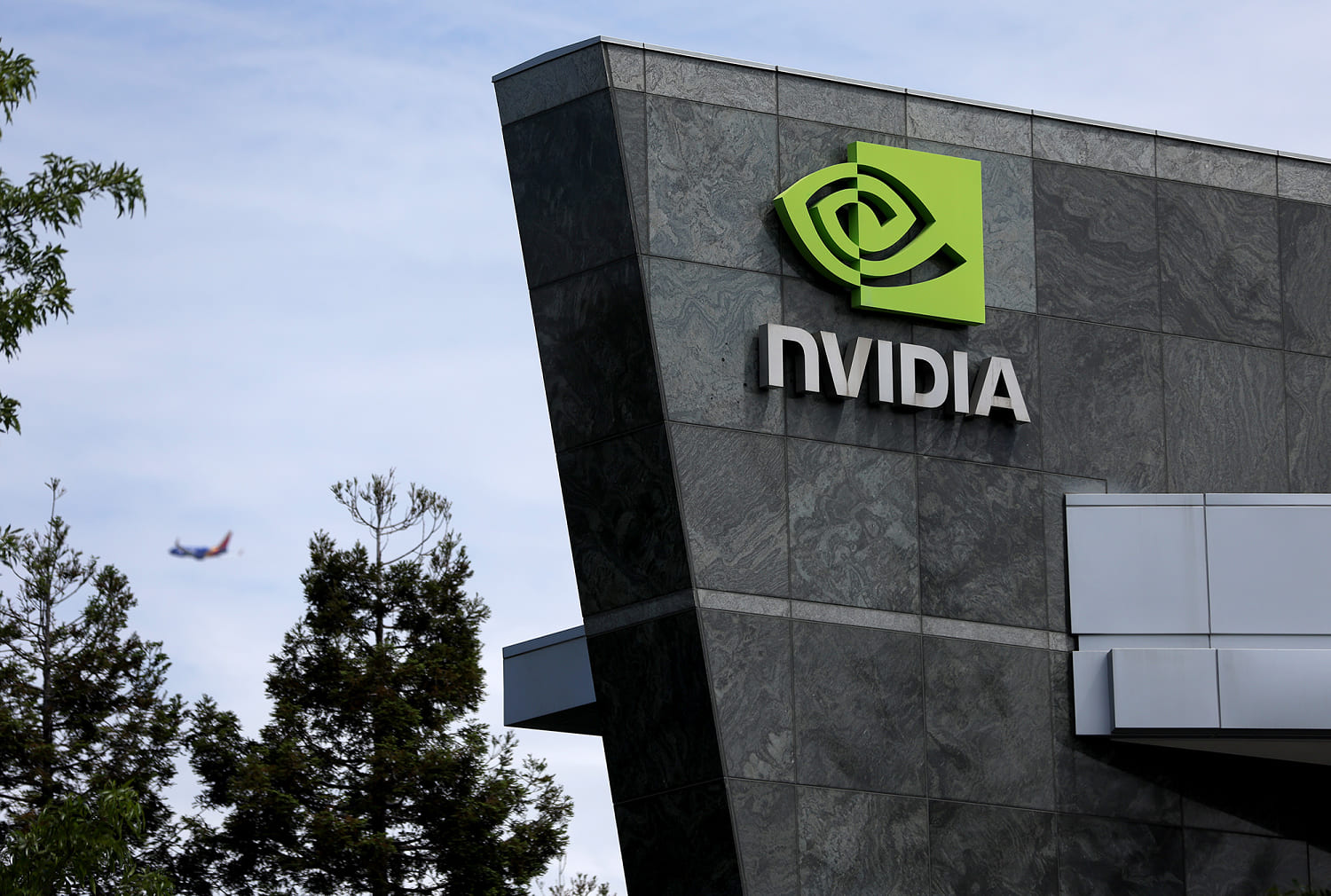
Nvidia — the world’s most valuable company thanks to its position in the AI food chain — earned $120 billion in profits last year.
That includes $43 billion in the three months ending in January, one of the strongest quarters for any business ever recorded.
Investors didn’t care.
Nvidia shares fell more than 5% on Thursday after the results. With a total market capitalization of roughly $4.5 trillion, the company’s one-day loss is roughly $256 billion worth of market capitalization.
Nvidia’s stock price decline is part of a broader phenomenon known as “AI scare trading” that is spreading in some corners of the stock market.
The bearish play threatens the driver of broad, double-digit gains across the S&P 500 benchmark over the past two years.
And while the stock market may look broad, its gains are concentrated in a few mega-cap names, including Nvidia. In other words, the performance of the entire market is highly correlated with the performance of these selected companies.
Nvidia says its growth story is still intact.
“We’ve now seen the influx of agentic AI and the utility of agents around the world and everywhere and across industries,” Nvidia CEO Jensen Huang said on the company’s quarterly earnings call on Wednesday, referring to AI chatbots such as OpenAI’s ChatGPT and Anthropic’s Claude.
“You’re seeing incredible compute demand because of that,” he said. “In this new world of AI, compute is revenue.”
Compute refers to the processing power required to train and operate AI models. Nvidia’s chips, each about 30 inches square, underpin the massive data centers needed to run AI chatbots and agents.
Nvidia’s dominance in the AI chip race means more companies than ever rely on its products, at a time when AI is evolving faster than its early adopters say they could have imagined.
Over the past five years, this has fueled a rush of investors to buy a piece of Nvidia, which has seen it rise nearly 1,300% since the start of 2021.
Motivated by a mix of FOMO and a belief in AI’s growth-at-any-cost business model, these investors and others like them flock to any company that has a tangential relationship to the AI industry.
This time, Nvidia is in charge. But so far this year, Nvidia’s share price has only been positive. Some firms, including HSBC, have argued that Nvidia needs a “new narrative,” such as AI demand or a meaningful expansion in pricing power, to justify another move in the company’s stock price.
But more broadly, the AI scare business visited on Nvidia on Thursday underscores growing anxiety around the future of AI.
After years of boom for both public and private companies, AI is now facing tough scrutiny. Questions remain about whether or not the AI boom is starting to look more like a bubble.
As such, investors are uncertain whether AI can generate the kind of near-term returns needed to justify the massive investments — and soaring stock prices — that are sweeping through the tech world.
“Artificial intelligence is one of the most impactful technologies in a generation, if not in the history of mankind, with enormous implications for the economy,” Moody’s economist Mark Zandi wrote in a new report Wednesday. “However, the specifics of how this will shape the future are highly uncertain and the subject of immense debate.”
That debate includes growing concerns about how AI agents will affect vulnerable industries like cybersecurity and software — and potentially upend traditional business models that have worked for decades.
Shares of software companies such as ServiceNow and Synopsys have fallen sharply amid those fears, falling 20% and 15%, respectively, in the past month. Salesforce is down about 25% this year.
So far this year, companies in the software industry have been the biggest drag on the S&P 500.
AI is “starting to question how software companies are really going to compete and deliver the best in this environment,” Melissa Otto, head of Visible Alpha Research at S&P Global, told NBC News.
Nvidia’s Huang tried to push back on this narrative in an interview with CNBC on Wednesday.
“The markets got it wrong” when it came to AI-driven panic around software, he said. Huang argued that AI will increase productivity and expand what software can do rather than kill an entire industry.
Huang’s attempt to allay investor fears didn’t move the needle much. On Thursday, the tech-heavy Nasdaq fell about 1.5% on the back of Nvidia’s slide. Software giants like Synopsys fell 5%, while shares of Microsoft and Alphabet also traded lower.
Beyond software, investors are grappling with other existential anxieties. Many of them were captured this week in an essay posted on Substack by Citrini Research, a small research firm. The Post warns that AI adoption will lead to a stock market crash, a sharp pullback in consumer spending and widespread white-collar layoffs by 2028.
The report painted a vivid picture of a financial doomsday scenario caused by AI, effectively animating investors’ vague, simmering fears. Payments giants like MasterCard and American Express were hit particularly hard after the Post named them potential casualties in a low-spending, AI-disrupted economy. Shares of the two payments giants recovered slightly on Thursday.
Many Wall Street analysts say it’s too early to panic.
“While we are seriously concerned about AI trading and private markets and other issues, we think it is premature to predict the kind of risk we are facing today,” Lori Calvacina, head of US equity strategy research at RBC Capital Markets, wrote in a client note earlier this month.
Christy Akullian, BlackRock’s head of Americas iShares investment strategy, added in a separate note Thursday that the recent sell-off “predicts a still-uncertain existential risk” rather than changes in the company’s earnings or business fundamentals.
Nevertheless, this existential risk is something investors are taking more seriously now than they did six months ago.