As Iran and the United States prepare for a third round of talks in Geneva on Thursday, a candid comment from chief American negotiator Steve Witkoff underscores the depth of mutual misunderstandings that keep both sides apart.
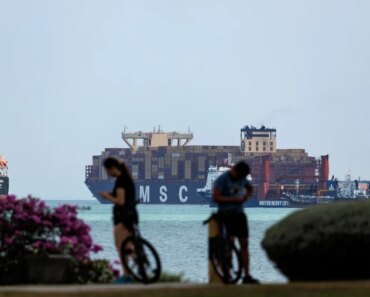
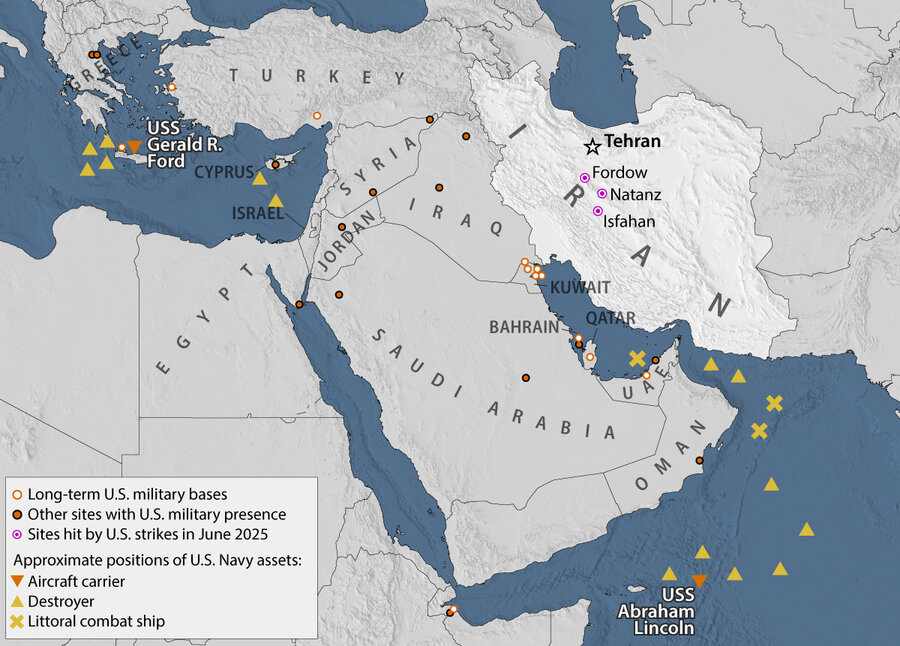
The US military – with two aircraft carrier battle groups and dozens of fighter jets and refueling tankers now deployed across the Middle East – has assembled the largest US combat force since the 2003 invasion of Iraq, although not a force geared toward ground combat.
US President Donald Trump says he wants Iran to dismantle, weaken and limit its strategic capabilities, and has threatened Iran with military strikes and even regime change if it does not agree to his terms.
Why do we write this?
The United States has built up its largest force since the war in Iraq. Iran threatens a full response to any attack, even a limited one. As they prepare for nuclear diplomacy in Geneva to avoid conflict, each side appears to be misunderstanding the other.
Witkoff told Fox News on February 22 that Trump was surprised that Iran, however, had moved little and remained defiant.
“I don’t want to use the word ‘frustrated,’” Witkoff said of Trump, after speaking with the president that morning.
“He’s curious why they haven’t – I don’t want to use the word ‘capitulated’ – but why they haven’t capitulated,” he said. “Why, under this kind of pressure, with the amount of sea power we have there, why haven’t they come to us and said, ‘We profess that we don’t want a weapon, so this is what we are prepared to do’?”
On Tuesday, Iran personally delivered a counterproposal to Omani negotiators, with options for limiting its nuclear program.
Trump has said Iran “should not” have the ability to build a nuclear weapon, an ambition Iran has repeatedly said it rejects, even as it has enriched uranium to near weapons-grade level. But Iran also refuses to discuss its support for allied regional militias or the range of its ballistic missiles, which can easily strike Israel.

To deter the United States, Iranian leaders have promised a full response even to a limited attack. Trump has suggested that he could order such a first strike to further increase pressure on Iran to accept his demands, with the prospect – if Iran does not agree – of a broader campaign later this year aimed at regime change.
But analysts say U.S. expectations that military deployments alone can force the Islamic Republic to capitulate illustrate a fundamental misreading of Iran’s hardline leadership.
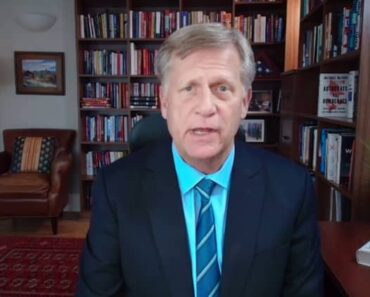
“It appears that President Trump has a framework for conducting the negotiations… The pressure applied (is supposed to lead) to at least some form of withdrawal or concession on the part of the other side,” says Farzan Sabet, an Iran expert at the Geneva Graduate Institute.
“When negotiating business in your previous life, or with allies, or even near-adversary states, it is possible that (pressure) works,” Dr. Sabet says.
“But with the Islamic Republic, where we are dealing with an anti-American revolutionary state – which is quite robust, resilient in the face of foreign pressure and has a very high level of resolve – there is not that clear logical chain in which the pressure applied equals a change in behavior and concessions,” he says.
What’s on the table?
As a result, underscoring the mutual misunderstanding between the sides, Iran appears to be approaching the Geneva talks as an opportunity to negotiate beneficial compensation – and prevent an attack – even as the United States, for its part, is issuing an ultimatum.
In the talks, Iran wants US sanctions that have hit its economy lifted. The economic grievances of its citizens in late December sparked anti-regime protests that spread across the country and were crushed during a two-day crackdown in January. Human rights organizations say at least 7,000 people died.
However, it is unclear what scale of sanctions relief – if any – the United States has put on the table, or what other incentives are being offered besides not launching military strikes.
“The dynamic resembles a high-stakes poker game,” wrote Danny Citrinowicz, former head of the Iranian branch of Israel Defense Intelligence, now at the Institute for National Security Studies in Tel Aviv, Israel, on the social platform X.
“Washington has upped the ante (deployments, public warnings, rhetorical escalation) on the assumption that Tehran, faced with weaker cards, will eventually surrender,” Citrinowicz wrote. “But Iran’s leadership operates under its own logic of sunk costs. After years of defiance and domestic messaging focused on resistance, backing down under visible pressure from the United States carries regime legitimacy costs that may outweigh material losses.”
Associated Press, Council on Foreign Relations
|
Jacob Turcotte/Staff
That appears to be the calculation of Iran’s supreme leader, Ayatollah Ali Khamenei, who has faced multiple threats, as president and then as leader, throughout the Islamic Republic’s 47-year history.
“Khamenei will not accept ‘unconditional surrender,’ not because he misunderstands the balance of power, (but) because, in his worldview, surrender is not a political outcome,” Arash Reisinezhad, a visiting professor at Tufts University’s Fletcher School of Law and Diplomacy, wrote in Foreign Policy.
The starting point is not centrifuges to enrich uranium or missiles, he wrote, but an identity of “resistance” encapsulated in the Islamic Revolution of 1979 that “continues in new forms.”
“In the internal memory of the Islamic Republic, what precipitated the collapse was hesitation, not repression,” Dr. Reisinezhad wrote. “The lesson learned by Khamenei’s leadership is stark: withdrawal under pressure invites greater pressure, concession signals fragility, and fragility accelerates decline.”

Office of the Iranian Supreme Leader/WANA/Reuters
The June War
Israel, after fighting Iran’s regional proxies for nearly two years in a conflict that had already engulfed Tehran, launched a surprise attack on Iran last June. That sparked a 12-day war in which Israel attacked Iran’s nuclear and missile infrastructure and killed top commanders and scientists. The United States joined the battle and attacked Iran’s deeply buried nuclear facilities, effectively stopping uranium enrichment.
In response, Iran launched more than 500 ballistic missiles and hundreds of drones at Israel, and a barrage of missiles at an evacuated US base in Qatar. It is believed to have thousands more missiles, including advanced models that can evade Israel’s still depleted missile defenses.
Yet Iran—perhaps too blithely, according to its own misinterpretation—dismisses the destructive power of the U.S. arsenal now deployed against it. Khamenei’s social media accounts last week posted an AI-created video of Iran blowing up and sinking several American warships, including the USS Gerald R. Ford aircraft carrier.
“If Iran gave up the rest of its nuclear program to defuse the current crisis, it is giving up what it considered long-term strategic assets by not attacking,” says Dr. Sabet in Geneva.
“But even if the Trump administration commits, that does not preclude a future American attack,” he says. “And it certainly does not preclude a future Israeli attack, against the missile program or its proxies… much, much sooner than that.”