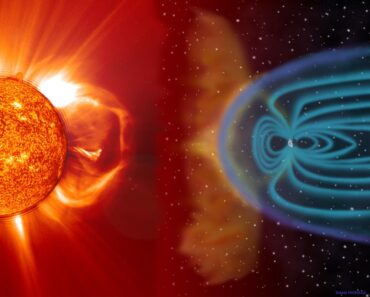
Several coronal mass ejections (CMEs) are currently hurtling toward Earth. The first expected impact occurred in the early hours of the morning (March 19), but appears to be arriving a bit late.
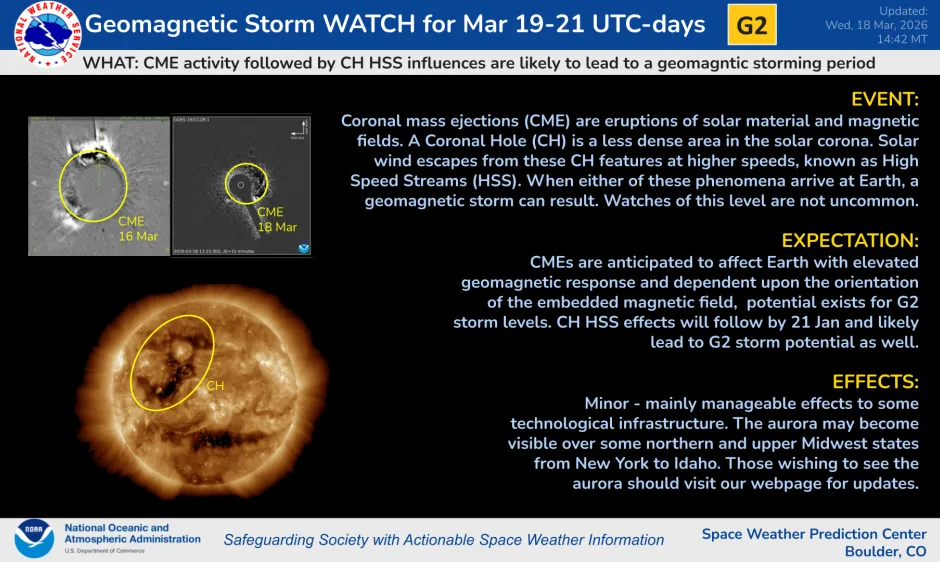
Forecasters now say that geomagnetic activity is likely to increase through the 19th-21st. March, with more CME impacts expected to trigger minor to moderate (G1 to G2) geomagnetic storms and a chance for stronger (G3) conditions, pushing northern lights further south than usual.
NOAA space weather reports have issued a G2 (moderate) geomagnetic storm watch for March 19-21 as a combination of incoming CMEs and high-speed solar wind is expected to impinge on Earth’s magnetic field. Although there is still considerable uncertainty about the exact timing and strength of the incoming CMEs, forecasters have greater confidence that a coronal high-speed stream will arrive by March 21 – helping to maintain geomagnetic storm conditions even if earlier CME impacts are weaker or delayed.
Where can I see the northern lights tonight?
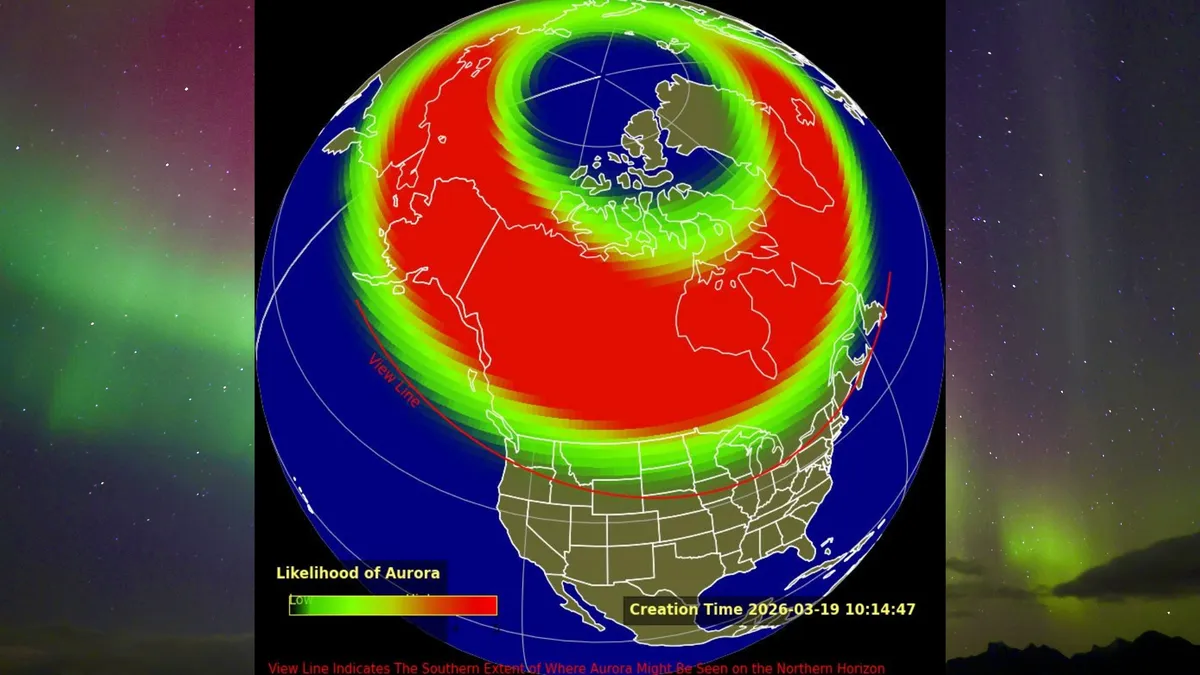
States that can see the Northern Lights tonight
Based on the latest NOAA aurora forecast mapthe following 18 US states are shown in whole or in part above the Northern Lights:
- Alaska
- North Dakota
- Minnesota
- Montana
- Washington
- Idaho
- Wisconsin
- South Dakota
- Michigan
- Maine
- Vermont
- New Hampshire
- Oregon
- Wyoming
- Iowa
- Nebraska
- New York
- Illinois
But remember that the northern lights can be relatively unpredictable. The list is based on current forecast data at the time of publication, but if conditions intensify, the northern lights may reach much further south than expected. Similarly, if the conditions are not right, we can end up sitting in the dark with no aurora at all. Whether the incoming CMEs deliver impressive aurora shows or end in disappointment depends largely on their magnetic orientation when they hit Earth. If the CME’s magnetic field is aligned south — a component known as Bz — it can couple up with Earth’s magnetic field, allowing solar energy to flow into our atmosphere and energize geomagnetic storms. But if it’s oriented north, Earth’s magnetic field deflects much of that energy, and the show may never materialize.
Some CMEs contain both north- and south-facing fields, which can lead to uneven or fluctuating activity – keeping forecasters and aurora chasers on their toes. We will not know the CME’s true magnetic orientation until it is directly sampled solar wind satellites such as DSCOVR and ACE, located approximately one million miles from Earth.
Aurora warning in the Northern Hemisphere courtesy of the UK Met Office
When is the best time to look for the northern lights tonight?
If the skies are clear, be sure to look for the Northern Lights as soon as it gets dark, as geomagnetic activity will be at elevated levels if the CMEs arrive as predicted. Currently, high geomagnetic activity is predicted to persist throughout the night.
according to NOAA’s 3-day forecastgeomagnetic storm activity is expected to be best at the following times:
|
EDT |
GMT |
Activity |
|---|---|---|
|
5pm (March 19) – 2am (March 20) |
2100 (March 19) -0600 (March 20) |
Moderate (G2) geomagnetic storm possible |
|
02:00 – 05:00 (March 20) |
0600-0900 (March 20) |
Minor (G1 geomagnetic storm possible |
Although individual CME impacts are delayed, the arrival of high-speed solar wind later this week means the aurora chance could remain elevated into March 21.
This is how you can see the northern lights tonight
If you’re in one of the 16 US states where the aurora borealis can appear tonight, a little preparation can go a long way to improving your chances of seeing them.
- Start by finding a place with an unobstructed view to the north, preferably a dark place and far away from city lights. The clearer the view of the northern horizon, the better.
- Start scanning the sky with your phone’s camera, as they’re usually good at picking up faint auroras that aren’t immediately apparent to the naked eye, helping you identify where the activity might be starting.
- Dark adaptation is crucial and often overlooked when chasing the northern lights. If you can, give your eyes at least 30 minutes to adjust to the dark so you can spot subtle auroras. Remember that even a quick glance at a bright light or phone screen can reset the process, forcing you to start over.
- Dress for the wait. Aurora shows can be unpredictable, and if conditions look promising you may find yourself waiting outside for a while. Make sure to use lots of layers!
We recommend downloading a space weather app that provides aurora alerts based on your location. One option I use is “My Aurora Forecast & Alerts,” available for both iOS and Android. However, any similar app should work fine. I also use the “Space Weather Live” app, which is available on iOS and Androidto gain a deeper understanding of the flow space weather conditions are favorable for northern lights. Want to take the perfect northern lights photo? Our how to photograph the aurora’s guide can help.
If you take a photo of the northern or southern lights and want to share it with Space.com readers, send your photos, comments, and your name and location to spacephotos@space.com.