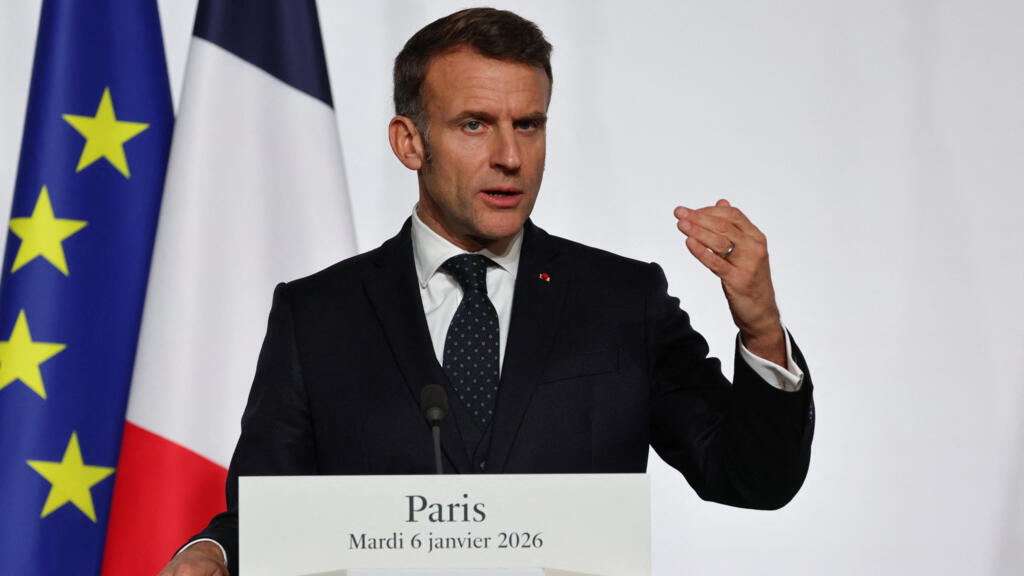
French President Emmanuel Macron will announce updates to French doctrine on the potential use of nuclear weapons in a speech from a military base that houses the country’s ballistic missile submarines.
Macron is expected to outline a new strategy explaining how French nuclear weapons fit into Europe’s broader security posture in the wake of new questions raised by Russia’s invasion of Ukraine and recurring tensions with U.S. President Donald Trump over Ukraine, Greenland and NATO.
European leaders have expressed growing uncertainty about the United States’ commitment to defending Europe under its own nuclear umbrella, a policy that has long sought to ensure that allies – particularly NATO members – are protected by US nuclear forces in the event of a threat without developing their own nuclear capabilities.
France is the only nuclear power in the European Union. Macron’s office said the speech is expected to build on his 2020 speech on nuclear deterrence, delivered before Russia’s full-scale invasion of Ukraine reshaped the security landscape in Europe.
Some European nations have already accepted an offer Macron made last year to discuss France’s nuclear deterrent and even partner European partners in nuclear exercises. Earlier this month, German Chancellor Friedrich Merz said he had had “initial conversations” with Macron on the issue and had theorized publicly about the possibility that German Air Force planes could be used to transport French nuclear bombs.
The long-planned speech will go ahead despite the expanding conflict in the Middle East following the joint Israeli-US strikes on Iran that decapitated much of its leadership over the weekend. The current violence in the Middle East highlights the importance of France’s power and independence in confronting growing threats, according to a French official, who spoke anonymously, in line with the policy of the French presidency.
“What we are experiencing shows that in the future world, power and independence will be two indispensable forces to confront the proliferation of threats,” a member of Macron’s team told AFP.
The fourth nuclear power in the world
“We have to rearticulate nuclear deterrence,” Macron said at the Munich Security Council this month, adding that France has already had “a strategic dialogue” with Merz and other European leaders on greater cooperation.
“Europe has to learn to become a geopolitical power,” he told Munich.
France and Britain adopted a joint declaration in July that allows the nuclear forces of both nations to be “coordinated” while remaining independent. The United Kingdom, no longer an EU member but a NATO ally, is the only other European country with a nuclear deterrent capability.
France’s deterrence doctrine is based on a defensive strategy aimed at safeguarding the country’s vital interests. While France is also a member of NATO, it maintains complete independence over its nuclear forces while contributing to the alliance’s broader deterrence posture.
Under the French Constitution, the president is the commander-in-chief of the armed forces and the only one who can decide on the potential use of nuclear weapons.
The French aircraft carrier Charles de Gaulle is the only surface warship in Europe capable of carrying nuclear weapons deployed by French Rafale fighter jets using catapult-assisted takeoffs.
France has four nuclear-armed submarines: Le Triomphant, Le Téméraire (The Fearless), Le Vigilant and Le Terrible, based at Île Longue on the Atlantic coast, one of the country’s most secret military sites. Since 1972, at least one nuclear-armed submarine has been on patrol at all times, ensuring France’s permanent ability to carry out an attack.
France is estimated to have 290 nuclear warheads, according to the latest figures published by the Stockholm International Peace Research Institute (SIPRI) and the Federation of American Scientists (FAS). More than 80% of French nuclear warheads are launched from submarines, according to the Bulletin of Atomic Scientists.
That makes France the fourth nuclear power in the world, after Russia, which occupies first place (with more than 4,300 warheads), followed by the United States (with 3,700) and China (600). The United Kingdom, which is no longer a member of the EU but remains a NATO ally, is estimated to have around 225 warheads, according to SIPRI and FAS.
(FRANCE 24 with AP, AFP and Reuters)