A life shaped by questions, not answers
Li Jianyu’s artistic identity is inseparable from an uncertain period that many considered unproductive, but which ultimately became the basis of his creative philosophy. Born in Seoul in 1992, he grew up with a strong curiosity and willingness to experiment with himself, but he did not successfully enter higher education or his intended career. Instead, his early adulthood was marked by long pauses when he refused to follow established routes simply because they were available. This pause is not passive. It carries the weight of confusion and discomfort, especially the shock of adulthood without a clear sense of direction or self-definition. Rather than repressing these feelings, he chose to face them head-on, knowing that unresolved issues would only get worse as time went on.
This confrontation takes a decisive form when he moves alone to an unfamiliar area, deliberately isolating himself from known relationships and daily life. In this new environment, everyday life becomes a form of investigation. New tasks, unfamiliar environments and constant self-questioning filled his days. He asks himself what he can do, what he fears, what he truly enjoys, and what he instinctively rejects. Over the course of about a year, he recorded these thoughts in a journal, treating his inner landscape as carefully as he would any external subject. This disciplined habit of observation gradually revealed patterns he had not previously recognized, showing him that identities are rarely consistent or singular.
Through this process, Lee realized this, which now forms the core of his work. Qualities he once labeled strengths can become limitations in certain situations, while perceived weaknesses often hold unexpected potential. More importantly, he recognized that human beings are born with contradictions that cannot be completely separated. Kindness and cruelty coexist, beauty and discomfort coexist, sincerity and selfishness coexist. These oppositions do not cancel each other out. Rather, they combine to form a more complete and honest picture of reality. This understanding is not limited to introspection. It gradually transformed into a broader thinking about life itself and became the conceptual foundation on which his artistic practice continues to stand.
Li Jianyu: From wood to form, from form to thought
Lee’s entry into the art world was neither planned nor romantic. For a long time, becoming an artist wasn’t even considered a realistic possibility. Art felt distant from his daily life, something to be admired from a distance rather than pursued. The turning point came unexpectedly around 2015, when a friend suggested he consider learning carpentry. At first, the idea felt foreign, even intimidating. Nonetheless, a quiet curiosity led him to explore books on woodworking, and he soon found himself drawn to wood’s physical presence and expressive potential. That curiosity turned into commitment when he discovered an artist through a book and waited six months for the opportunity to study with him, eventually receiving a year of formal woodworking training.
During this period, Lee balanced two parallel paths. On the one hand, he produces commercial furniture to meet functional needs and customer expectations. On the other hand, he pursued sculptural work, which allowed him to construct forms rooted in his own internal concerns rather than market demands. His real interest lies in the latter. Sculpture offers him the freedom to shape his inner voice, even if it means spending more than a year and a half creating a single piece. This slow, immersive approach presents practical difficulties. Without the resources to maintain a private studio, he worked in a shared space until circumstances suddenly forced him to leave, leaving him without a place to continue his practice.
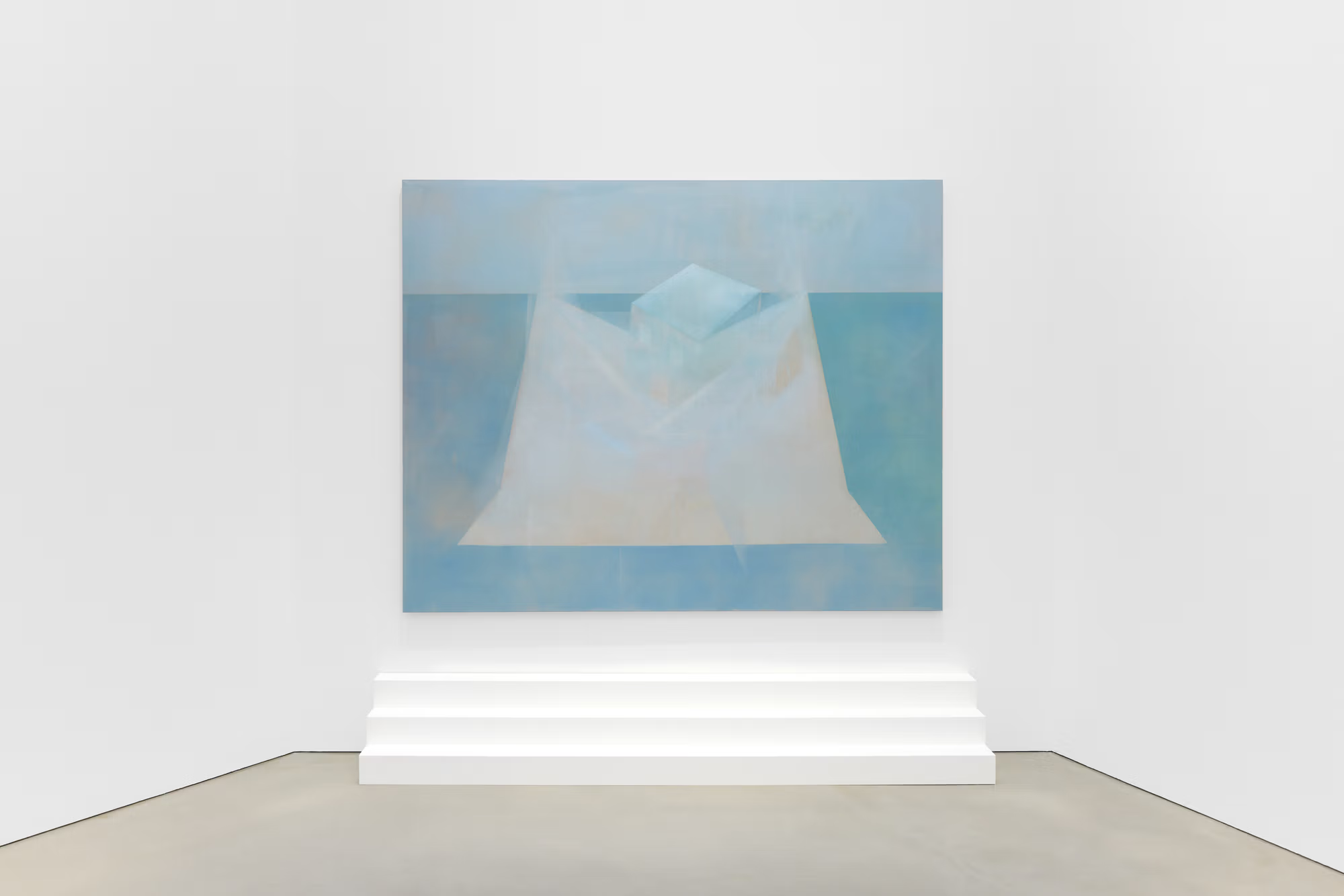
This sudden loss resulted in a period of stagnation and emotional heaviness, but it also triggered a major shift in perspective. Lee realized that if his artistic philosophy was stable, material and form were not at the core of his work. With this in mind, he turned to painting, not just for convenience, but because it allowed him to continue creating within the constraints of a small room. This transition is challenging. Lacking formal training in painting, he taught himself everything through experimentation, from using a paintbrush to understanding the differences between oils and acrylics. Out of this struggle was born the Balam series, also known as the Wind series, which has since become a decisive body of work. Through painting, he found a new way to express enduring questions about nature, humanity, and the invisible forces that connect them.
The space between nature, simplicity and opposites
At the heart of Li’s practice is a commitment to allowing opposing values to coexist in a single form. The idea is not seen as a visual trick or intellectual exercise, but as a reflection of how life itself works. Whether working with wood, paint or digital media, he consistently explores the tension between perfection and imperfection, natural elements and man-made structures, ordered systems and irregular disruption. His work does not resolve these tensions but rather balances them, demonstrating that harmony does not require unity. This approach stems directly from his own experience of self-examination, where contradictions prove to be both inevitable and meaningful.
Nature plays a central role in this philosophy, particularly in the Balam series, where wind serves as both subject and metaphor. The wind is invisible, but its presence through movement and change is undeniable. By using it as a conceptual medium, Lee considers nature as the most constant force in an ever-changing world, while also considering the humans that exist within its systems. His observation extends to everyday life, where the contrast between natural and man-made materials cannot be ignored. The time spent camping became particularly important to his process. Detached from man-made surroundings, he focuses purely on perception and reflection, allowing these experiences to influence the emotional clarity of his work.
Despite the deep thinking behind his practice, Lee consciously avoids unnecessary complexity in his presentations. He does not wish to burden his audience with cumbersome theory or difficult-to-understand references. In his view, life itself is already very demanding and hierarchical. Therefore, art should provide immediate visual clarity and comfort. This belief led him towards a minimalist formal language that emphasized simplicity without sacrificing meaning. By keeping the form approachable, he invites viewers of all ages and backgrounds to participate freely, encouraging personal interpretation rather than prescribed understanding. His goal is not to impress, but to create works that coexist gently with people, remaining in their lives without explanation.
Li Jianyu: The weight of the starting point and the future direction
Among Lee’s many works, one has a special emotional significance: KIWA from his first work, the KIWA series. This sculpture represents the true beginning of his life as an artist and continues to shape his understanding of creation. When he first began working with wood, driven by an ambition that now seems almost reckless, he began three large works simultaneously. Their enormous size and weight require constant help and a spacious workshop. To avoid disturbing others, he often worked alone early in the morning, standing in front of heavy machinery while the rest of the room slept. The process lasted more than a year and a half and required physical endurance and unwavering focus.
The most decisive moment occurred shortly before his first exhibition. Two weeks before the opening, cracks appeared on the surface of the finished piece due to the natural expansion and contraction of the wood. The shock was overwhelming. Repairing the damage seemed like the obvious solution, but after thinking long and hard, Lee chose another path. He decided not to touch upon the cracks, viewing them as evidence of time and the behavior of materials rather than flaws that needed to be hidden. This decision transformed the piece. What initially felt like a failure became a palpable expression of his belief in coexistence, where damage and beauty occupy the same space. The public response was overwhelming, and the cracks eventually became a distinct feature of his work.
Today, Lee continues to expand his practice while remaining grounded in these formative experiences. In addition to painting, he actively develops generative and media art, collaborates with professional programmers, and integrates the latest advances in artificial intelligence technology to bring his ideas into new contexts. These digital works aim to transcend the walls of traditional galleries and enter everyday spaces where people unexpectedly encounter art. At the same time, he was envisioning new sculptural projects that built on his earlier explorations of form and material. Collaborations with different brands and artists also play an important role, providing opportunities to create results that differ from traditional exhibitions. In all these directions, his guiding principle has remained unchanged: to explore contradictions without fear and to allow different elements to coexist without hierarchy.