Tehran’s ambassador to the UN in Geneva said on Tuesday that bases in neighboring countries used as launching pads for attacks and invasions would be “legitimate targets”, as the conflict in the Middle East enters its fourth day.
“If any base in a neighboring country is used to attack and invade other countries, that would be a legitimate target,” Ali Bahraini said, reiterating Iranian Parliament Speaker Mohammad Bagher Ghalibaf’s warning from a month ago, when negotiations over Tehran’s nuclear capabilities were still ongoing.
After the first US-Israeli strikes in Iran that killed Ayatollah Ali Khamenei and the Islamic regime’s top leaders on Saturday, Tehran launched Operation True Promise 4 – waves of retaliatory strikes against US bases and other assets in the Middle East – that led Washington to close two of its embassies in the region.
Earlier on Tuesday, Iranian Foreign Minister Abbas Araghchi told Iranian state media: “We cannot reach (US) territory, but we can reach their bases. I think those bases are legitimate targets.”
There are eight persistent bases and 11 other military sites in the Middle East that are run by US Central Command, according to a Congressional Research Service (CRS) report released in 2024. Several of these bases are located in compounds owned by regional allies.
On Monday night (local time), a senior Iranian Revolutionary Guard (IRGC) official said the Strait of Hormuz, a narrow waterway through which a fifth of the world’s energy supplies transit, is closed and that Iran will fire on any ship attempting to pass through it.
The IRGC wields its own naval force, among its other military branches, which operates independently of Iran’s regular navy.
Global oil prices have risen 15 percent since Friday and stock indices opened sharply lower on Monday.
Story continues below this ad.
Iran’s arsenal already houses a number of ballistic missiles with ranges of up to 2,000 kilometers, putting most US bases in the region within striking distance. It also has the Shahed drones, a series of inexpensive ‘suicide drones’ of similar range.
Operation True Promise 4
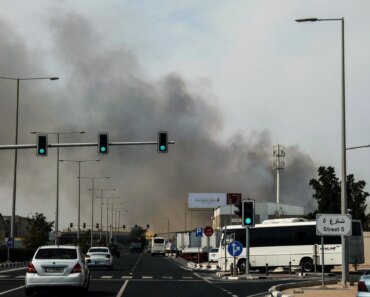
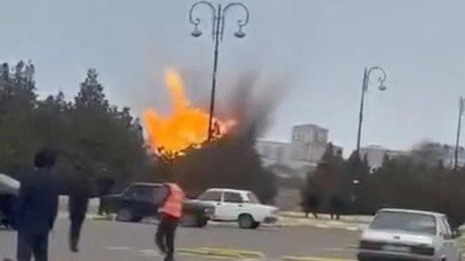
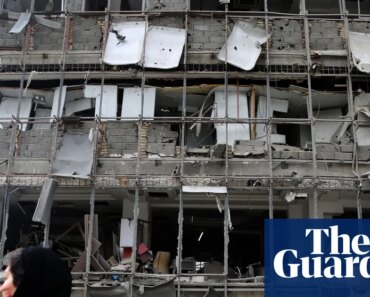
Several civilian and military facilities in Bahrain, Iraq, Kuwait, Saudi Arabia and the United Arab Emirates were hit by Iranian retaliatory strikes.
At least six US service members have been killed since the Iranian bombings began. Four of them were killed in an attack on Camp Arifjan in Kuwait on Sunday.
The United States closed its embassies in Saudi Arabia and Kuwait on Tuesday after Iranian drones attacked their facilities. Washington also ordered the evacuation of non-essential personnel in several other countries.
Story continues below this ad.
A commercial flight terminal at Kuwait International Airport was attacked on Saturday. The airport complex is home to the Abdullah Al-Mubarak Air Base, the largest US air logistics facility in the region.
As of Monday, 555 deaths had been reported in Iran, including 175 at a primary school in Minab, southern Iran. Dozens more were reported across the Middle East.
No cooldown in sight
While hostilities worsen in the region, Iran’s uranium enrichment remains the main stumbling block. Neither party is willing to give in. The conflict began a day after talks on the nuclear program in Geneva collapsed. Last June, the United States and Israel crippled the program in bombing campaigns. The two allies have also attacked Iran’s nuclear sites in this operation.
Washington has signaled it will continue the conflict despite having no clear idea of who will lead Tehran in the coming days, leaving the prospect of negotiations in limbo. Earlier on Tuesday, US President Donald Trump said Iranian leaders “want to talk” but “it’s too late.”
Story continues below this ad.
On Monday, Trump said cnn“Us I don’t know what the succession plan is in Iran. or who will be the new leader.” Washington and Tel Aviv have been calling on Iranian citizens to overthrow the Islamic regime. In a briefing the same day, he also said plans projected the war would last “four or five weeks,” but added that the U.S. military has the “ability to last much longer than that.”
The allies have been repeatedly attacking the Islamic regime’s leaders since Saturday’s operation.
Ayatollah Alireza Arafi temporarily assumed command of the country on Monday, but the 88-member Assembly of Experts has yet to name the next Supreme Leader who will determine the country’s policy and destiny.
Hours before Trump’s comment on Monday, his Secretary of Defense, Pete Hegseth, said Washington is committed to continuing the conflict “surgically, overwhelmingly and unapologetically,” adding that it will only end on ‘America First’ terms.
Story continues below this ad.
“We didn’t start this war, but under President Trump we are ending it,” Hegseth said.
Hegseth argued that Tehran was stalling negotiations and taking advantage of the time to “reload its missile arsenals and restart its nuclear ambitions.”
The United States has deployed the Lincoln Carrier Strike Group, warships and military aircraft, including F-35 multirole stealth fighters, to the region.