Light, movement and abstract language
Color surges, gestures sweep, and space seems to breathe in Katherine McCarty’s vast abstractions. Her paintings are not quiet meditations but vibrant environments full of energy and invitation. Her work is rooted in the traditions of post-painterly abstraction and color field painting, carrying on a lineage of luminous surfaces and immersive scales while asserting a unique personal sensibility. Rather than pursuing strict formalism, she emphasizes feeling and elevation, looking for moments when tone, movement and spatial presence converge into something unexpected. Each canvas becomes a stage for discovery, shaped less by rigorous planning than by responsiveness and intuition. Viewers encounter fields of brilliant color that seem to extend beyond their edges, creating a visual experience that is both atmospheric and immersive. In the interplay between structure and spontaneity, McCarty positions abstraction as a living, breathing force capable of stirring emotion and awakening perception.
Her artistic formation began in Wisconsin and was influenced by her studies at the School of the Art Institute of Chicago, where she earned a Bachelor of Fine Arts. A formative year in Florence, Italy, deepened her sensitivity to light, composition and the expressive potential of surface. Exposure to European art history and architectural space broadened her understanding of how color can define atmosphere and guide movement in a plane. These academic experiences provided a solid technical and conceptual foundation, but her mature voice emerged through experimentation and risk. The disciplines of painting and art historical study instilled in her confidence, but intuition gradually became her main compass. Over time, she developed a practice centered on presence and openness, allowing each painting to evolve through layered decision-making rather than a predetermined outcome. This balance between education and instinct continues to characterize the deterministic and exploratory character of her abstract language.
The pivotal move to Northwest Washington marked another important chapter in her development. The Skagit Valley, with its bright coastal light and changing weather patterns, had a quiet but lasting impact on her visual vocabulary. Water, cliffs, forests and sky are in constant dialogue there, and this dynamic exchange finds resonance in her work. She does not paint the landscape directly, but translates its feeling into movement and color intensity. Ocean blues, emerald greens, acidic yellows and saturated pinks interplay to echo tidal movements and atmospheric changes. Exposed daily to the valley’s changing light conditions, her sensitivity to transparency and light became even more acute. The environment is not a backdrop but an active catalyst, shaping the emotional tone and structural rhythms of her canvases. Through abstraction, she captures the feeling of being immersed in an ever-changing and glorious landscape.
Catherine McCarty: From Walls to Floors, a Transformative Transformation
McCarty’s practice took a decisive turn when she stopped working with vertically mounted plaster canvases and began working on raw canvases placed directly on the floor. This change reoriented her entire relationship to the painting surface. Gravity, movement and physical engagement become more prominent, allowing her to approach each piece with a heightened physical involvement. Acrylic paint is poured and dyed onto unprimed fabric, allowing the color to sink into the fibers, creating a glowing field that feels embedded rather than applied. The surface absorbs pigment unevenly, creating subtle changes in saturation and hue that add depth. Without the barrier of plaster, the canvas becomes porous and responsive, capturing each gesture as an imprint of movement. This approach fosters a sense of immediacy and risk, as once the color penetrates into the raw material, it cannot be fully restored. The resulting work bears traces of control and surrender.
Layering plays a crucial role in the complexity of these works. After establishing a translucent stain, McCarty introduces translucent ribbons, arcs, and sweeping gestures that move across the surface at a confident pace. Transparency and opacity engage in visual dialogue, creating a rhythmic interplay between foreground and background. Forms overlap and intersect, sometimes gently hovering and sometimes asserting a bold presence. The oscillation between depth and flatness creates a tension that energizes the entire painting. Although her process is intuitive, it is by no means arbitrary. Years of experience have given her a keen sensitivity for balance, proportion and directional flow. Diagonals offset vertical movement, saturated passages are moderated by open areas of the canvas, and dense activity is counteracted by breathing space. The physicality of pouring, staining and gesture is always visible, preserving the spontaneity of the action while maintaining a carefully calibrated structural coherence.
This immersive approach aligns her with the legacy of dye painters, but her work stands out through its emphasis on structural tension and chromatic vibrancy. While some approaches favor diffusion and softness, McCarty’s work often introduces confident gestures across veils of color, like the flow of wind or changing tides. The floor-based process allows her to move freely across the canvas, responding to emerging forms from multiple vantage points. The painting evolves as a field of relationships rather than a preconceived fixed image. Through this physical contact, she develops a heightened awareness of scale and spatial impact. Large areas of color are not just decorative; They create an environment that surrounds the audience. Therefore, the transition from walls to floors means more than just a technical adjustment. It marks a philosophical shift towards openness, immersion and trust in the unfolding process.
Semitone boost and ambient resonance
McCarty often describes her work as an exploration of elevation, an intention most evident in her bold and lively color palette. Acid yellow contrasts with ocean blue, and verdant green blends with saturated magenta, creating visual sparks from unexpected color collisions. These colors are not isolated accents but active forces that shape the emotional atmosphere of each canvas. By layering and staining, the hues appear to glow from within, creating a radiant feel reminiscent of the bright ambience of the Pacific Northwest coastline. Transparency allows underlying tones to shine through the upper layers, enriching the overall depth. The colors do not reach harmony too quickly, but collide, dissolve and reappear, maintaining a dynamic tension that keeps the eye in motion. This vibrant interplay of colors exemplifies her commitment to creating spaces that heighten perception and invite viewers into a highly sensory experience.
The coastal setting of the Skagit Valley continues to influence the movement and mood of her abstract works. Daily walks through a landscape of water, cliffs, and forests provide a steady source of visual and emotional stimulation. Changing weather patterns alter the light and shadow throughout the day, providing a constant reminder of impermanence and transformation. McCarty translates these observations into gestural arcs that suggest tidal crossings, atmospheric changes, or plant rhythms without parsing them into literal representations. The paintings are full of energy, as if electricity is flowing beneath their surfaces. The open passage of the original canvas evokes a moment of pause or breath, echoing the vast landscape. By internalizing these environmental experiences rather than depicting them directly, she creates works that resonate with place while maintaining an abstract autonomy. The result is a body of work that feels rooted in lived experience, but whose possibilities for interpretation are wide-ranging.
Immersion becomes especially powerful in her large-scale paintings, where the viewer’s body is in direct dialogue with the color field. Scale amplifies gesture and intensifies the feeling of spatial depth. Standing in front of one of the canvases, the eye follows the unobstructed form, sinking into translucent passages, experiencing color as atmosphere rather than surface decoration. The absence of strict boundaries in the composition encourages prolonged engagement as relationships between shapes continue to emerge over time. This unfolding sense of discovery reflects her own process in the studio, where every decision is made in response to what has already happened. By maintaining openness throughout the creative process, she maintains a sense of freshness in the final work. The paintings become an environment that retains both the memory of their creation and the promise of ongoing interpretation.
Catherine McCarty: Expanding your intuitive horizons
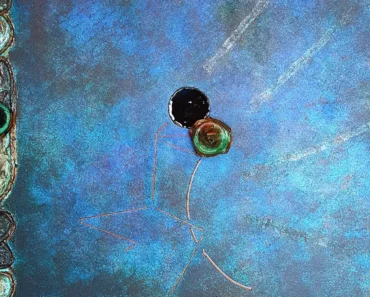
Among her important works, Collision is a vivid example of her handling of scale, tension and the power of color. Measuring five by four feet and painted in acrylic on original canvas, the painting embodies her fascination with balancing transparency and bold gesture. Dyed veils establish a luminous ground, while sweeping arcs and confident brushstrokes cut across the surface with palpable energy. The interplay between these elements creates a dynamic visual tension, as if forces are converging and dispersing simultaneously. Depth is revealed through overlapping forms, but the original canvas remains an active participant, visible in areas where the paint has thinned or faded. Collide invites viewers to step into its colorful surroundings and experience the push and pull of movement within its vast realm. The work exemplifies her ability to translate intuitive decisions into works that are both spontaneous and clearly structured.
Now working full-time in her studio, McCarty is developing a new series of large-scale paintings that synthesize earlier explorations into a broader visual language. The current phase reflects a deepening trust in intuition and technical confidence gained through years of experimentation. Elements from her previous approach, including staining, layering and gestural interventions, are integrated with greater fluidity and assurance. The emphasis on elevation remains central, but the complexity and ambition of the work continues to evolve. By embracing openness and responsiveness, she maintains a practice defined by growth rather than repetition. Each canvas becomes an opportunity to test new relationships between color, space and movement. Through her ongoing commitment to exploration, Catherine McCarty affirms abstraction as a living process capable of transforming raw materials and lived experiences into radiant, immersive encounters.