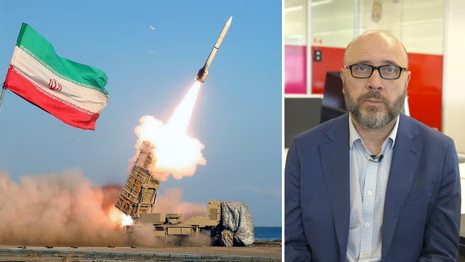
It is believed to be a first: the deliberate attack on a commercial data center by the armed forces of a country at war.
At 4:30 a.m. on Sunday, an Iranian Shahed 136 drone attacked an Amazon Web Services data center in the United Arab Emirates, causing a devastating fire and forcing a power outage. Further damage was inflicted when attempts were made to douse the flames with water.
Shortly after, a second data center owned by the American technology company was attacked. A third was then said to be in trouble, this time in Bahrain, after an Iranian suicide drone turned into a fireball upon impact with nearby terrain.
Iranian state television has claimed that Iran’s Islamic Revolutionary Guard Corps launched the attack “to identify the role of these centers in supporting the enemy’s military and intelligence activities.”
The network built by Jeff Bezos’ company could withstand one of its regional centers being out of service, but not a second, much less a third of its enormous technology warehouses.
The coordinated strike had an immediate impact.
Millions of people in Dubai and Abu Dhabi woke up on Monday unable to pay for a taxi, order food delivery or check their bank balance on their mobile apps.
It is unclear whether there was a military impact, but the attacks quickly brought the war directly into the lives of 11 million people in the United Arab Emirates, nine in 10 of whom are foreign citizens. Amazon has advised its customers to protect their data outside the region.
Perhaps most significantly, attacks on this “next generation” war target are now raising questions about the prospects of the UAE leveraging its plans and many billions of pounds in US and foreign investment to exploit what it hopes will be the “new oil”: artificial intelligence (AI).
“The UAE really wants to be a major player in AI,” said Chris McGuire, an AI and technology competitions expert who served as a White House national security council official during Joe Biden’s administration.. “Their government has a very strong conviction about this technology, probably stronger than any other government in the world, and if there are going to start to be security issues around that, then they are going to have to resolve them very quickly, somehow.”
A data center is a facility designed to store, manage and operate digital data.
Growing demand from companies for artificial intelligence (AI) and cloud computing (where companies have a pay-as-you-go relationship with server, storage and software providers) is driving the need for centers that have significantly more computing power.
It requires a ready and constant supply of very cheap electricity.
The UAE, as it seeks to diversify away from fossil fuels, has been able to signal that it has this in abundance, along with a huge sovereign wealth fund willing to invest in and subsidize projects.
According to the Turner & Townsend Global Data Center Index, the overall global cost increase of data center construction increased in 2025 by 5.5%, but the UAE is ranked 44th most expensive unit cost per watt out of 52.
The UAE’s geography also makes it a critical landing point for undersea cables, providing access between Europe and Asia.
Then there is geopolitics, where the United States wants to keep the Gulf states away from Chinese technology.
A four-day tour by Donald Trump of Saudi Arabia, Qatar and the United Arab Emirates last May coincided with the announcement of the construction of a vast new AI campus (a partnership between the United Arab Emirates and the United States) to train powerful AI models.
As part of the deal, the Trump administration eased restrictions on sales of advanced chips to the Gulf. OpenAI has said the planned campus in the UAE could eventually serve half of the world’s population.
McGuire said this week’s events could be pivotal. “If we are going to build large-scale data centers in the Middle East, we will have to take very seriously how we protect them,” he said. “We think about how to protect it right now and say, ‘Oh, it means you have guards and good cybersecurity.'”
“If you’re really going to double down on the Middle East, maybe that means missile defense in data centers.”
Sean Gorman, chief executive of Zephr.xyz, a US air force contractor technology company, said the Gulf states’ ambitions would likely have been on the thoughts of military planners in Tehran.
He said: “I believe the Iranians are leveraging tactics they have found effective in the Ukraine conflict. Asymmetric warfare that can attack critical infrastructure creates pressure on adversaries by disrupting public security and economic activity.
“Both the UAE and Bahrain have been positioning themselves as global AI hubs by investing heavily in data centers and fiber infrastructure to connect them to the rest of the world.
“If they can disrupt that infrastructure, they will jeopardize their strategic position and at the same time disrupt operations that are important to the economy. Additionally, there could be an adjacent impact from defense operations, but that would probably be more luck than the main objective.”
Gorman said the UAE had a “long history of managing regional instability without becoming part of it” but that there were a number of risks beyond the air.
He said: “The UAE also has one of the most diversified submarine cable landing environments in the Middle East, but the diversity is geographically uneven.
“There are multiple landing stations and cable systems, but many of them are concentrated on the east coast of Fujairah, creating a partial geographic bottleneck.
“In addition, there is a specific risk from Iranian cyber operations targeting US-aligned digital infrastructure in the Gulf, which presents a more concrete near-term threat to data centers and cloud operations than geography in the traditional sense.”
Gorman said the concern would be if Iran demonstrated any additional capabilities to attack the Gulf’s digital infrastructure as part of its retaliation.
He said: “The UAE will have to show its partners that its infrastructure is defensible. This is the question investors should be asking, not whether AI’s broader ambition survives.”
Vili Lehdonvirta, a senior researcher at the Oxford Internet Institute at the University of Oxford, said such defenses came with significant costs, but the danger was real.
Former chairman of the US National Security Commission on AI, Eric Schmidt, suggested last year that a country that falls behind in an AI arms race could bomb its adversary’s data centers.
Lehdonvirta said he suspected that no one really believed that data centers “would be bombed even though such scenarios have been openly floated for some time.”
“If that’s the case, from now on we may see prominent data center operators like AWS (Amazon Web Services) investing in air defense, similar to how maritime operators armed themselves against hackers,” he said.
Where could Iran fruitfully strike next?
“The Iranians will be well aware that the fiber optic cables connecting these data centers to the United States and the rest of the world pass through the Strait of Hormuz,” Lehdonvirta said, “although they will be closely monitored by the United States and allied forces.”