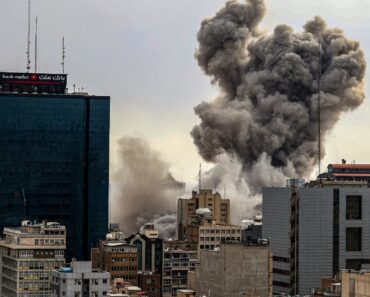
An Israeli operation in eastern Lebanon to locate the remains of a famous IDF pilot ended in failure overnight, when commandos became caught in a firefight with Hezbollah and local residents, prompting Israeli planes to bomb the area with airstrikes that killed dozens of people.
The fighting left three Lebanese soldiers and 41 residents of the Bekaa Valley dead, according to the Lebanese army and the Ministry of Health. No injuries were reported among Israeli soldiers.
Two Israeli helicopters landed outside the towns of Nabi Chit and Khraibeh, along the Syrian-Lebanese border in the eastern Bekaa Valley, at 10 p.m. on Friday, dropping off Israeli soldiers, according to the Lebanese army. Israeli soldiers headed to a cemetery in Nabi Chit and began digging a grave, where they suspected the remains of Ron Arad, an Israeli pilot who disappeared in Lebanon in 1986, were being held.
The Lebanese army detected the incursion and dropped flares on the Israeli helicopters, according to a Lebanese army statement, sparking a firefight between Israeli forces, local residents and Hezbollah fighters.
The pro-Iran group Hezbollah claimed to have also observed the landing of Israeli helicopters and that its fighters ambushed soldiers outside the cemetery, supported by area residents. The Israeli army launched at least 40 airstrikes on the city as its soldiers on the ground battled local residents and Hezbollah, with the fighting lasting until 3am, according to the Lebanese army.
Videos of the incident showed gunfire, with a constant stream of tracer bullets flying through the air, and residents asking people from other villages to come and help repel the Israelis. Residents of the eastern Bekaa are heavily armed and many support Hezbollah.
Several buildings in the town of Nabi Chit were leveled, a main road was inaccessible and Israeli airstrikes left a huge crater.
Arad was an Israeli pilot whose plane was damaged by a defective bomb while flying over southern Lebanon on a mission to attack PLO targets. He was captured by the Amal movement, a Shiite militia, and handed over to Hezbollah. No proof of his captors’ life has been provided since the late 1980s and an Israeli government commission concluded in 2004 that he had died in the mid-1990s.
The Israeli government has continued to try to locate his remains, with then-Prime Minister Naftali Bennett saying in 2021 that Israeli intelligence had kidnapped an Iranian general from Syria as part of its search for Arad.
A former officer previously involved in the search for Arad’s remains said the operation would have been based on new intelligence.
“They would have had a new lead and decided to act accordingly,” the officer said. “That there is a great war underway does not matter. There is an obligation to put an end to this tragedy,” they added.
In December, Ahmed Shukr, a retired Lebanese general security officer, was kidnapped in the town of Nabi Chit after being lured by unknown men to the rural Bekaa Valley for what was supposed to be a property visit. Lebanese officials suspected that he had been captured by Israeli intelligence and taken to Israel for interrogation, as Israeli intelligence suspected his brother Hassan of being involved in Arad’s capture.
A photograph of the grave marker excavated by the Israelis in Nabi Chit on Friday night showed that it belonged to someone named Hussein Shukr.
Tami Arad, Arad’s widow, posted a statement on social media, thanking those involved in the operation, but said the family did not want Israeli military lives to be risked in the search for his remains.
“For 40 years we have lived with the fact that Ron is missing, we want to know what happened to Ron, but not at any price. We would rather live with the painful possibility that Ron’s bones lie in Lebanon rather than wake up in the morning to the news that an IDF soldier was injured, or God forbid, killed, in the operation to recover his bones, if they are his bones,” he said.
Last year, Israeli President Isaac Herzog said Israel “must never cease its efforts to bury Arad in Israel.”
“This is the supreme pact between a state and its soldiers, one that we must maintain even after decades,” Herzog said at a ceremony commemorating missing fallen soldiers.