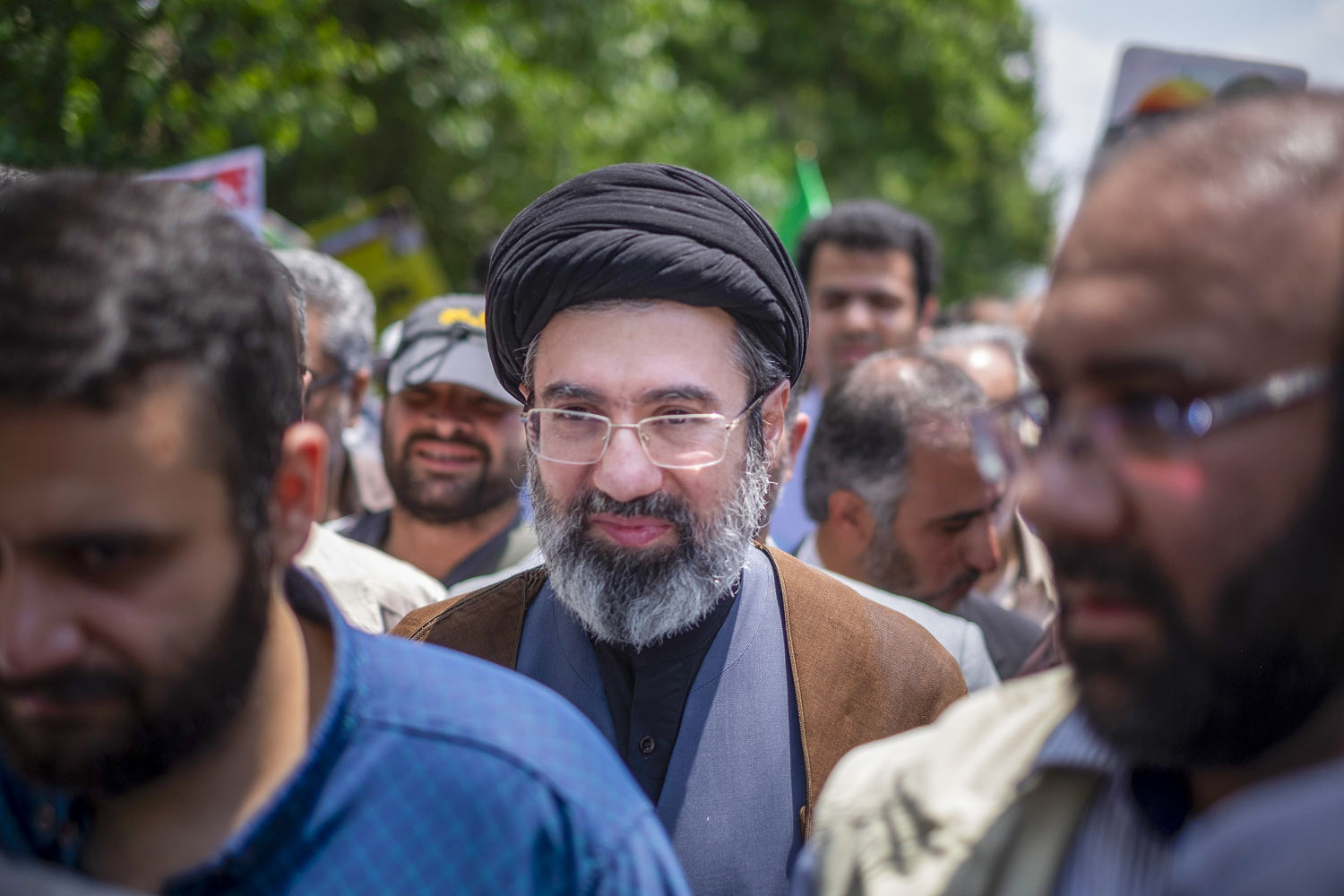
Iran’s new Supreme Leader Mojtaba Khamenei issued a fiery first public statement on Thursday, vowing to block the key Strait of Hormuz oil trade route and attack neighboring countries that host US military bases.
The written statement was one of protest even as President Donald Trump indicated he wanted to end the conflict soon as global energy markets faced an economic shock from the closure of the strait.
The health and current whereabouts of the 56-year-old new leader remain unclear, after Iranian state TV previously suggested he had been injured in a wave of US and Israeli strikes that killed his father and predecessor, Ayatollah Ali Khamenei, 86, and several of his relatives.
Also on Thursday, state TV offered no explanation as to why Khamenei did not appear in person, only a written statement read by an announcer.
Israel has previously indicated it would target anyone appointed to succeed the slain elder Khamenei, and experts suggest a written statement poses less of a security risk to the new supreme leader than a video message from a public appearance or potentially identifiable location.
“He’s obviously going to have to take extreme measures to physically defend himself,” said Alex Vatanka, a senior fellow at the Middle East Institute, a Washington think tank. “They’re essentially hunting.”
Suzanne Maloney, vice president and director of the foreign policy program at leading think tank Brookings, said the Iranian regime is feeling pressure to reassure the nation.
“As long as he remains absent from the public perspective, there will be great concern about the stability of this new leadership and the administration as a whole,” Maloney said. “My feeling is that a written statement that others will read will not alleviate those concerns or speculation. We’ll see if they decide to deploy him in a more public-facing way.”
In his statement, Khamenei took issue with Iran’s threats to shipping, saying “the lever to block the Strait of Hormuz must still be used.”
Iran has repeatedly shot down ships trying to cross the 24-mile strait, through which one-fifth of the world’s oil passes each year. That has created a massive backlash in global oil pipelines, causing crude prices to rocket and threatening a wider period of worldwide inflation.
“If necessary,” the statement added, Iran would continue to attack Western military bases hosted by its Gulf neighbors, with whom Iran seeks “friendly and sincere relations.” It urged them to “close those bases as soon as possible”.
Although Iran claimed to have targeted only US bases across the Gulf, the attacks hit civilian targets, including residential buildings and oil facilities.
The new leader vowed revenge for “the blood of your martyrs” and specifically “the blood of our children” after the strike on the elementary school, which Iranian officials said killed more than 170 people, mostly children.
Preliminary findings of a US military investigation into the strike suggest the US was responsible, sources familiar with the findings told NBC News, adding that outdated intelligence is likely to blame.
The younger Khamenei was seen as a contender before his father’s death, but was never elected or appointed to a government position. He is the third Supreme Leader of Iran since the 1979 Iranian Revolution, which overthrew the hereditary monarchy.
A relatively secretive figure, he is known as a hard-liner with links to the powerful Islamic Revolutionary Guard Corps, a paramilitary organization with huge political and economic influence within the Islamic Republic.
He was one of nine members of the inner circle of supreme leaders sanctioned by the US Treasury Department in 2019 and considered to have played a role in previous violent crackdowns.
Before being elected last week, Trump said Khamenei’s candidacy was “unacceptable to me,” adding that “we want someone who will bring harmony and peace to Iran.”