More than a million people have been displaced and more than 900 killed in Lebanon as Israel intensifies its offensive against the militant group Hezbollah.
Israel says those displaced from southern Lebanon will not be allowed to return to their homes until the IDF dismantles Hezbollah’s infrastructure in the area.
The latest round of violence erupted on March 2 when the group fired missiles into northern Israel in support of its ally Iran, which had come under a US-Israeli attack four days earlier.
Israel responded with full force, launching hundreds of strikes across Lebanon, mostly concentrated in southern Lebanon.
But there have been many strikes in the Lebanese capital Beirut, including in the southern suburb of Dahiya – a Hezbollah stronghold but densely populated with civilian residents.
The strikes coincided with a widespread evacuation order covering half of the capital.
And in southern Lebanon, the IDF has ordered the evacuation of everyone living south of the Zahrani River — the largest evacuation order issued by the Israeli military in recent history.
Sky News estimates that the area covered by the evacuation orders was previously home to two million people – or a third of Lebanon’s population.
At least two bridges across the Litani River have been destroyed in recent weeks, although civilians are required to cross it to comply with the IDF’s evacuation orders.
On March 18, the IDF announced it would begin striking the remaining bridges, accusing Hezbollah of using them to transport soldiers and military equipment.
“The orders have come with terrible force, and there is fear,” says international human rights lawyer Geoffrey Nice KC.
“Panic is your responsibility if you are ordering them to leave.”
“It seems to me that there is enough evidence to say that it is illegal,” he adds.
“We are following international law and we are doing everything to avoid harming civilians,” an IDF official told Sky News.
Israel may be planning to stay
Israeli Defense Secretary Israel Katz said on March 18 that those fleeing southern Lebanon would not be allowed to return to the area south of the Litani River “until the safety of the residents of the north (of Israel) is guaranteed.”
Under a 2006 UN resolution, the only armed groups allowed to operate south of the Litani River are the Lebanese Armed Forces and UN peacekeepers.
By removing Hezbollah from the region, Israel says it is trying to implement a UN resolution.
Last year, Mr. Katz said Israel would maintain a “security zone” inside Lebanon for the foreseeable future.
As of 2024, the IDF has maintained at least five bases on Lebanese territory.
Candice Ordiel, spokeswoman for the UN’s peacekeeping mission in Lebanon (UNIFIL), told Sky News that the existence of the bases was a “clear violation” of the 2006 resolution.
An IDF official told Sky News that “Israel was bound by that agreement until Hezbollah attacked our citizens.”
Satellite imagery shared with Sky News by the London-based Center for Information Resilience suggests three additional bases have been built in recent months.
Mr. Katz said the IDF’s goal in the current war is to “take control of additional strategic positions in Lebanon.”
In early March, Yair Lapid, the leader of the country’s opposition party, called this expanded security zone “an area without Lebanese villages.”
“Eliminating two or three Lebanese villages may have been unhealthy or unpleasant, but they brought it on themselves,” he told i24 News.
Many are experiencing displacement for the second time
When Sky News visited Beirut on 12 March, our team found people sleeping in tents and cars near the port.
“People are leaving very quickly when evacuation orders are announced,” says Carolina Lindholm Billing, the Lebanon representative for the UN’s refugee agency (UNHCR).
“They go in their car without storing some extra clothes or things for fear of being there when the aerial strikes start. And one reason is, they’ve experienced the same thing in 2024.”
Before the latest round of hostilities, more than 64,000 people were still displaced from the last major escalation in 2024, according to the International Migration Observatory.
Although a ceasefire was signed in November 2024, many were unable to return to their homes due to frequent Israeli attacks.
Others have no homes to return to, with some border towns like Aita Al Chab nearly destroyed.
The video below, shared on March 17, shows the IDF demolishing several houses in the town, most of which are already in ruins.
Satellite imagery taken in November shows that by then 91% of the buildings in the town center had already been destroyed.
An Israeli military official admitted to Sky News that the IDF was responsible for widespread destruction in the area, but insisted that it only targeted buildings used by Hezbollah.
When Sky visited Aita Al Chab in December, some of the remaining residents told us they wanted to rebuild – but IDF strikes on construction equipment made that impossible.
Human Rights Watch, a US-based international rights group, described the strikes on reconstruction equipment as “systematic”.
“They don’t allow anyone who wants to build or resettle in Aita Al Chab,” said cafe owner Nehmeh Mahmoud Al Zain.
“If you have a problem with Hezbollah, sort it out with Hezbollah. It’s not our problem – we’re citizens here and we have nothing to hide.”
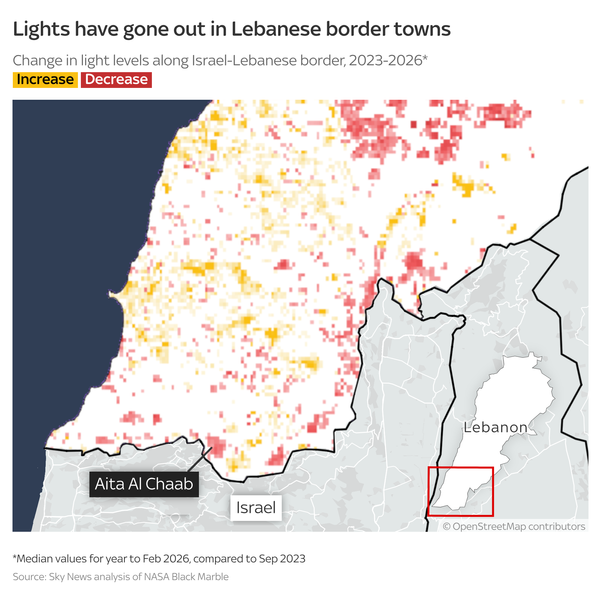
Population scale along the border can be seen from space, with night-time satellite imagery showing a significant decrease in light levels.
The map below shows the change, with decreases highlighted in red. Across the border with Israel, lights are dimmed in Lebanese towns.
Concerns about the use of white phosphorus
Since October 2023, Sky News has interviewed dozens of residents of southern Lebanon who say they have seen white phosphorus sprayed on their crops, farmland and homes.
The video below, first shared on March 15 and reviewed by Sky News, shows an IDF operation in southern Lebanon.
Amel Kotlarsk, a weapons expert at defense intelligence company Jane’s, told Sky News the substance was white phosphorus.
The chemical is used by the military to create smokescreens or illuminate as above, but can start fires, damage crops and cause severe burns.
Its indiscriminate use in populated areas is illegal under international law.
The photograph below, reviewed by Sky News, shows a white cloud covering buildings in the town of Yohmore on March 3. Human Rights Watch said the substance was confirmed to be white phosphorus.
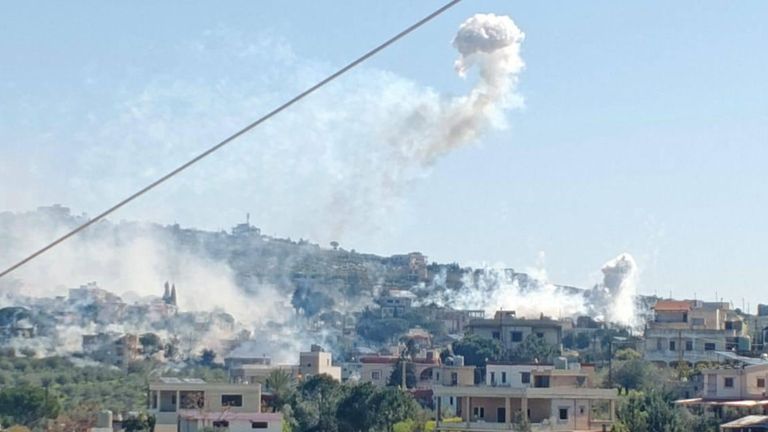
A white cloud rises over the town of Yohmor, Lebanon on March 3, 2026. Human Rights Watch says the substance is white phosphorus. Image: Islamic Health Committee
Human Rights Watch previously documented widespread use of white phosphorus by the IDF in Lebanese border towns in late 2023 and early 2024.
When asked by Sky News, the IDF did not deny using white phosphorus during recent operations in Lebanon but said it always does so in a way that “complies with and exceeds the requirements of international law”.
Ramzi Kais, Lebanon researcher for Human Rights Watch, tells Sky News that the use of white phosphorus in populated areas risks damaging homes and agricultural land.
“I think the use of white phosphorus now is another strategy to push people out of those towns or make it more difficult for them to return,” he says.
The Data and Forensics The team is a multi-skilled unit dedicated to providing transparent journalism from Sky News. We collect, analyze and visualize data to tell data-driven stories. We combine traditional reporting skills with advanced analysis of satellite images, social media and other open source data. Through multimedia storytelling we aim to better explain the world while showing how our journalism is done.