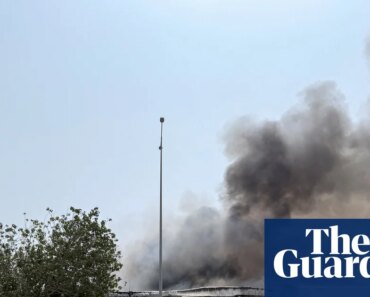
YesInsomnia, fear and exhaustion gripped Tehran residents as successive waves of attacks hit the Iranian capital, judging by messages sent by people in the city after the latest overnight attack, which several described as the worst bombing in six days of war.
With Iran imposing a near-total internet blackout, information emerging from inside the country is fragmentary and difficult to verify. But in a series of accounts sent via proxy connections and calls with friends abroad, Tehran described a night of intense explosions.
Zahra, a teacher and mother of one who lives in central Tehran, said the attacks, in what she said was the most intense attack to date, had left her deeply concerned for civilians who were in danger not only from Iran’s attackers but also from their own government.
“This is the first time since the war started that I am truly afraid for my fellow Iranians,” Zahra* said. “We are caught between the regime that is killing us with machine guns and a foreign power that has probably decided that we are collateral damage.”
Although he had protested against the government in January and celebrated the assassination of supreme leader Ali Khamenei in the first seconds of the war a week ago, he increasingly fears the number of civilian casualties.
“The initial joy of the regime leaders who pay the price soon turns to fear. Who will be left in free Iran if they kill us all?” Zahra said.
She described Thursday night as unlike anything she had experienced before. “I don’t think I’ve ever experienced a night like this before or seen (something like it) in the movies. I’m really scared, especially since I’m in a total information blackout.”
“If they don’t stop now, Tehran will become Gaza,” said Farzad*, a 36-year-old man who fled the city. “Now we can distinguish between the sounds of fighter jets, air defense and missiles. Sometimes we stand together and watch hypersonic missile tests in the sky.”
“It saddens me that most people around me are happy with this situation, both those who are pro-regime and those who are against the regime. Both for different reasons. Nobody cares about innocent lives,” Farzad said. “In the end, it feels like what people say: ‘Whether the wolf is killed or the wolf devours the shepherd, everyone gets caught up in the tragedy.’”
A journalist based in Tehran in the eastern part of the city described being awakened by violent explosions. “I was asleep, and somehow in the last few days I managed to sleep because we got used to the sounds of explosions. But early this morning, the situation became really scary. The windows were shaking and I could hear people screaming.
“They didn’t hit us, but I thought the roof would fall on me and I would die. I am devastated to see my beloved city destroyed like this.”
The journalist later went offline and could not be contacted for updates.
Other messages passed to the Guardian through overseas contacts described similar scenes of panic across the capital. “Tonight was the worst! I woke up to the sound of fighter jets and then it felt like the bombing was happening right in my ears. I really thought I was going to die,” said one resident.
Another short Telegram message said: “I was not far from dying tonight in the bombing. But I sent a message to inform you that we have fled the capital since then.”
Once the sun rose on Friday, residents said the city felt dull and partially deserted. Only a handful of grocery stores were open in the neighborhoods of those who could be contacted, as many families tried to leave the capital after the nightly strikes. “I hope I’m not in ruins again,” said one resident.
Saeed, a student at Tehran University, pleaded: “Please use your voice to ask Mr. Trump if there is a plan to keep us safe while they attack military targets, because we are terrified that this morning’s attacks, which really seemed the most intense since Saturday, must have killed so many people.”
A former political prisoner in western Tehran said fewer Tehrans had left the city than in last June’s 12-day war, and that most shops had remained open despite the bombing. “Since the 12-day war, people are caught at a historical crossroads: on the one hand they are murdered by their own government and on the other by the State of Israel,” he said.
“The reality is that the finger of blame should be pointed at the government that caused this destruction and devastation, and that now burns in the same fire that it itself lit. What I or the average person thinks about the war, or what situation we find ourselves in, doesn’t really matter when it has no effect on the equation.”
He added: “Last night they attacked the center of Tehran with B-2s. This morning, for the second time, I felt really very close to death.”
A human rights activist in central Tehran said: “Now, it is strange that because of propaganda, most people think that the more they bomb, the weaker this government will become. That is their opinion. In the intellectual class there are many pacifist individuals, but at the grassroots level, no. People have seen so many difficulties that they think that the more they bomb, it seems that the majority of people on the streets are actually happier.”
*Names have been changed