Islamabad, Pakistan – Protests broke out across Pakistan on Sunday, with 20 dead and dozens injured across the country, after the United States and Israel confirmed the assassination of Iran’s Supreme Leader Ayatollah Ali Khamenei in coordinated airstrikes on Tehran.
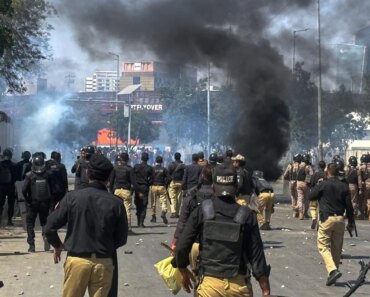
The deaths included 10 people in Karachi, at least eight in Skardu and two in the capital Islamabad, as demonstrations largely led by members of Pakistan’s Shiite Muslim community intensified and security forces fired tear gas and rubber bullets at protesters.
Recommended stories
list of 4 itemsend of list
Pakistan, a country of more than 250 million people, is predominantly Sunni Muslim, but Shiites make up more than 20 percent of the population and are spread throughout the country.
In Islamabad, thousands of people gathered near the Red Zone, the heavily fortified district that houses parliament, government offices and foreign embassies. Protesters chanted: “Those who side with the United States are traitors” and called for “revenge against Israel.”
Between 5,000 and 8,000 people, including women and children, gathered near one of the capital’s largest hotels, holding signs with Khamenei’s image.
Syed Nayab Zehra, a 28-year-old protester, said she had joined the demonstration with her family to express solidarity with Iranians, even if “our government is not with you.”
“We want to show the world not to take us Shiites lightly. We are here to remind the world that we will seek revenge. We cannot expect anything from our own government, but we will defend our community,” he told Al Jazeera.
Pakistan’s government condemned the joint US-Israeli military attack on Iran that killed Khamenei. He has also criticized Iran’s subsequent attacks on Gulf nations.
On Sunday, some people in the crowd urged protesters to march toward the diplomatic enclave, while others shouted instructions to maintain “discipline.”
Ali Nawab, a worker with Majlis Wahdat-e-Muslimeen, a Shiite political party, said organizers had agreed with local authorities to keep the protest peaceful.
“There are some people who can be seen here deliberately trying to make provocative gestures and force us to do things we are not supposed to do. We are here for a cause and we will move forward when we are told,” he said.
Authorities had sealed roads leading to the Red Zone, which houses the US embassy and other diplomatic missions. When protesters tried to advance, security forces fired tear gas and rubber bullets. Witnesses said real gunshots were also heard.
As the crowd retreated, more bursts of tear gas were fired, injuring several people.
Mouwaddid Hussain, a 52-year-old protester, said the government had betrayed them.
“Are we enemies of the state? We were here to mourn the death of our leader, and we can’t even cry here? They promised to let us be here and protest, but they violated their commitment,” he said.
Al Jazeera saw several people injured by shrapnel from rubber bullets. Doctors at the government-run Poly Clinic in Islamabad said the hospital had received at least two bodies and treated at least 35 injured people.

Karachi turns deadly
The bloodiest scenes unfolded in Karachi, Pakistan’s largest city, where hundreds of people gathered outside the US embassy and consulates on Mai Kolachi Road.
A group of youths climbed over the outer door of the consulate, entered the driveway and broke the windows of the main building. The crowd was eventually dispersed with tear gas and gunshots. It was not immediately clear if the shots came from police personnel deployed at the scene.
At least 10 people were killed and 60 injured in the clashes, police surgeon Summaiya Syed said in a statement.
The chief minister of Sindh province, of which Karachi is a part, Murad Ali Shah, called the incident “extremely tragic” and ordered an impartial investigation.
“At a time when the country is facing a war situation, it is inappropriate to sabotage peace and order,” he said, while expressing solidarity with Iran and its people.
The US embassy in Islamabad said in a brief statement on X that it was “following reports of ongoing demonstrations” at US facilities in Karachi, Lahore and Islamabad, and advised US citizens to avoid large crowds.
Sunday’s violence was not unprecedented. In November 1979, a mob broke into and set fire to the US embassy in Islamabad, killing two Americans and two Pakistani staff.
The attack came days after Ruhollah Khomeini, the leader of Iran’s Islamic revolution, spread claims, later proven false, that the United States and Israel were behind the storming of the Grand Mosque in Mecca.
The rumor quickly spread throughout Pakistan, drawing crowds that overwhelmed security forces. The episode remains one of the most serious attacks on a US diplomatic facility in the country’s history.
Violence in the north
In Gilgit-Baltistan, the northern mountainous region with a significant Shiite population, unrest was also severe.
At least eight people were killed in the town of Skardu after protesters set fire to the offices of the United Nations Military Observer Group in India and Pakistan. Other buildings, including a school, were damaged.
Authorities imposed a three-day curfew in Skardu and officials described the situation as tense.
In the city of Lahore, hundreds of people gathered in front of the US embassy. Some tried to force their way in before police dispersed them with tear gas. No deaths were reported there.
Protests also took place in Peshawar, Multan and Faisalabad, where large crowds took to the streets to denounce the United States and Israel and mourn Khamenei’s death.
Call for calm
Earlier on Sunday, Interior Minister Mohsin Naqvi visited parts of Islamabad to review security and ordered reinforcements around the diplomatic enclave. In a video message, he asked for moderation.
“After the martyrdom of Ayatollah Khamenei, every citizen of Pakistan is saddened in the same way as the citizens of Iran are,” he said.
“We are all with you. We ask citizens not to take the law into their own hands and to register their protest peacefully,” Naqvi added.
Prime Minister Shehbaz Sharif later expressed his “pain and sadness” over Khamenei’s death in a social media post.
“Pakistan also expresses its concern over the violation of the norms of international law. It is an ancient convention that says that Heads of State and Government should not be attacked. We pray for the soul of the deceased. May Almighty God grant patience and strength to the Iranian people to bear this irreparable loss,” the prime minister said.
Deputy Prime Minister and Foreign Minister Ishaq Dar had spoken to his Iranian counterpart Seyed Abbas Araghchi shortly after the attacks began a day earlier.
According to Pakistan’s Ministry of Foreign Affairs, Dar “strongly condemned the unjustified attacks on Iran” and called for an immediate stop to the escalation through diplomacy.
Pakistan shares a border of more than 900 kilometers (559 miles) with Iran and maintains trade and energy ties with its neighbor. It does not recognize Israel and has long supported a two-state solution to the Israeli-Palestinian conflict.