Iranian authorities arrested Louis Arnaud in 2022, accusing him of threatening state security by participating in “propaganda” and protests. His family denied the allegations, saying he had “kept his distance” from public demonstrations when he visited Iran as a tourist.
Her arrest comes amid a crackdown on the “Women, Life, Freedom” movement – widespread anti-government protests sparked by the death of 22-year-old Mahsa Amini, who was arrested for wearing the hijab incorrectly and died in police custody.
Arnaud spent almost two years in Evin prison, where many opponents of the regime – including political prisoners, academics and activists – as well as foreign nationals accused of espionage or distributing propaganda were held.
The prison has, for decades, been a symbol of brutal repression, with detainees facing routine physical and mental torture and the constant threat of summary execution or enforced disappearance.
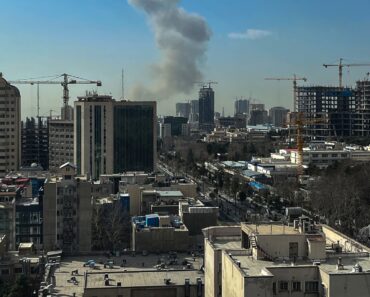
US and Israeli attacks on Iran this week have brought new risks and made prisoners one of the country’s most dangerous groups.
Arnaud, author of “La Revolution Interior” (The Internal Revolution), spoke to France 24 about his fear that the Iranian regime will use the conflict to crack down even harder on prisoners to eliminate internal enemies.
FRANCE 24: Human rights groups are reporting that the conflict in Iran has put prisoners at great risk – for example, it They are being denied food and shelter during the Israeli and US strikes. Can your experience put this into context, especially what everyday life is like?
Louis Arnaud: I was detained in Ward 209, a high-security section of the Iranian intelligence service, in Evin prison for political prisoners. And it was a slaughterhouse.
People were thrown into windowless, bedless cells, stripped of everything, living under lights that never went out, blurring the notion of time. We did not get enough food.
And then there was the humiliation and torture to force you to accept what they decided to make you accept.

On top of this, Iran has a history of escalating its violence in the event of any conflict. The regime increases executions under the guise of external events such as its abuses, violence and war. When tens of thousands of prisoners were executed during the Iran-Iraq war, this happened without any legal framework.
And today’s biggest fear is that – the execution of political prisoners will be carried out in secret without informing their families, so that the Iranian public cannot react and will be given to them. compliance.
There are also fears that political prisoners and common law prisoners will be subjected to execution, abuse, violence and abuse, which is worse than usual to scare the population.
This is a way for the regime to terrorize its people – especially at this time – because the regime’s biggest fear is that the population will use this war to rise up again, as they did in January.
So the prisoners are now More vulnerable than ever?
Absolutely, because war is an opportunity for the regime to eliminate its opponents. It has already used this type of opportunity in the past.
The administration is completely ignoring the trapped prisoners who cannot get out and find shelter (during air raids). Residents of the area surrounding Evin prison have been told to seek shelter, to evacuate the area as much as possible, which is apparently not possible for prisoners.
The same thing happened during the Israeli-US 12 day war over Iran. The neighborhood around Evin was bombed along with the prison, and inmates were wounded or killed in the bombing when members of the prison administration had already fled.
View moreAt least 71 people were killed in an Israeli attack on Tehran’s Evin prison
Today we are told that some members of the prison administration have already left and the prison is in the hands of an unknown police force whose motives and intentions are unknown.
Worse still, there are great fears that the prisoners have been moved with a view to using them as human shields to prevent them from attacking some Revolutionary Guard targets.

What was it like to live among political prisoners in Evin? who are they
For the first three months of my detention I spent time with political prisoners in Evin during the “Women, Life, Freedom” movement. I mingled with all classes of people – workers, bricklayers, students, doctors, poets, artists – who stood up during this agitation, because they were at the height of their despair. They were suffocating for lack of freedom or dignity.
Those who rose that day were the ones who rose again in January and were massacred.
During the second part of my detention, I met long-term political prisoners – people serving sentences of five, 10, 20 and sometimes 30 years – who had already served 10 years in prison. Some of these people may have been part of the 1979 revolution and were imprisoned under the Shah’s previous regime, then returned to prison during the political purge at the start of the Islamic Republic.
These people are the intellectual elite of the country. They are students of the best universities, they are sociologists, political scientists, human rights defenders like Narges Mohammadi, who won the Nobel Peace Prize while we were in prison.
Read moreIran has sentenced Nobel Peace Prize laureate Narges Mohammadi to six years in prison
He used to guide the lights in the jail. He has the integrity to continue his fight out of prison, even when he is under immense pressure to give up.
And they took me in as one of themselves and became my family. And these people who are still in the forefront against the regime today want to use this opportunity to get rid of them.
You are in touch Anyone in Iran at this time?
No, not in prisons or in Iran because internet and communications have been cut off for more than 72 hours.
You have an even stronger connection with Iran and Iranians. Regarding The current conflict, you mainly do Is there fear or some signs of hope for the future of the country?
We must understand that Iranians have reached unimaginable levels of desperation.
He was imprisoned, tortured and killed for 47 years for wanting some dignity, some freedom. They have risen again and again, and recently more than 30,000 people have been slaughtered in just 12 days.
Read more‘Like in wartime’: Iranian doctors describe deadly crackdown on protesters
There is tremendous shock. Everyone knows at least one person who died.
So the Iranians came to say to themselves, ‘We have no choice but to bomb. We wanted them to bomb us. And maybe we die. But, in fact, it makes no difference whether we die by Mullah’s bullets or American bombs.
Iranians are one of the most educated populations in the world and the most educated population in the Middle East. They are fully aware that the Americans and the Israelis have their own different agenda, but they have descended into such desperation.
This is absolutely tragic, because it means that these people are hoping that these strikes will weaken the regime in order to seize their future.
And anything is possible. But today, unfortunately, I am pessimistic about what is to come.
We hear Donald Trump say America will take care of ballistic missiles and nuclear weapons because they are a threat, then the Iranian people will exercise their freedom and seize their institutions if they want. At the end of the day, the international military capabilities of the Revolutionary Guards may have been weakened, but they don’t need much to massacre their populations.
And they are fully prepared to do just that. They do not want to give up power. There is an atmosphere of hatred in Iran since the January massacre. And for the Revolutionary Guards, it was kill or be killed.
What I fear most is that after the Israeli-American intervention is over and their military goals are achieved, there will be another bloodbath in Iran.
(tags to be translated)France