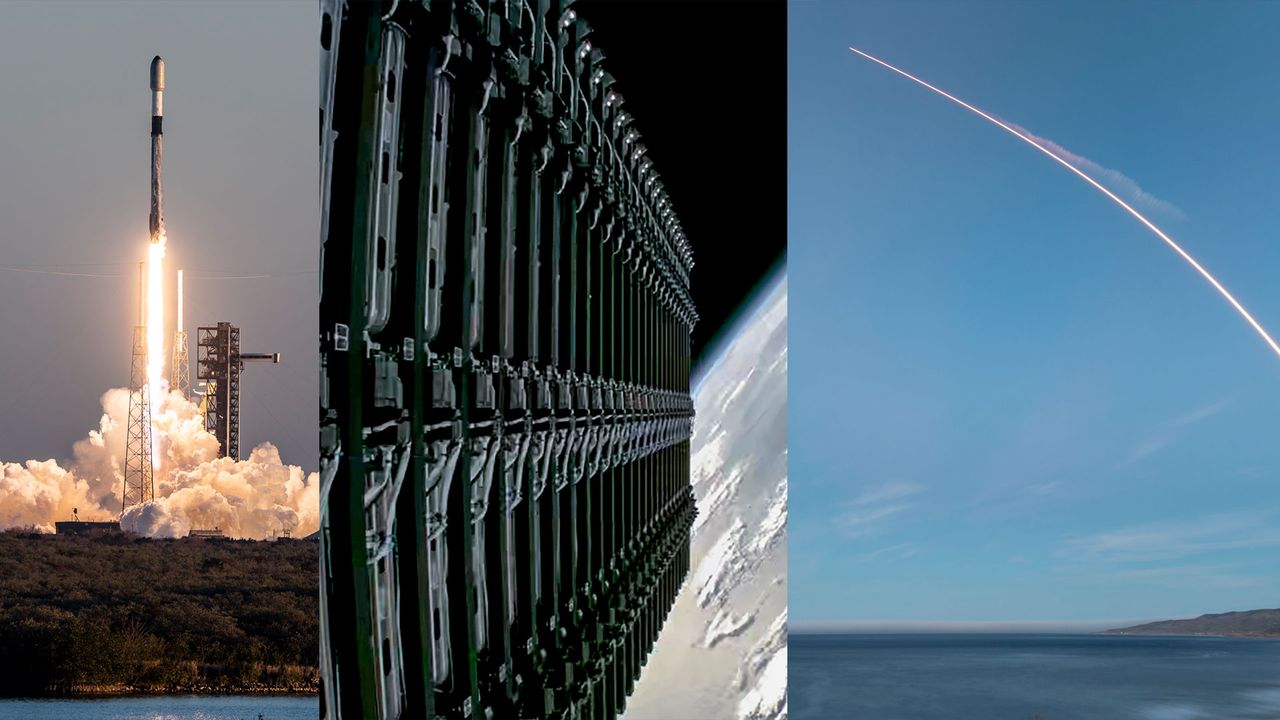
In what has hardly been a leap for the company, SpaceX wrapped up its Starlink satellite launches for February 2026 with a trio of flights this week.
Tuesday (February 24) at 18:04 EST (2304 GMT), a Falcon 9 lifted the first 29 satellites into low earth orbit from Space Launch Complex 40 (SLC-40) at Cape Canaveral Space Force Station in Florida. The next day, 25 more Starlink units were launched into space by another Falcon 9 that flew at 9:17 a.m. EST (1417 GMT or 6:17 a.m. PST local time) from Space Launch Complex 4 East (SLC-4E) of Vandenberg Space Force Base in California.
All three launches deployed their Starlink payloads (Groups 6-110, 17-26 and 6-108) into the expected orbit, SpaceX confirmed.
Also on all three flights, the Falcon 9 rocket’s first stage flew back to Earth to land on a sea-based drone ship. Tuesday’s booster (B1092) hit Just Read the Instructions stationed in the Atlantic Ocean, completing its 10th mission. Wednesday’s booster (B1093) landed at Of Course I Still Love You stationed in the Pacific Ocean, marking the end of its 11th flight.
Friday’s booster (B1069) completed its 30th trip to space and back on A lack of gravitas drone ship, which was stationed in the Atlantic Ocean.
The 83 satellites increased the commercial broadband network to include more than 9,850 devices in Earth orbit, according to satellite tracker Jonathan McDowell.
The Starlink service provides internet access to areas around the world where connectivity is sparse or non-existent. The network also supports cell-to-satellite on selected operators and onboard wifi on some airlines.
Friday’s launch was SpaceX’s 25th Falcon 9 mission in 2026.