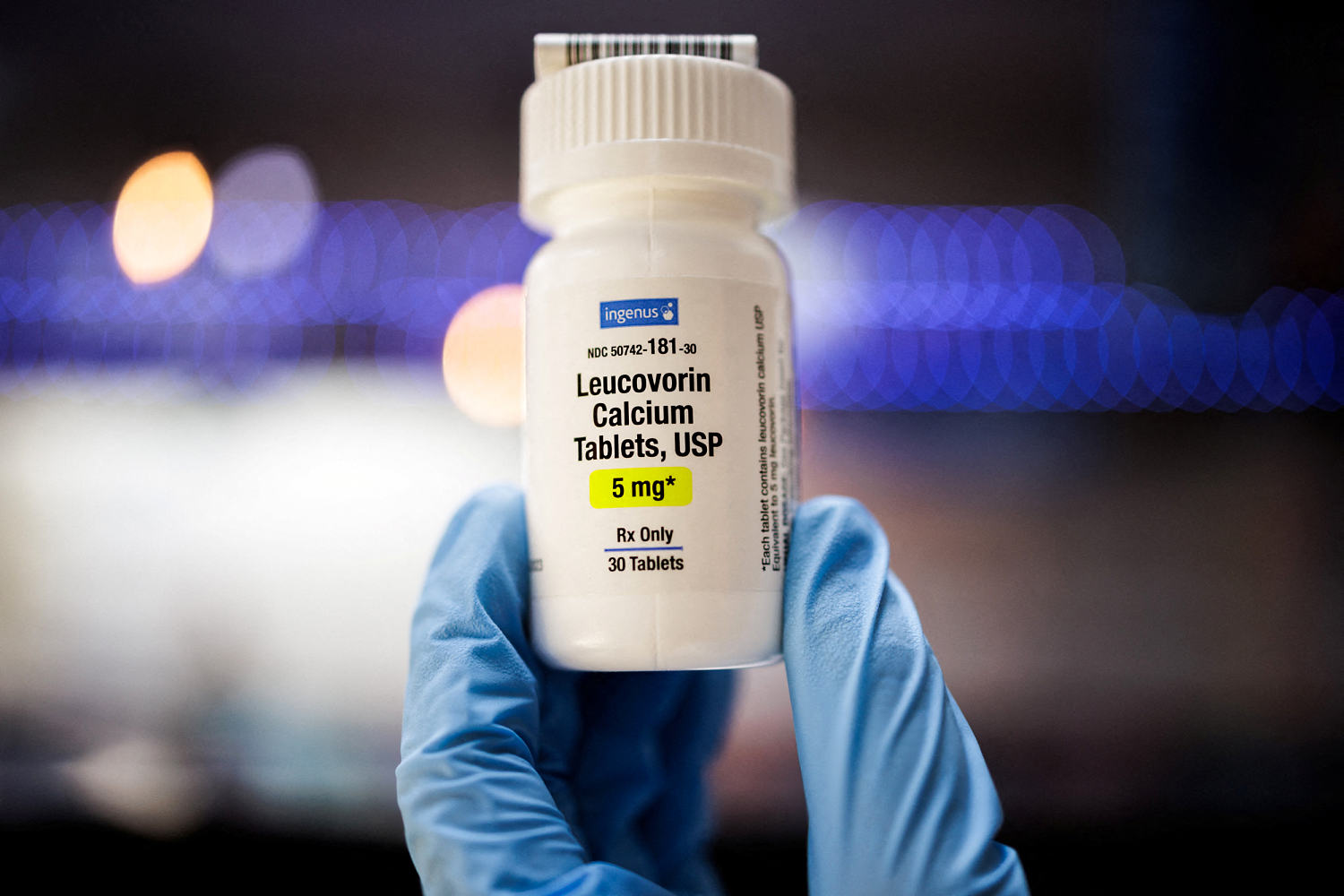
The Food and Drug Administration on Tuesday announced a new approved use for the drug leucovorin, a synthetic form of vitamin B9 that the Trump administration has promoted as a treatment for autism symptoms.
But the new approval is not for autism, but for brain folate deficiency, a rare neurological condition characterized by low levels of vitamin B9 in the brain.
Contrary to messages given by President Donald Trump and FDA Commissioner Marty Makary in September when they announced a plan to relabel the drug, a senior FDA official said Monday that there is not enough data to support the use of leucovorin as a treatment for autism.
“We don’t have enough data to say we could establish efficacy for autism more broadly,” the official said. “It will be up to patients to talk to their doctors to see if that might be right for them.”
Leucovorin is primarily used to help mitigate the side effects of chemotherapy or improve its effectiveness in cancer patients. But in a Sept. 22 briefing, Makary said the FDA was taking steps to change the drug’s label “so that it can be made available to children with autism,” adding that “in my opinion, hundreds of thousands of children will benefit.”
Trump said at the time that the drug’s updated label would “reflect potential benefits in reducing some symptoms of autism.”
“This gives hope to many parents with autistic children that it is possible to improve their lives,” he said.
Many experts who research or treat autism disputed that rhetoric and said the drug needed more study before being distributed to autism patients.
Alycia Halladay, chief scientific officer at the Autism Science Foundation, said Tuesday’s FDA announcement is “1,000% different” from the administration’s rhetoric in September.
The actual change the FDA proposed nearly six months ago did not say the drug would be approved to treat autism. Rather, the agency said it was initiating approval of leucovorin tablets for patients with brain folate deficiency and described an overlap between symptoms of that condition and autism, such as challenges with social communication, sensory processing and repetitive behaviors.
An estimated one in every million people has brain folate deficiency, and although some researchers suspect the condition may be associated with autism, it is thought to affect only a small minority of autism patients.
Although leucovorin is not approved to treat autism, doctors can prescribe it without approval. Some were doing so before Trump’s comments in September, based on findings from a handful of small trials conducted primarily outside the U.S. The results of one of those trials, published in the European Journal of Pediatrics, were retracted in January after the authors identified several errors in their data.
In the two and a half months after Trump’s announcement in September, leucovorin prescriptions for children increased 71%, according to data published last week in the medical journal The Lancet.
“The bell has rung and we have already seen through the data that leucovorin prescriptions have skyrocketed,” Halladay said. “I don’t see that changing with this announcement that it’s only approved for brain folate deficiency.”
David Mandell, a professor of psychiatry at the University of Pennsylvania, said this week’s FDA announcement amounts to mixed messages, given the Trump administration’s description of leucovorin in September.
“This is just terrible for families: this back-and-forth about what autism is about, what autism isn’t, what causes it, what doesn’t cause it,” she said. “Families deserve better than that. They deserve more careful science. They deserve more accurate information.”
Still, Mandell said he was “relieved” that the FDA is not approving leucovorin for patients with autism, “given the very weak data and my understanding that the current trials underway are not showing promise for autism.”