The weaponization of energy when Russia invaded Ukraine has given way to “weaponizing everything” since Donald Trump returned to the White House, Germany’s former economy minister said.
Robert Habeck, the Green politician responsible for keeping the lights on during the last energy crisis, said the belief that gas “would never be a political weapon” led successive German governments to blindly fall into Putin’s trap by building the Nord Stream gas pipelines and selling strategic reserves to Gazprom, which Russia emptied before the invasion.
But Donald Trump’s re-election sparked a second security shock with “dramatic, drastic… and far-reaching” consequences including the weaponization of tariffs and technology, he told The Guardian.
“From weaponizing energy (which is pretty bad) to weaponizing everything, this is the lesson I hope everyone has learned,” said Habeck, vice chancellor in the last German coalition government.
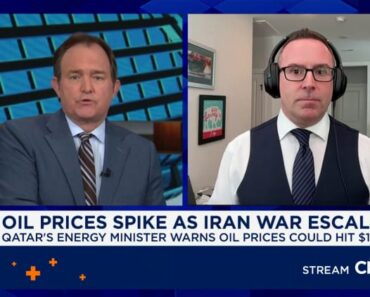
Europe faces a looming energy crisis after the United States and Israel attacked Iran in February, prompting retaliatory attacks that closed the Strait of Hormuz, through which 20% of the world’s oil and liquefied natural gas (LNG) flows.
The price increases have sparked new calls for clean local energy and complaints that Europe should have abandoned foreign fuels faster.
Habeck, who rushed to build LNG terminals and secure alternative gas supplies when Russia invaded Ukraine, said he faced “sleepless nights” during the last energy crisis at the prospect of telling industries to close factories if he failed to deliver gas to them on time.
“Current gas prices in Germany could be high,” he said. “But that time there was a real threat that we wouldn’t have any gas.”
He rejected criticism that focusing on switching suppliers and building import terminals risked stranding assets as the country cut pollution.
He also defended his 2022 decision to delay the closure of Germany’s last nuclear plants by just a few months, rather than letting them refuel and run longer. The center-right Christian Democrats, then in opposition, criticized the Economy Ministry for not having conducted an open examination of the issue. A parliamentary inquiry last year reached no conclusion.
“I personally wouldn’t have had a problem using (the reactors) for a few more years if that had been the end,” Habeck said. He said parts of the opposition appeared to be using it as a “Trojan horse” to reopen the phase-out law, and that changing the rules to allow refueling could increase generation to a level that would “destroy the growing renewable energy market.”
Germany produced 60% of its electricity from renewables last year, with coal and gas accounting for the rest. Habeck said he had become “a bit agnostic” about the risks of nuclear power in Germany, but remembered the Chernobyl disaster in 1986 and the radiation that blanketed Europe.
“There was no dancing in the rain, there was no kissing in the rain, there was no sleeping on the beach, because there was radioactive fallout everywhere,” he said. “We basically stayed at home, and I really said at the age of 16 that this is not the form of energy that should govern my life.”
The Ukraine war prompted EU officials to speed up their permitting process for wind turbines and solar panels, which now produce more electricity than fossil fuels, but analysts say they have been slow to reduce energy demand, reduce waste and electrify activities such as driving and heating homes.
Germany introduced a handful of short-term gas-saving measures at the start of the war, such as lowering thermostats in public buildings to 18°C (“people in my ministry sat there with winter jackets on their desks”) and sought to curb future consumption by phasing out gas boilers.
The policy, known as “Habeck’s heating hammer” for an aggressive sensationalist campaign, turned heat pumps into objects of ridicule. Its renewable energy needs are being diluted by the Conservative-led coalition government.
Speaking from Copenhagen, where he works as an analyst at the Danish Institute of International Studies, Habeck said Nordic nations that have adopted heat pumps laugh at Germany for its resistance to clean heating.
But he said his narrow focus on avoiding gas shortages led him to underestimate the level to which Germans were fed up with inflation and the interference in their personal lives. He said he also underestimated the resistance of the people who run the gas companies.
“Some of them I know personally, they’re decent guys and I guess when they talk to their kids they always say ‘yes, we have to change to save the planet’ and ‘global warming is a threat’, but in the end, as the owners of the company, they have a stake,” he said.
The Greens were expelled from the coalition government in February 2025 amid a decline in the importance of the climate and fierce attacks from parties that blamed Habeck for Germany’s economic woes. In a possible sign of recovery, they won state elections on Sunday in Baden-Württemberg, the wealthy heart of the German car industry.
“I would say that Germany has made peace with a different form of heating systems and that electric vehicles are now on the rise,” Habeck said. “So yes, too late – and not just a month or a year but 10 years late, looking at other countries – but because of the very close decisions (it is) basically on the right track now.”