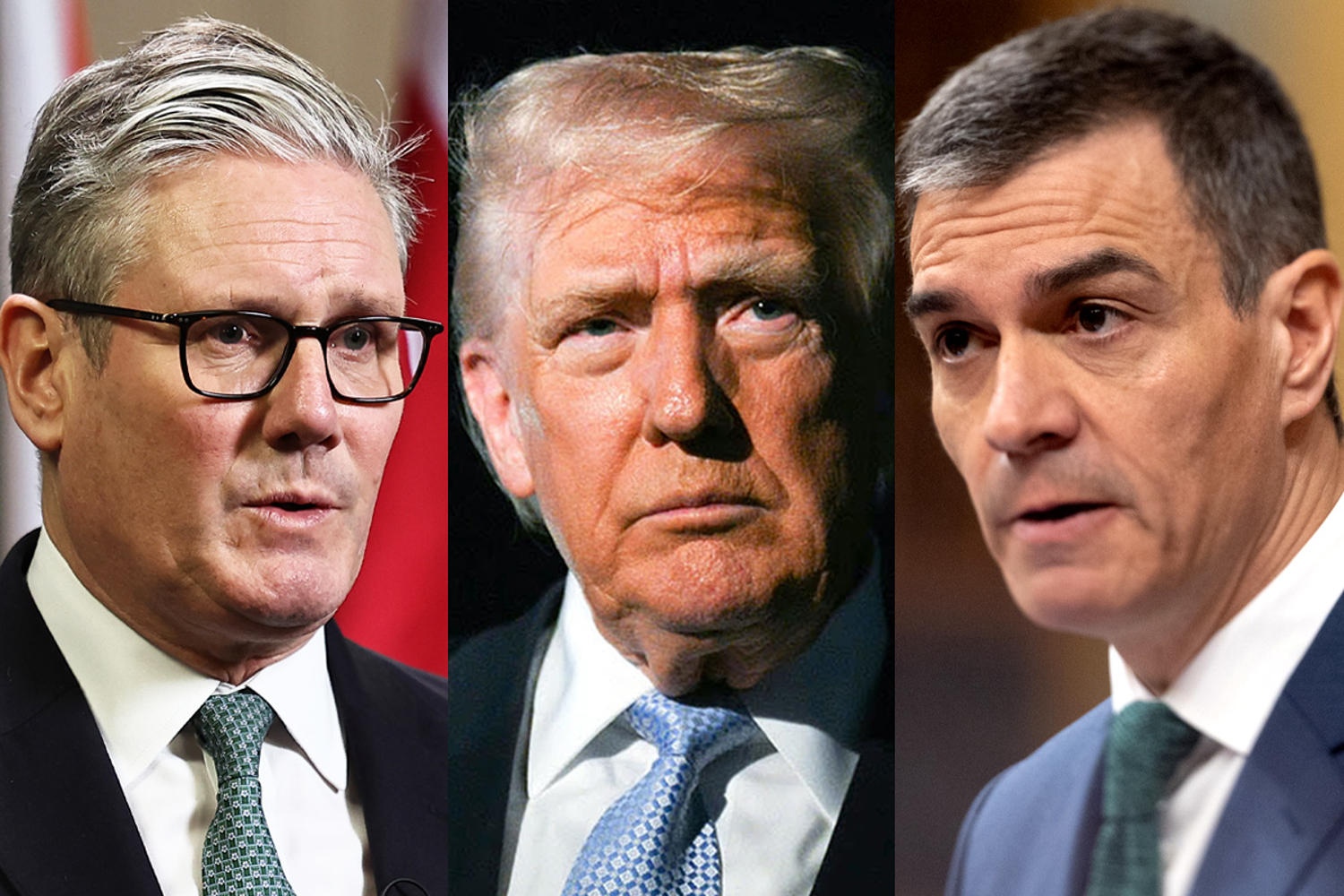
After a year of tariff threats, insults and diplomatic clashes with European allies, President Donald Trump must wage war on Iran with only Israel at his side.
“We are not dealing with Winston Churchill,” Trump said Monday after U.K. Prime Minister Keir Starmer refused to allow the United States to use British bases as part of its initial attacks, and only later allowed the use of his bases for “defensive” actions.
A day later, after Spain banned U.S. military aircraft from using its jointly operated bases in Andalusia, Trump said the United States would seek to “cut off all trade with Spain,” a member of the European Union’s single market.
France, by backing Spain in their dispute, further risked incurring the president’s wrath when President Emmanuel Macron said on Tuesday that attacks on Iran were “outside the framework of international law.”
Some European leaders remain in Trump’s favor for now. Germany Conservative Chancellor Friedrich Merz, who sat next to Trump when the president spoke about Spain, appears to have remained pro-Trump after allowing the US Ramstein air base to be used amid the conflict.
“Germany has been great,” Trump said. “They are letting us land in certain areas and we appreciate it.”
Italian newspaper Corriere della Sera reported Sunday that Trump praised the country’s far-right Prime Minister Giorgia Meloni, who said Italy would respect existing agreements on the use of bases. In a phone interview, Trump called her a “great leader” who “always tries to help.”
White House press secretary Karoline Leavitt said Wednesday that Trump expects “all of our European allies, of course, to cooperate on this long-sought mission,” stating that Iran “also threatens our European allies.”
While European allies played key roles in past military interventions in Afghanistan and Iraq, the United States has fought wars without its allies before, and Western Europe notably refused to send troops to Vietnam, although some countries provided other support.
The continent’s cautious response to the war in Iran and Trump’s broader threats have raised fears that a diplomatic split could escalate into another trade confrontation, but one expert downplayed the rift between the transatlantic partners.
“We should not fool ourselves into believing that European governments do not really support the United States in Iran,” said Fawaz Gerges, a professor of international relations at the London School of Economics.
“We shouldn’t really focus on the rhetoric of European leaders,” he added. “We must focus on their actions and their deployment of naval and air power to provide other direct or indirect support to the US-Israeli war in Iran.”
Kaja Kallas, head of foreign policy of the European Union He said on Friday that Washington’s foreign policy shift had “shaken the transatlantic relationship to its foundations” but appeared to align the bloc with the United States, accusing Iran of being “a war exporter.”
He told reporters at a news conference that Iran was trying to “sow chaos” in the region and that he saw an opportunity for the Iranian people to “determine their own future.”
Despite Europe’s disagreements with Trump, “despite his bullying, despite his humiliation of Europe, most European leaders still feel dependent on the American strategic umbrella,” Gerges added.
The president of the Spanish Government is “the only one who has stood up,” he stated.
While responses to US requests have been different, Europe remains united on the need to defend the continent from any Iranian threat.
Spain, Italy, France and the Netherlands have deployed naval and air assets to European Union member Cyprus after an Iranian-made drone attacked a British base in the country on Monday.
Spain sent its most advanced warship to the eastern Mediterranean, signaling its continued commitment to European defense cooperation despite refusal to help Trump.
Britain’s Ministry of Defense said on Saturday that one of its two aircraft carriers had been placed on advanced readiness, raising speculation that it could be deployed to the Mediterranean.
“It’s okay, Prime Minister Starmer, we don’t need them anymore,” Trump responded on Truth Social. “We don’t need people joining wars after we’ve already won!”
But the United States’ various requests for European support appear to show some desire for a mutually beneficial relationship with Europe, which has at times seemed uncertain since Trump’s return to power.
“I think Trump has realized that Europe is important,” Michael Bociurkiw, a nonresident senior fellow at the Atlantic Council’s Eurasia Center, told NBC News. The president “has approached many governments for support and probably believes that they do not support him enough.”
In 2025, Bociurkiw added, European governments were coming to Washington “on their knees, trying to smear Trump” while trying to get Washington support for the war in Ukraine, “but I think they are now realizing that they need to act more independently.”
A year ago, Trump called Ukrainian President Volodymyr Zelenskyy a “dictator” with no “cards” to play, cutting support for Ukraine in its war with Russia while promoting a peace deal that would see the Eastern European nation cede vast swaths of territory.
But Zelenskyy said Wednesday that the United States has turned to him for help with anti-drone defenses, drawing on Ukraine’s years of experience fighting Shahed drones designed by Iran and deployed by Russia.
“We received a request from the United States for specific support in protecting against the ‘Shaheds’ in the Middle East region,” Zelenskyy wrote in X. “I gave instructions to provide the necessary means and ensure the presence of Ukrainian specialists who can ensure the required security.”
Zelenskyy “has a much stronger deck of cards in his hands than he did a week ago,” Bociurkiw added.