NASA’s Curiosity Mars rover has discovered the largest organic (carbon-containing) molecules ever found on the Red Planet. The discovery is one of the most significant discoveries in the search for evidence of past life on Mars. This is because, at least on Earth, relatively complex, long-chain carbon molecules are involved in biology. These molecules can actually be fragments of fatty acids, which are found in, for example, the membranes around biological cells.
Scientists believe that if life ever appeared on Mars, it was likely microbial in nature. Because microbes are so small, it is difficult to be definitive about any evidence of life found on Mars. Such evidence needs more powerful scientific instruments that are too large to be put on a rover.
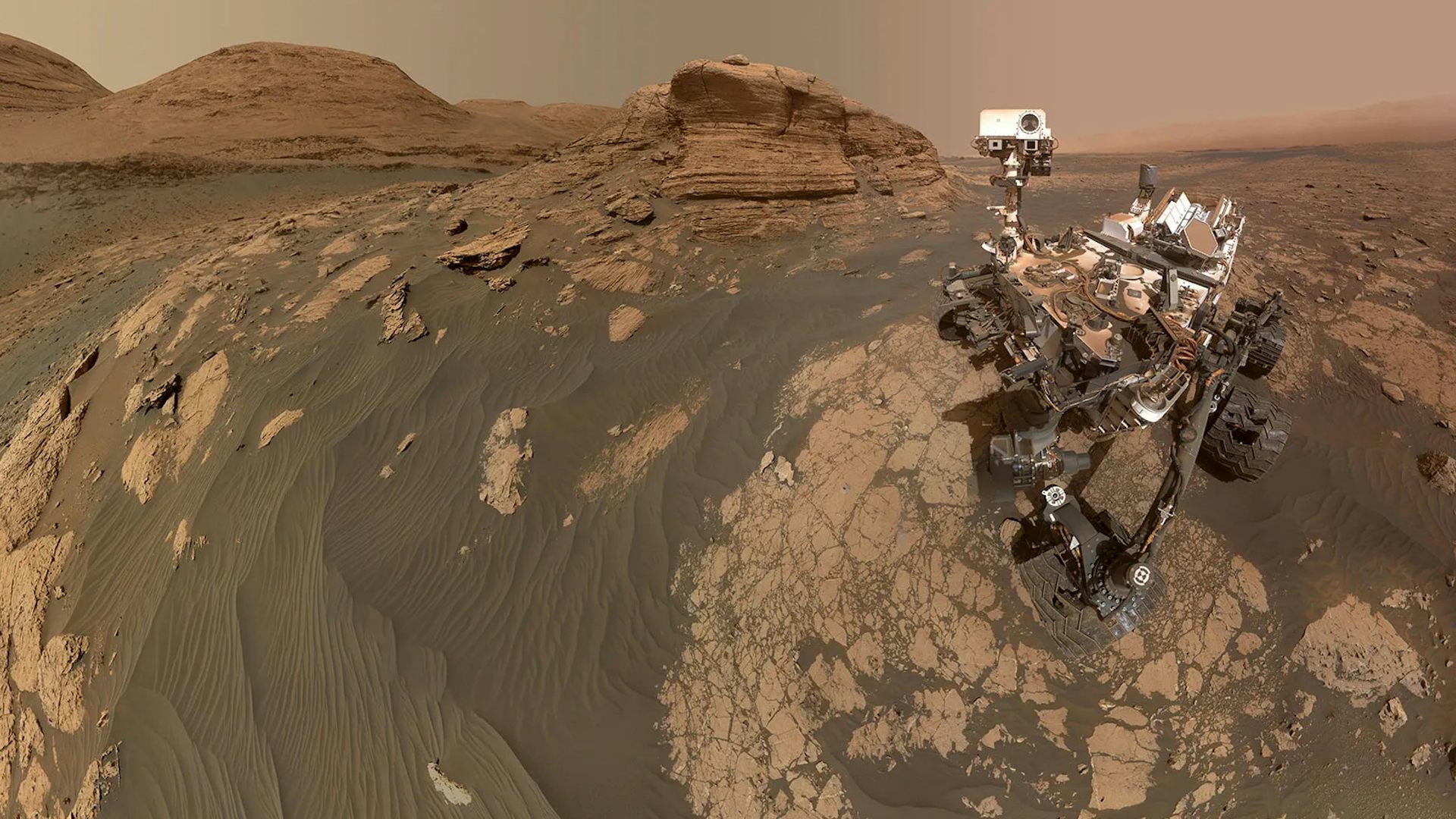
Curiosity rover near the Mont Mercou site on Mars. Source: NASA/JPL-Caltech/MSSS
The organic molecules found by Curiosity consist of carbon atoms linked in long chains, with other elements bound to them, such as hydrogen and oxygen. They come from a 3.7-billion-year-old rock called Cumberland, encountered by the rover at a presumed dried-up lake bed in Mars’ Gale Crater. Scientists used the Sample Analysis at Mars (SAM) instrument on the Nasa rover to make their discovery.
Scientists were actually looking for evidence of amino acids, which are the building blocks of proteins and therefore key components of life as we know it. But this unexpected find is almost as exciting. The research is published in the Proceedings of the National Academies of Science.
Among the molecules were decane, which has 10 carbon atoms and 22 hydrogen atoms, and dodecane, with 12 carbon atoms and 26 hydrogen atoms. These are known as alkanes, which fall under the umbrella of the chemical compounds known as hydrocarbons.
It is an exciting time in the search for life on Mars. In March this year, scientists presented evidence of features in another rock sampled elsewhere on Mars by the Perseverance rover. These features, called “leopard spots” and “poppy seeds,” may or may not have been produced by the action of microbial life in the distant past. The findings were presented at an American conference and have not yet been published in a peer-reviewed journal.
The Mars Sample Return mission, a collaboration between Nasa and the European Space Agency, offers hope that samples of rock collected and stored by Perseverance can be brought to Earth for study in laboratories. The powerful instruments available in terrestrial laboratories may finally confirm whether there is clear evidence of past life on Mars. In 2023, however, an independent review committee criticized increases in Mars Sample Returns’ budget. This caused the agencies to reconsider how the assignment could be carried out. They are currently investigating two revised options.
Signs of life?
Cumberland was found in a region of Gale Crater called Yellowknife Bay. This area contains rock formations that look suspiciously like those formed when sediment builds up on the bottom of a lake. One of Curiosity’s science goals is to investigate the prospect that past conditions on Mars would have been suitable for the development of life, so an ancient lake bed is the perfect place to look for them.
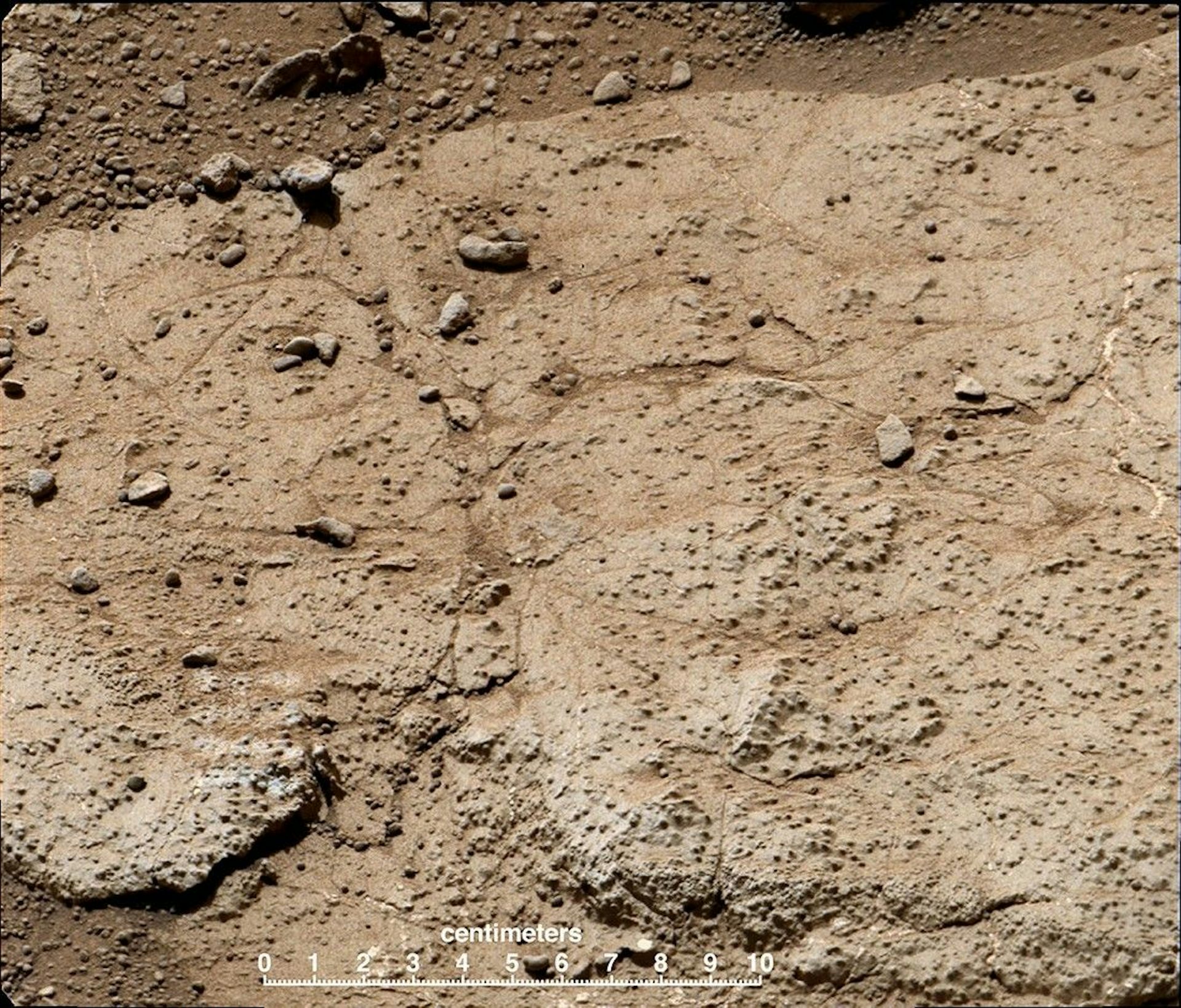
The Martian rock known as Cumberland, which was sampled in the study. Credit: NASA/JPL-Caltech/MSSS
The researchers believe that the alkane molecules may once have been components of more complex fatty acid molecules. On Earth, fatty acids are components of fats and oils. They are produced through biological activity in processes which, for example, contribute to forming cell membranes. The proposed presence of fatty acids in this rock sample has been around for years, but the new paper details the full evidence.
Fatty acids are long, linear hydrocarbon molecules with a carboxyl group (COOH) at one end and a methyl group (CH3) at the other, forming a chain of carbon and hydrogen atoms.
A fat molecule consists of two main components: glycerol and fatty acids. Glycerol is an alcohol molecule with three carbon atoms, five hydrogen atoms and three hydroxyl groups (chemically bonded oxygen and hydrogen, OH). Fatty acids can have 4-36 carbon atoms; however, most of them have 12-18. The longest carbon chains found in Cumberland are 12 atoms long.
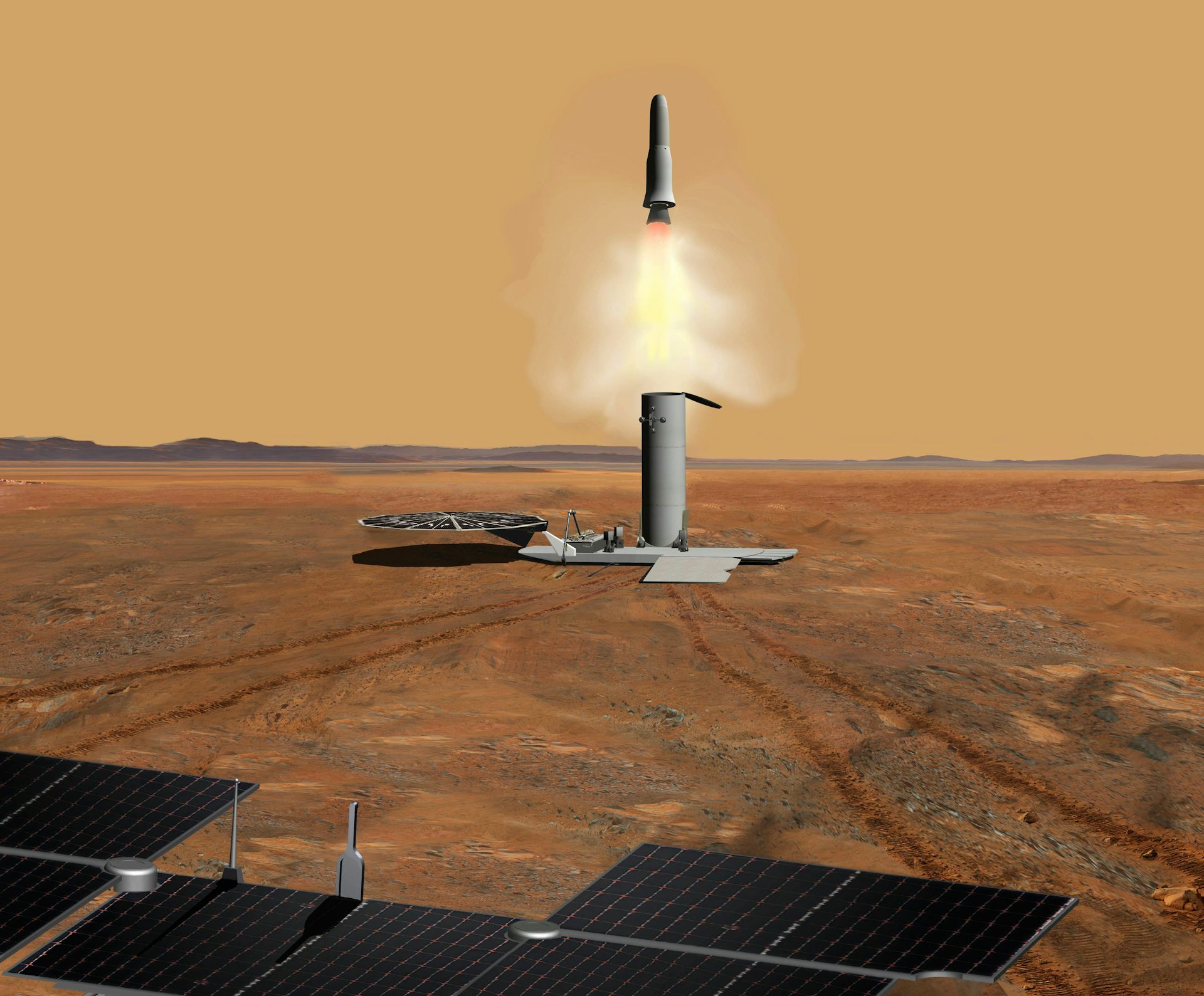
Mars Sample Return will deliver Martian rocks to Earth for study. This artist’s impression shows the ascent vehicle leaving Mars with rock samples. Nasa/JPL-Caltech
Organic molecules preserved in ancient Martian rocks provide a critical record of Mars’ past habitability and may be chemical biosignatures (signs that life was once there).
The sample from Cumberland has been analyzed by the SAM instrument many times, using different experimental techniques, and has shown evidence of clay minerals, as well as the first (smaller and simpler) organic molecules found on Mars, back in 2015. These included several classes of chlorinated and sulfur-containing organic compounds in Gale rock crater up to six carbon structures from crater atomic sediment. The new discovery doubles the number of carbon atoms found in a single molecule on Mars.
The alkane molecules are significant in the search for biosignatures on Mars, but how they were actually formed is still unclear. They may also be derived through geological or other chemical mechanisms that do not involve fatty acids or life. These are known as abiotic sources. However, the fact that they exist intact today in samples that have been exposed to a harsh environment for many millions of years gives astrobiologists (scientists who study the possibility of life beyond Earth) hope that evidence of ancient life can still be detected today.
It is possible that the sample contains organic molecules with even longer chains. It may also contain more complex molecules that indicate life, rather than geological processes. Unfortunately, Sam is unable to detect them, so the next step is to deliver rocks and soil from Mars to more capable laboratories on Earth. Mars Sample Return would do this with the samples already collected by the Perseverance Mars rover. All that is needed now is the budget.
By Derek Ward-Thompson, Professor of Astrophysics, University of Central Lancashire and Megan Argo, Senior Lecturer in Astronomy, University of Central Lancashire. This article is republished from The Conversation under a Creative Commons license. Read the original article.