Introduction to centrifugation
Centrifugation is one of the most fundamental and widely used laboratory techniques in modern biomedical, clinical and molecular research. The centrifugesa core laboratory instrument, allows researchers to separate components of complex mixtures quickly and efficiently based on differences in density, size and shape.
At its core, centrifugation involves spinning samples at very high speeds to generate centrifugal forcewhich accelerates the natural process of sedimentation. Under normal gravity, particles can take hours or days to settle. However, centrifugation speeds up this process dramatically, allowing separation to be achieved within minutes.
During centrifugation:
This process results in two distinct fractions:
This simple but powerful principle underlies countless laboratory workflows, from blood separation in hospitals to DNA purification in advanced research laboratories.
Centrifugation principle (detailed explanation)
The centrifugation principle is based on the application of centrifugal forcea force that acts outward on particles when they are rotated around a central axis.
When a sample is placed inside a centrifuge and spun:
-
Each particle experiences a force proportional to its own mass, distance from center (radius)and rotation speed
-
Larger and denser particles experience greater force and settle faster
-
Smaller or less dense particles remain suspended for longer periods
This process is governed by physical laws that relate angular velocity and radius to the force experienced by particles.
Relative Centrifugal Force (RCF)
RCF=rω2gRCF = \frac{r \omega^2}{g}
Where:
Why RCF is important
RCF is a standardized way of describing centrifugation strength because:
-
It reflects actual force applied to particles
-
It allows comparison between different centrifuges regardless of rotor size
-
It ensures reproducibility across experiments and laboratories
In practical terms, the RCF determines how efficiently particles are separated and whether the experiment succeeds or fails.
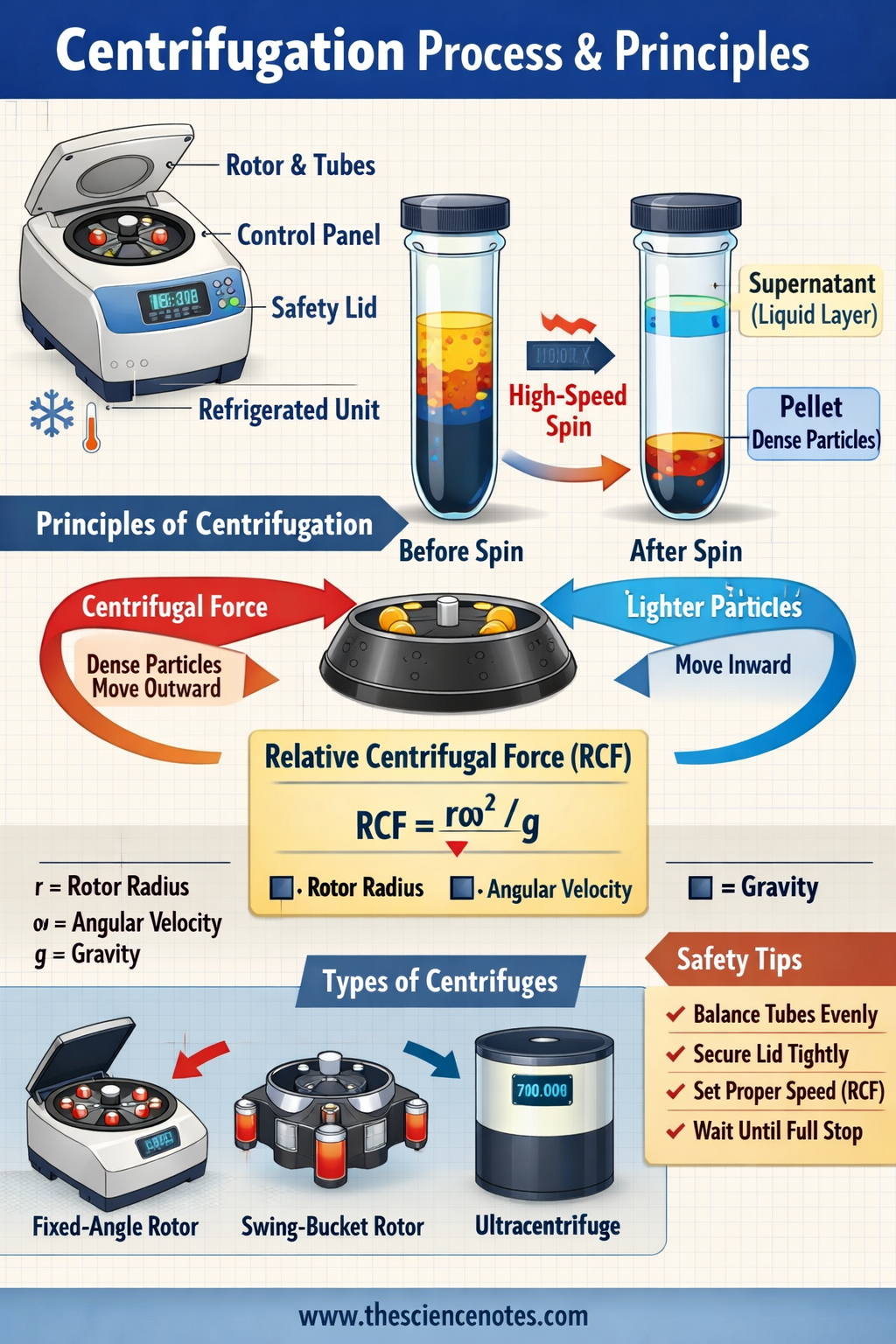
RPM vs RCF: A deeper understanding
Although centrifuges are often used RPM (revolutions per minute)this value can be misleading if interpreted incorrectly.
RPM (revolutions per minute)
-
Measures how fast the rotor spins
-
do it does not directly indicate power
-
Depends strongly on rotor size
RCF (Relative Centrifugal Force)
-
Meter actual force acting on particles
-
Regardless of rotor size
-
Expressed as multiples of gravity (× g)
Why this distinction is critical
Two centrifuges operating at the same speed can produce very different forces because:
👉 Example:
A centrifuge with a large rotor at 5,000 RPM can exert the same force as a smaller rotor at 10,000 RPM.
Practical tip
Most modern centrifuges include:
These tools help researchers avoid manual calculations and ensure accurate experimental conditions.
Components of a centrifuge (in depth)
Understanding the components of a centrifuge helps users operate it efficiently and safely.
1. Rotor
The rotor is the most critical component:
Rotors can vary in:
2. Spindle (drive shaft)
-
Connects the rotor to the motor
-
Transfers rotational energy
-
Ensures smooth and stable spinning
3. Lid and safety lock
-
Prevents accidental opening during operation
-
Protects users from high velocity debris
-
Often includes automatic locking systems
4. Control panel
Modern centrifuges include digital interfaces that allow precise control of:
5. Cooling system
Temperature control is essential for sensitive samples:
-
Prevents protein breakdown
-
Maintains enzyme activity
-
Important for molecular biology applications
Step-by-step centrifugation procedure
1. Sample preparation
Before centrifugation:
-
Label the pipes clearly to avoid confusion
-
Ensure that sample volumes are equal whenever possible
-
Check tube compatibility with rotor type
2. Balancing the centrifuge (critical step)
Balancing is important because centrifuges generate extreme kinetic energy.
Correct balancing involves:
-
Place tubes of equal weight opposite each other
-
By using a counterweight tube filled with water or buffer if necessary
-
Arrange multiple pipes symmetrically (e.g. triangle formation for three pipes)
⚠️ Consequences of imbalance:
3. Loading the rotor
4. Setting of parameters
Enter appropriate values based on your protocol:
5. Run the centrifuge
If abnormalities occur:
6. Complete the drive
When the centrifuge stops:
7. Treatment after centrifugation
After separation:
-
Pellets: Contains the desired material (cells, proteins, etc.)
-
Supernatant: Contains soluble components
Methods for removing the supernatant:
8. Resuspension and washing
Resuspension involves:
Repeated centrifugation + resuspension step is called:
👉 Cell wash
This is widely used for:
Types of centrifuges
1. Fixed angle rotor centrifuge
Advantages:
Applications:
-
Cell harvesting
-
Protein precipitation
2. Swing-Bucket Rotor Centrifuge
Advantages:
Applications:
3. Ultracentrifuge
-
Extremely high speeds (>70,000 RPM)
-
Generates very high RCF values
Advantages:
Applications:
-
DNA/RNA isolation
-
Virus cleaning
-
Organelle separation
⚠️ Requires specialized training and strict safety protocols.
Applications for centrifugation
Biomedical research
Clinical diagnostics
Molecular biology
-
DNA, RNA and protein purification
-
Preparation of samples for PCR and sequencing
Microbiology
Biochemistry
-
Enzyme analysis
-
Protein fractionation
Safety rules
To ensure safe operation:
-
Always balance samples accurately
-
Inspect the rotor for cracks or damage
-
Use proper pipes rated for speed
-
Do not exceed the manufacturer’s limits
-
Keep the lid closed during operation
-
Avoid opening the centrifuge before it has completely stopped
-
Use appropriate PPE (gloves, lab coat)
Common mistakes to avoid
-
Using RPM instead of RCF error
-
Incorrect balancing
-
Pipe overflow
-
Ignores temperature requirements
-
Use of damaged rotors
-
Removes tubes too quickly after centrifugation
Conclusion
Centrifugation is an indispensable technique that underpins a wide range of scientific and clinical applications. By using centrifugal force, it enables the rapid and efficient separation of complex mixtures into their individual components.
A thorough understanding of:
is essential to achieve accurate, reproducible results.
Whether you are a student, researcher or laboratory professional, mastering centrifugation will significantly improve your experimental success and laboratory efficiency.