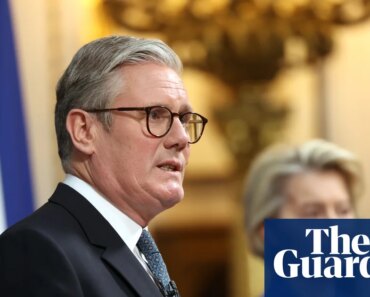
Canada and Australia will be stronger negotiating alongside superpowers, including Donald Trump’s United States, acting as “strategic cousins” rather than competitors, Mark Carney told the Australian federal parliament.
In a major speech in Canberra on the last full day of his visit to Australia, the Canadian prime minister called for greater cooperation on critical minerals, defense and trade and announced that Australia would join the G7 critical minerals alliance, the largest group of democratic countries with significant reserves in the world.
Carney also said he had come to Australia to reaffirm the alliance between Ottawa and Canberra, amid the “global architecture that is now unraveling by consecutive crises.”
Combined, Canada and Australia produce 34% of the world’s lithium reserves, 32% of uranium supply and 41% of iron ore.
“In the old world, and even to some extent today, the temptation has been to see each other as competitors,” he said after a welcome ceremony Thursday morning.
“In this new world, we must be strategic collaborators. To boost investments, accelerate technical cooperation, improve supply chain resilience, expand our domestic processing capabilities, and at the same time boost our strategic autonomy.”
In a speech Wednesday night at Sydney’s Lowy Institute, Carney softened his support for US and Israeli attacks on Iran. He said that while he welcomed the end of Ayatollah Ali Khamenei’s regime, he did not believe the attacks on Iran were legal and that they represented “another example of the failure of the international order.”
Carney said the U.S. and Israeli attacks appeared illegal because they were not carried out with the support of the U.N. Security Council or in the face of an imminent threat.
“They did not consult us about the measures that were taken,” he said. “There was no process, no broader process for it. It would appear, prima facie… to be incompatible with international law.”
Carney has received praise around the world for pushing for renewed middle-power diplomacy, calling time on the rules-based international order and urging countries such as Australia, Japan, India, South Korea and Canada to come together to protect institutions and promote mutual interests.
His speech at the World Economic Forum in Davos in January was seen as the strongest rejection of the Trump administration and other superpowers, including China, urging countries not to lament the post-World War II international structure for too long and instead to pivot to protecting and enhancing national sovereignty.
On Thursday he said Canada and Australia did the right thing by developing defense capabilities, including next-generation drones, surveillance aircraft, cyber and artificial intelligence tools.
As members of the international voluntary peace planning coalition in Ukraine, once the end of the war caused by the Russian invasion is guaranteed, Carney said countries will need to “provide strong security guarantees” to stop the conflict in Europe.
“At the same time, we know we must work with other middle powers to build our sovereign AI capabilities, so that we don’t get caught between hyperscalers and hegemons,” Carney said.
“That’s why Canada is collaborating with like-minded nations in Europe and why we are partnering with Australia and India on a trilateral AI initiative to strengthen our cooperation and sovereign capabilities.”
Australia has maintained strong support for the attacks on Iran, which have led to growing conflict in the Middle East, disruption to the economy and chaos to international travel.
Albanese and Foreign Minister Penny Wong maintain that questions of international law related to the attacks are matters for the United States and Israel.
Carney will hold meetings with Governor-General Sam Mostyn and Opposition Leader Angus Taylor in Canberra. He is also scheduled to hold a joint press conference with Albanese on Thursday.
He said Canada and Australia “are nations still in the making.”
“The important work of reconciliation with indigenous peoples continues, we continue to strive so that everyone has equal opportunities regardless of gender, race, sexual orientation or starting point in life.
“This work is not a sign of weakness; rather, it is a product of a confidence that honestly recognizes when we fail and strives tirelessly to do better.”