Overview
The Bunsen burner is one of the most recognizable and widely used instruments in modern laboratories. Named after Robert Bunsenwho co-designed it in 1854, this laboratory tool produces a warm, soot-free and non-luminous flame which can be precisely tuned for a wide range of experimental applications. The design allows careful mixing of gas and oxygen in the central barrel before combustion, allowing users to regulate temperature, size and intensity of the flame with high precision.
The Bunsen burner is indispensable in laboratories for heating chemicals, sterilizing instruments, and even performing certain delicate manipulations of glass or metal. A particularly important application is to create a convection currentwhich lift airborne particles away from experimental areas. This effect is critical to maintain a sterile work areaespecially in microbiology, cell culture or molecular biology experiments.
But because the Bunsen burner produces a open flameit requires strict adherence to security protocols. Before use, laboratory personnel must ensure that all loose hair, clothing or accessories are secured and that fire safety equipmentsuch as fire extinguishers or fire blankets, are readily available. With careful attention to setup, operation and safety, the Bunsen burner is a reliable, efficient and essential laboratory instrument.
Components of a bunsen burner
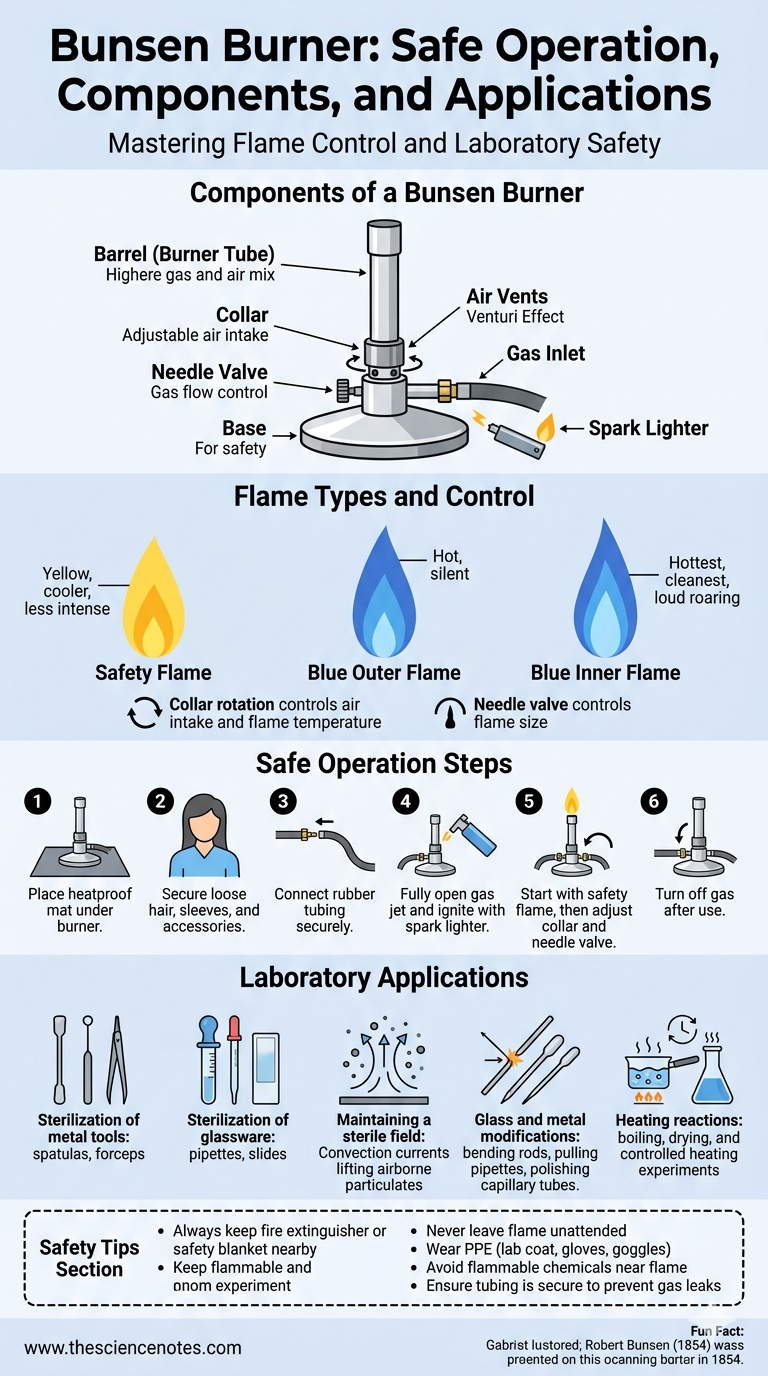
A typical bunsen burner consists of several critical components which together ensure safe and controlled operation:
-
Barrel (burner tube):
The barrel is the vertical pipe there air and gas mixture before combustion. The design of the barrel allows the user to control the characteristics of the flame based on airflow and gas supply. A properly adjusted flame is both warm and cleanwithout producing smoke or soot. -
Collar:
Located at the bottom of the barrel, the collar regulates air intakewhich directly affects the temperature of the flame. Rotating the collar counter-clockwise opens the air valves, allowing more oxygen into the mixture, resulting in a hotter, blue flame. Rotating clockwise closes the valves, producing a cooler yellow safety flame. -
Air valves and the Venturi effect:
The Bunsen burner uses Venturi effect to draw air into the barrel through collar openings. This happens because reducing the air pressure inside the tube draws ambient air into the barrel, ensuring proper combustion. -
Needle (gas flow) valve:
The needle valve controls flow of gas from the gas intake. By adjusting this valve, users can fine tune the size and intensity of the flameworks in tandem with the collar to achieve optimal combustion. -
Base:
The torch’s base provides stability and remains cool during operation, enabling safe handling and moving of the instrument. -
Gas inlet and hose:
The gas inlet connects the burner to a gas source through rubber tubes. Properly secured tubing is essential to prevent leaks and maintain safety. -
Ignition source:
A spark lighter or striker is usually used to ignite the gas-air mixture. Using a reliable ignition source minimizes the risk and ensures immediate flame formation.
How to use a bunsen burner safely
Use of a Bunsen burner requires careful attention for both setup and operational reliability:
-
Setup:
-
Place a heat resistant mat under the burner to protect the work surface and catch sparks.
-
Place the burner at least 12 inches from overhead shelving or equipment.
-
Secure loose hair, sleeves or accessories and make sure safety equipment is nearby.
-
-
Connect the gas supply:
-
Ignition:
-
Open the gas jet fully.
-
Use a spark lighter to light the burner.
-
With the collar completely closed, a yellow “safety flame” is displayed. This cooling flame is used as a visual indicator that the burner is on, although it is not suitable for heating experiments.
-
-
Adjusting the flame:
-
Turn the collar counterclockwise to open the air vents.
-
Two different flames appear:
-
Blue Outer Flame: Warmer, quieter and harder to see.
-
Blue Inner Flame: Hottest and cleanest, with a characteristic “roaring” sound.
-
-
Adjust the needle valve to increase or decrease the flame size as needed.
-
-
Turns off:
Applications of the Bunsen burner in the laboratory
The versatility of the Bunsen burner allows for a wide range of laboratory applications:
1. Sterilization
-
Metal instruments: In microbiology, inoculation loops, metal spatulas, scissors and forceps are often ignited between samples.
-
Glass instruments: Glassware such as serological pipettes can be briefly passed through the flame to remove contaminants.
-
Flame sterilization is also maintained sterile openingslift airborne particles away via convection currents.
2. Heating experiments
-
Provides precise heat for reactions that require controlled temperature.
-
Allows cooking, drying and other heat-dependent procedures.
3. Microscopy preparation
4. Modification of tools in glass and metal
-
Thin glass rods can be heated and bent to create bacteria spreaders.
-
Bunsen flames allow for pulling, bending or polishing pipettes.
-
Glass dissecting needles or sealed thread picks can be made by heating and shaping materials over the flame.
5. Maintain sterile work areas
-
The flame’s convection current holds experimental containers free of airborne contaminants.
-
Useful in cell culture, molecular biology and microbiological experiments to maintain sterility around reagents and equipment.
Advanced tips for optimal use
-
Always start with collar fully closed to light a safety flame.
-
Use Venturi effect to your advantage by gradually opening vents for hotter, cleaner flames.
-
Avoid placing flammable materials near the burner.
-
Never leave a flame without supervisioneven cards.
-
Adjust both parts needle valve and collar for precise control during experiments.
-
Always allow instruments cool after flaming to prevent burns or injury.
Security considerations
Safe operation of a Bunsen burner is critical:
-
Keep fire safety equipment nearby.
-
Monitor the flame at all times.
-
Use correctly PPEincluding lab coats, gloves and goggles.
-
Make sure the hose connections are solid to prevent gas leaks.
-
Be aware of flammable chemicals near the flame.
-
Always turn off the gas supply at the end of use.
Conclusion
The Bunsen burner is an essential tool in laboratories worldwide, offering precision, versatility and the ability to maintain sterile work environments. Got it components, flame types, operating techniques and safety measures is critical for both beginners and experienced laboratory personnel. From sterilization and heating to glass modification and microscopy preparation, the Bunsen burner remains a cornerstone of laboratory experimentation. Mastery of this instrument not only increases efficiency but also ensures one safe and controlled laboratory environment.