The Bank of England (BoE) has signaled a softening of its regulatory approach to the sterling stablecoin after facing backlash from lawmakers and industry leaders over certain proposed policies.
BoE Reconsiders Proposal to Regulate Stablecoin
On Wednesday, Bank of England deputy governor Sarah Breeden confirmed the financial authority was “really open” to reviewing its firm proposals, including the ownership cap and 60:40 asset-backing split, which were published for public consultation in late 2025.
In this context, the financial regulator has proposed to temporarily limit the ownership of stablecoins in order to “reduce risks to financial stability arising from a large and rapid outflow of deposits from the banking sector.”
According to the November consultation document, the limit would be set at £10,000 to £20,000 for individuals and £10 million for businesses, reflecting its proposed approach to the digital pound.
In addition, the BoE proposed that systemic stablecoin issuers would be required to hold at least 40% of stable reserves as non-remunerative deposits with the central bank, aiming to ensure “stable reassurance and public confidence, even in times of stress.”
During a meeting with the House of Lords Financial Services Regulation Committee, Breden said the BoE was open to alternative approaches that could achieve its financial stability objective without relying on its controversial proposals.
According to recent reports, the central bank has “suggested restrictions as a way to manage this risk.” Braden told the House of Lords committee that they were “open to ideas about other ways of achieving that.”
He also revealed that the BoE will examine whether the 60:40 asset split supported by stablecoins is “too conservative”. However, he argued that the structure is broadly consistent with measures proposed in the United States and has already been adopted in the European Union (EU).
Industry pressure is “very real”.
Breeden reportedly acknowledged the technical challenges of introducing a stablecoin cap, but defended the central bank’s proposed rules, saying the caps “support an orderly transition to reshape the system.”
Benoit Marzouk, CEO of Tokenised GBP, the issuer of one of the few stablecoins denominated in sterling, told Bloomberg that there is a “really small” window to get the policy right. “If we have this limit for both retail and companies, it could be really damaging for Britain,” he said, adding: “As a business, you can’t do much with £10m.”
Meanwhile, Tom Rhodes, CLO at Agant, a company planning to float the sterling stablecoin, argued that keeping track of who holds the tokens would be a “huge administrative burden” for issuers.
The deputy governor also acknowledged the industry’s response, confirming that the pressure is “very real”. Although he stated that the central bank has not yet received “the constructive cooperation in other ways to solve the problem that I would have hoped for.”
As reported by Bitcoinist, a coalition of British lawmakers has opposed the BoE’s stablecoin policies, which could undermine the government’s efforts to position Britain as a leading country in digital assets.
In a letter to Chancellor Rachel Reeves, members of the House of Lords, House of Commons and peers argued that the financial regulator’s proposal to limit ownership of stablecoins could prevent the UK from taking full advantage of opportunities, drive innovation offshore and drive investors to US dollar-denominated alternatives, while potentially eroding the UK’s position.
Similarly, local crypto industry groups asserted that the minimum stablecoin proposal was a “step in the wrong direction” and called on the Bank of England to scrap it last year.
Breeden announced that the central bank will release draft rules for public consultation in June. The bank aims to complete the regulations by the end of the year to meet global regulatory standards.
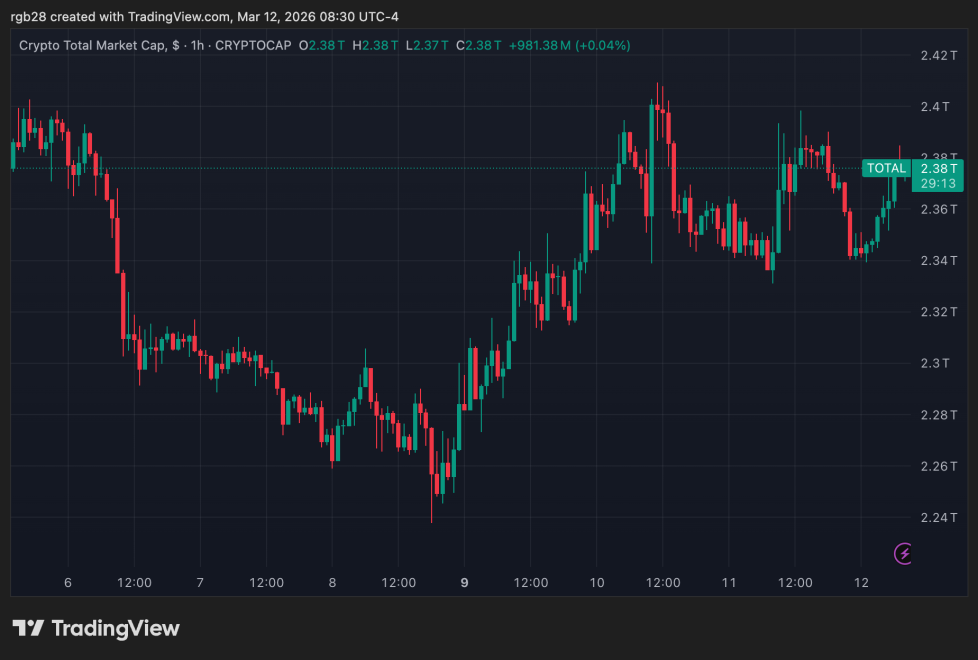
The total crypto market capitalization sits at $2.38 trillion on the one-week chart. Source: TOTAL on TradingView
Featured image from Unsplash.com, Chart from TradingView.com
Editing process because bitcoinist is committed to delivering thoroughly researched, accurate and unbiased content. We adhere to strict sourcing standards and every page is rigorously reviewed by a team of top technology experts and experienced editors. This process ensures the integrity, relevance and value of our content to our readers.