Bitcoin is showing tentative signs of stability after it bounced back from $74,000, but Glassnode says the recovery does not yet have the components of a decisive turn. In the March 9 Market Pulse week, the analyst firm described a market that is improving at the margin, even as spot participation, capital flows and broad sentiment remain.
Glassnode’s comment is cautiously constructive, but only up to a point. The firm wrote, “ETF activity remains an area of relative strength. Net inflows accelerated and trading volume increased.” However, in the same breath, it emphasized that “in general, conditions are stabilizing”, while “capital flows remain soft”, a framework that contains the central tension of the report: some domestic components are recovering, but the market still looks fragile, not fully re-energized.
Glassnode sees Bitcoin market stabilizing
This volatility is most evident in the spot markets. Glassnode said the 14-day RSI rose from 45.2 to 47.7, a moderate improvement in momentum that points to stronger buyer activity without suggesting the move is overheated. But more important point signals have moved in the other direction. Spot CVD fell to negative $97.6 million from negative $84.4 million, indicating stronger selling pressure from aggressive traders, while spot volume fell to $9.1 billion from $9.8 billion. The report says participants are showing less urgency as they expect stronger direction, leaving sellers to play a bigger role in price discovery.
Related reading
Derivatives paint a more complex picture. Futures open interest rose 5.1% to $29.4 billion, indicating that leverage and speculative engagement are recovering, while perpetual CVD rose 201.7% to $172.6 million, indicating aggressive buying activity in tight markets. At the same time, funding fell sharply to negative $391,700, falling below Glassnode’s statistical lows and indicating stronger demand for short exposures. In other words, leveraged traders are active, but they are not directional.
Options markets, by contrast, were less defensive. Open interest increased from $32.8 billion to $34.1 billion, the volatility spread decreased from negative 25.78% to negative 17.64%, and the 25-delta skew decreased from 16.51% to 11.72%. Glassnode’s interpretation was that fear is moderate and demand for downside protection has eased, leaving the options position more balanced than a week ago.
Related reading
The clearest area of strength remains the US ETF complex. Weekly net inflows increased from $776 million to $934 million, while trading volume increased from $16.0 billion to $23.1 billion. But even there, the signal is not clear. ETF MVRV fell from 1.07 to negative 0.53, pushing the average ETF owner under water. Glassnode said the change “comes with capitulation-like conditions” and suggests that institutional-style demand is still coming in, even as existing positions remain under pressure.
Chain data tells a similar story of stabilization with no new heat. Active addresses fell 2.0% to 649.3K and payment volume fell 5.1% to $170.5K, both signs of a quieter network environment, even as transaction volume rose 23.7% to $5.9 billion. Cap volatility improved from negative 2.4% to negative 1.9%, indicating outflows are slowing, but the share of hot capital fell to 23.3%, well below statistical lows. This points to a market still dominated by old capital, with little evidence of new speculative rigging.
Profitability indicators improved slightly with the offering in profit from 54.6% to 56.8%, NUPL improved from negative 31.9% to negative 26.7% and P/L ratio increased from negative 0.8 to negative 0.7. This relieves some of the pressure caused by the descent.
Still, it’s hard to miss Glassnode’s broader message: Bitcoin’s market structure looks more stable than it did a week ago, but until spot demand is factored in, the recovery remains more predictable than convincing.
At press time, Bitcoin was at $70,755.
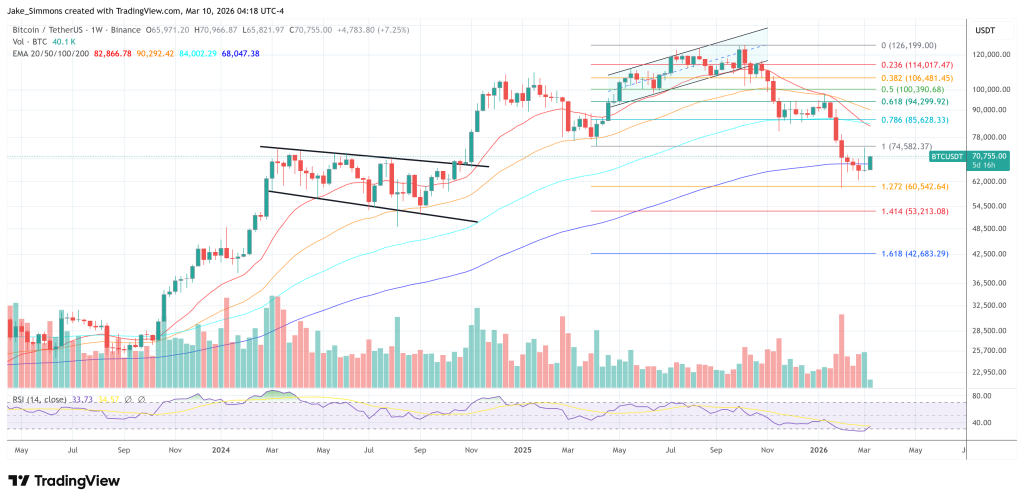
Featured image created with DALL.E, chart from TradingView.com