On Thursday, the price of AVAX settled near a key level as the market reacted to the launch of a new exchange-traded fund linked to the token.
Conclusion
- When Grayscale’s Avalanche ETF began trading, AVAX traded near its weekly high.
- The new product gives traditional investors exposure to Avalanche and its rewards.
- Traders are watching the $10 level, which has acted as a strong resistance zone.
At press time, Avalanche (AVAX) was trading at $9.58, down about 0.8% over the past 24 hours. The token has moved from $8.82 to $9.87 over the past week and is now near the top of that range.
In the past month, AVAX has gained about 8.8% as buyers try to push the price even higher. However, the token is about 47% lower than a year ago after a long slide that hit much of the crypto market.
In the last day, activity in the derivatives market cooled down a bit. CoinGlass data shows futures volume fell 26% to $489 million, while open interest fell 4.41% to $432 million.
When both numbers fall at the same time, it often means that some traders are closing positions while others are waiting for the next move.
Grayscale Avalanche ETF begins trading
The market is reacting to the new product of Grayscale Investments. The Grayscale Avalanche Staking ETF, trading under the ticker GAVA, began trading on the Nasdaq on March 12.
The fund first appeared as Grayscale Avalanche Trust in August 2024. At the time, it was only available through a private placement to accredited investors. After filing with US regulators in 2025, the product was converted to a publicly traded product.
The ETF began trading with a net asset value of $23.33 per share and approximately $5.55 million in assets under management. It tracks the price of AVAX as well as factors that earn rewards from the network. In 2025, stacking on Avalanche has returned an average of about 7%, which is now reflected in the fund structure.
Products like this often attract new attention because they allow investors to gain through traditional markets. Whether the ETF attracts large inflows will likely determine how much it affects AVAX’s price.
Technical analysis of AVAX prices
On the chart, AVAX is slowly moving towards $10, which acted as a strong barrier during the previous rallies. The price is now close to the upper Bollinger band near $9.8-$10 and traders are watching to see if it can break above this area.
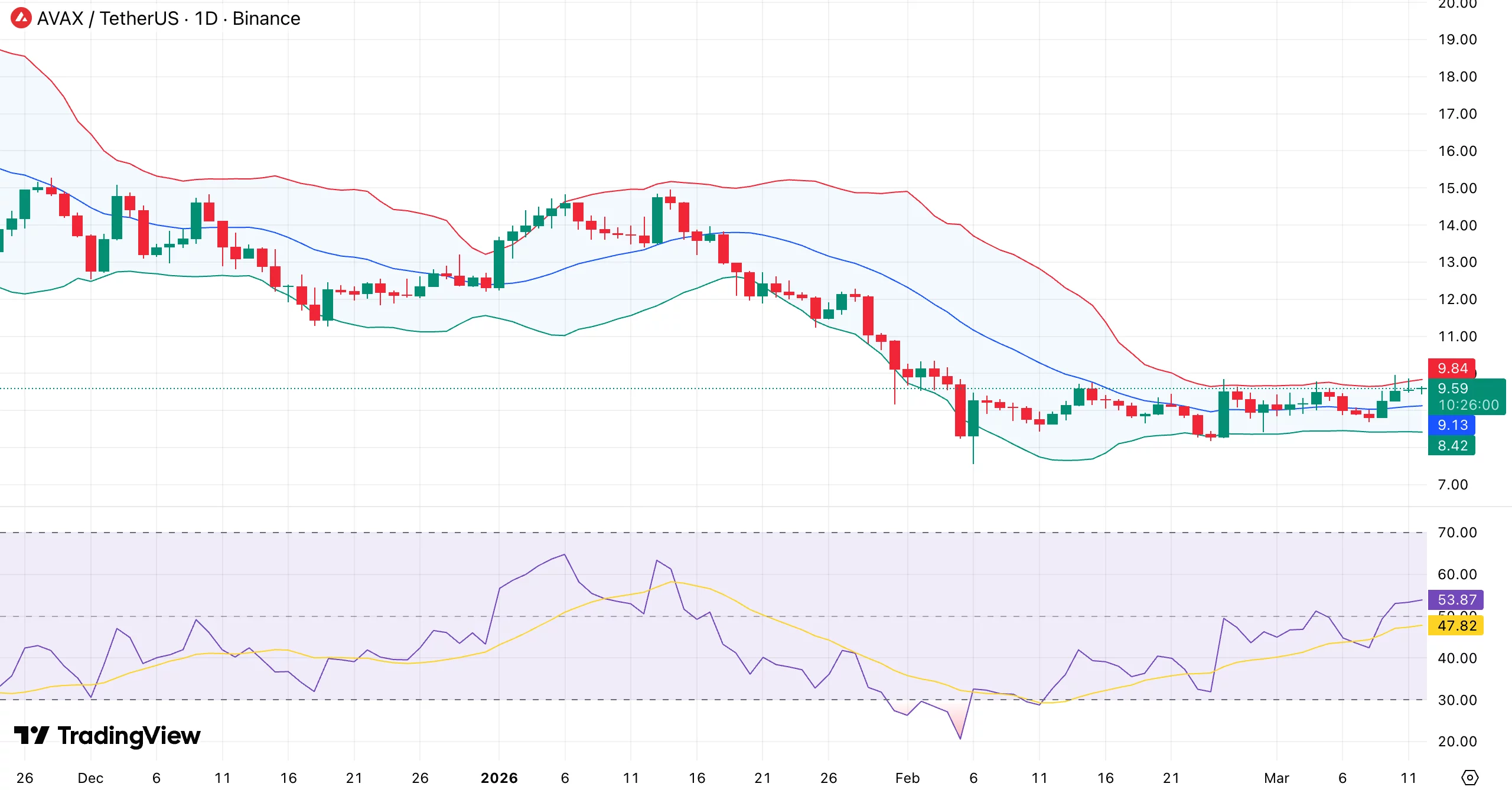
Volatility has eased over the past few days as the Bollinger Bands converge. This type of setup often occurs before a larger move, when the price finally breaks out of the range.
AVAX also bounced back from its 20-day moving average near $9.1-$9.2. This level was held during recent pullbacks, with buyers entering each time the price approached it.
The momentum has also improved. Slightly above the neutral zone, the relative strength index is currently at 53. Since this indicator is not yet in overbought territory, price movement is possible if buying pressure remains.
Beginning in early February, the chart also began to show lows, a pattern that often occurs when buyers build positions.
Support is near $9.10 – $9.20, while a deeper pullback could test the $8.40 – $8.50 area. At the moment, entry-level traders are focused on the $10. A daily close above this line would be the first strong sign that AVAX could be headed higher after months of decline.