The US-Israeli attack on Iran is aimed at resolving a 24-year standoff over Tehran’s nuclear program but risks backfiring and leading the regime to build a secret bomb, proliferation experts have warned.
The regime in Tehran has long insisted that the program is for civilian purposes and that it has no intention of making a nuclear weapon. However, since two undeclared sites for uranium enrichment and heavy water plutonium production were discovered in 2002, the program has been treated with intense suspicion.
A nuclear deal in 2015 imposed harsh limits and extensive inspections on Iran, but when Donald Trump abandoned the deal in 2018, leading to its collapse, Iran stepped up its work on enrichment and other aspects of the program.
What is most worrying for the international community is that last summer Iran had produced a reserve of just over 440 kg of highly enriched uranium (HEU), with a purity of 60%. In terms of technical difficulty, once 60% is reached, it is a relatively easy step to get to 90%: weapons-grade uranium that can be used to make a compact warhead.
With further enrichment and conversion of uranium from gas to metal, Iran’s 440kg reserves would be enough to make more than 10 warheads.
Anxiety over this arsenal, built up since the torpedoing of the 2015 nuclear deal, was the reason for the US and Israeli attacks on Iran last June. The United States’ role, Operation Midnight Hammer, focused on dropping bunker-buster bombs on Iran’s nuclear sites.
Trump claimed that the bombing had “destroyed” the nuclear program, but it soon became clear that this was not true. The bombs had caused extensive damage, but deep underground sites, dug under mountains in two places in particular, Isfahan and Natanz, could not be destroyed.
In response to the attacks, Iran excluded UN inspectors from the International Atomic Energy Agency (IAEA) from those and other sensitive sites, with the result that the watchdog lost track of what happened to the 440kg stockpile of HEU and what was being done in the deep tunnels at Isfahan and Natanz.
In its latest report, the IAEA admitted it could not verify whether Iran had suspended all enrichment-related activities or the size of its uranium stockpile at the affected nuclear facilities.
Despite this uncertainty, IAEA Director General Rafael Grossi stated on Monday that “we do not see a structured program to manufacture nuclear weapons.”
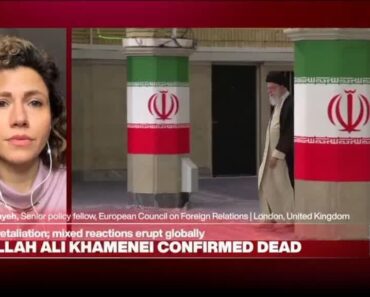
However, nuclear proliferation experts fear that could change following an attack aimed at destroying the regime that has ruled Iran for 47 years and the assassination of its supreme leader, Ali Khamenei, who had issued a religious edict, a fatwa, against building a bomb.
“That’s what makes this such a tremendous roll of the dice,” said Jeffrey Lewis, a distinguished scholar of global security at Monterey’s Middlebury Institute of International Studies. “Because if the attack fails to bring down a regime, there are thousands of people left in Iran who are capable of reconstituting a program like this.”
Lewis added: “The technology itself is decades old, and a vengeful Iran that survives this attack will likely come to the same conclusion that North Korea did: that the world that exists with the United States is dangerous and that it is better to go nuclear.”
Kelsey Davenport, director of nonproliferation policy at the Arms Control Association, agreed that after the attack there would be greater motivation within the remnants of the regime “pushing Iran toward weaponization no matter how this conflict ends, because of the nature in which it began.”
Davenport noted that if the regime collapsed or a civil war broke out, the fate of Iran’s HEU reserves would become a major global issue.
“If we end up in a scenario where we have a regime implosion, where Iran becomes so destabilized internally that there is a real risk that material will be diverted, that it will be stolen… there will be a lot of pressure on the United States to put troops on the ground,” Davenport said.
“There is a real risk of nuclear terrorism to Trump’s goal of regime change that I have not heard the administration acknowledge.”