Two NASA astronauts prepared the International Space Station (ISS) to add a new solar panel on the first US spacewalk in nearly a year.
Expedition 74 crew members Jessica Meir and Chris Williams ventured outside the space station’s Quest airlock at 8:52 a.m. EDT (1252 GMT) Wednesday (March 18) to install a mount for an advanced power-generating solar array. The pair worked on the left (or port) side of the space station’s spine, where they first assembled and then attached the bracket structure that will support an ISS Roll-Out Array (iROSA), which will be installed on a future spacewalk.
The article continues below
The space station’s original solar panels have been degraded, having exceeded their 15-year lifespan. When all are in place, the new iROSAs will increase the circuit lab’s power supply by 20% to 30%.
Its use on the ISS also paved the way for NASA to use the technology for space travel, including the Double Asteroid Redirection Test (DARTS) mission that demonstrated a method for planetary defense by changing the orbit of a small asteroid in 2022. NASA has also planned to deploy solar panels on its Gateway lunar orbiting space station, but it appears the outpost may be canceled.
The additional power on the ISS will help support expanded commercial activities and the upcoming transition from the ISS to commercially operated space stations.
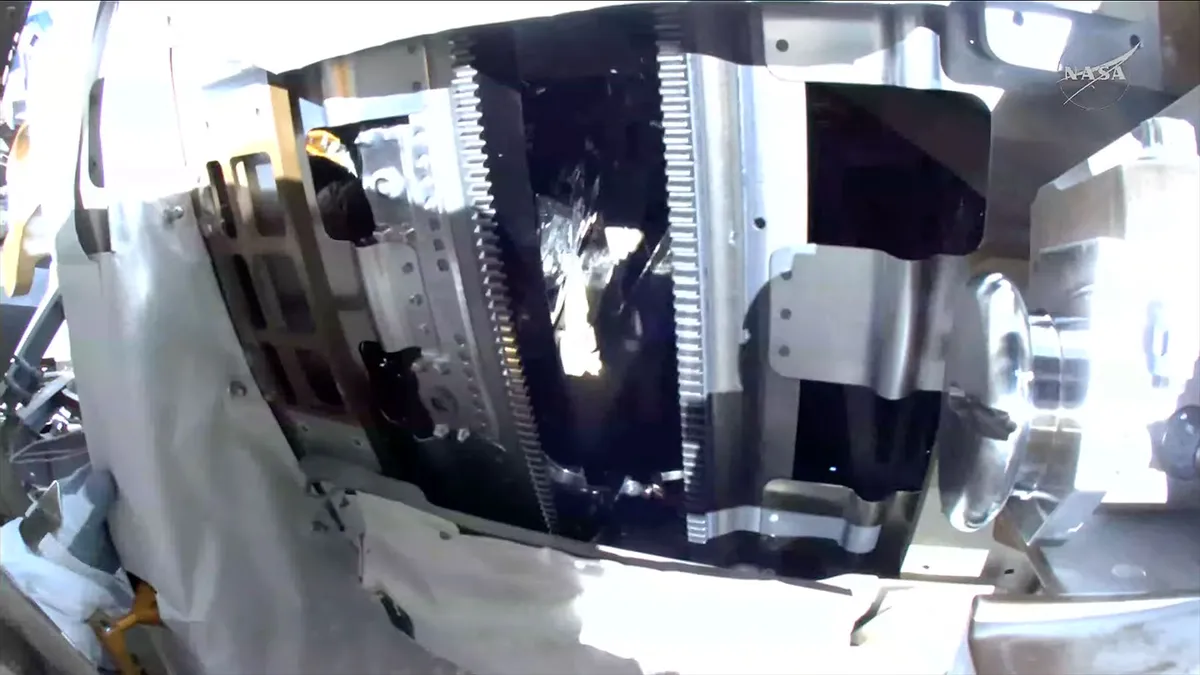
After completing work on the iROSA modification kit about five hours into the EVA, Williams moved over to photo-document the port-side SARJ, or solar rotary joint, gears that allow the attached wings to track the sun. Meir simultaneously worked on installing an electrical jumper to enable robotic servicing of the components that make up the 2A power channel.
Meir and Williams then cleaned up their respective work areas and stowed equipment they had used before reentering the Quest airlock.
Citing the limited amount of time remaining—the spacewalk was scheduled to last approximately 6.5 hours—EVA managers in Mission Control postponed the planned swabbing of the exterior of the space station for microorganisms and the installation of a lens cover on a camera on the Canadarm2 robotic arm to a future excursion. Neither of the two tasks was considered mission-critical.
Wednesday’s spacewalk ended at 3:54 p.m. EDT (1954 GMT), 7 hours and 2 minutes after it began.
“Well done!” Meir said to Williams just before re-entering the station’s hatch.
“It was a lot of work and a lot of fun,” Williams replied.
NASA had originally planned for the iROSA kit to be installed during an EVA in May 2025, but that was postponed in favor of moving an antenna. NASA then planned for the same task to be performed during a spacewalk in January, but one of the then-assigned spacewalkers, Mike Finckehad an undisclosed medical problem that required the excursion to be canceled and he and his crewmates back to Earth a month early.
This was William’s first spacewalk and Meir’s fourth. She has now logged 28 hours and 46 minutes working outside in the vacuum of space, including being part of the world’s first female EVA in 2019.
“Today, March 18, marks exactly 61 years since Alexei Leonov became the very first human to walk boldly into the vacuum and darkness of space. Our international efforts in space exploration have evolved considerably since then, but the enormity of venturing outside the hatch of your own mini-spacecraft remains,” Meir said after closing the hatch.
“I can report that my fourth spacewalk feels even more special than my previous ones. That’s because I shared the experience with first-time spacewalker Chris Williams. It’s a tremendous experience to pass the torch to the next generation of explorers who will keep this space station going,” she said.
“Leonov said he felt like a grain of sand in the universea perspective gained from the privilege of looking down on the earth from above, as we did today. Like grains of sand, at least we drift here together. The view is always better when you share it with a friend,” concluded Meir.
Wednesday’s spacewalk was the 278th EVA in support of the assembly, maintenance and upgrade of the International Space Station, totaling 1,760 hours and 28 minutes. It was also the first ISS spacewalk in 2026, the first by Expedition 74, and the first by US astronauts since 1 May 2025when NASA’s Anne McClain and Nichole Ayers ventured outside the orbital laboratory.