Paris — French President Emmanuel Macron is giving a major speech on Monday on France’s nuclear deterrence policy, as his European allies express growing concerns about a possible US withdrawal and Russian threats.
France is the European Union’s only nuclear power and its deterrence doctrine relies on a strictly defensive strategy aimed at safeguarding the country’s “vital interests”. Macron has long maintained that those “vital interests” have a “European dimension”.
Although France is a NATO member, it maintains complete independence over its nuclear forces while contributing to the alliance’s broader deterrence posture. Under the French constitution, the president is the commander-in-chief of the armed forces and the only person who can decide on the potential use of nuclear weapons.
Here’s a look at France’s nuclear capabilities by the numbers:
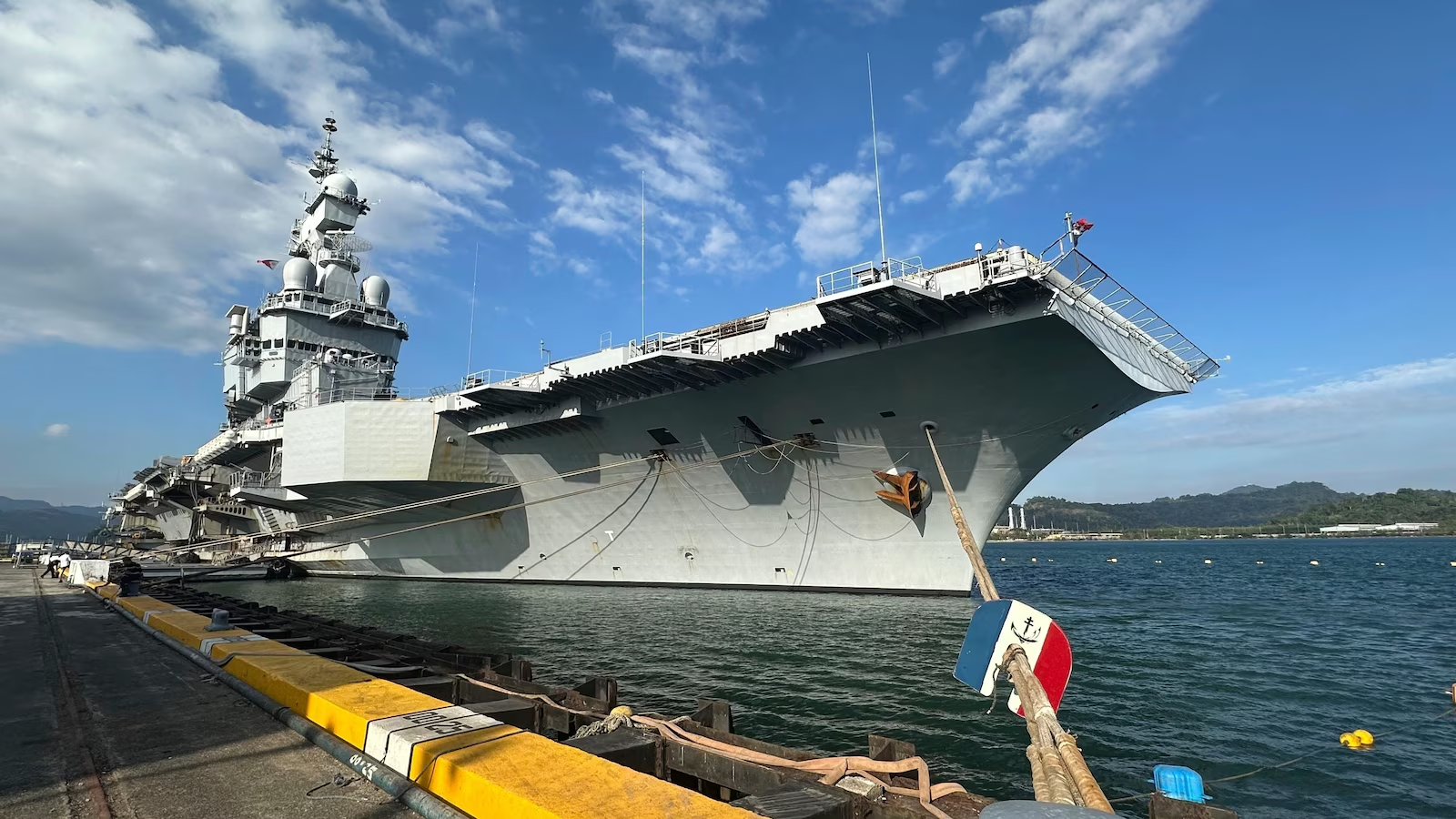
France’s aircraft carrier Charles de Gaulle is the only surface warship in Europe capable of carrying nuclear weapons deployed by Rafale fighter jets using catapult-assisted takeoffs.
The navy flagship has been operating in the North Atlantic and Baltic Sea in recent weeks, most recently docked in the Swedish port of Malmö.
As the carrier undergoes long periodic overhauls, France does not have a permanent sea-based air nuclear capability.
Macron confirmed in December that the country would build a new nuclear-powered aircraft carrier to replace the Charles de Gaulle by 2038.
France has four nuclear-armed submarines: Le Triumfont, Le Temeraire, Le Vigilante and Le Terrible (The Triumphant, The Fearless, The Vigilante and The Terrible).
They are stationed on Isle Long on the Atlantic coast, one of the nation’s most secretive military sites.
Each 138-meter (453-ft) submarine is manned by a crew of about 110 and can carry up to 16 M51 intercontinental ballistic missiles armed with multiple warheads.
Since 1972, at least one nuclear-armed submarine has been on patrol at all times, ensuring France’s permanent ability to carry out a strike.
The ASMPA air-launched cruise missile — short for enhanced medium-range air-to-surface missile — has an estimated range of about 500 kilometers (310 miles).
Launched by Rafale fighter jets, it is designed to act as a final warning before any potential escalation to a large-scale nuclear conflict.
The missiles are operated by the Strategic Air Forces, which was created in 1964 and is based at three sites across France. They can also be launched by jets powered by Charles de Gaulle.
The M51 submarine-launched ballistic missile has an estimated range of 8,000 to 10,000 kilometers (5,000 to 6,200 miles). The exact rank has not been made public.
The upgraded M51 entered operational service in October and has improved accuracy and an enhanced ability to penetrate missile defenses, according to the French Ministry of Defense. Each missile carries multiple independently targetable nuclear warheads.
According to the latest figures released by the Stockholm International Peace Research Institute (SIPRI) and the Federation of American Scientists (FAS), France has an estimated 290 nuclear warheads. According to the Bulletin of the Atomic Scientists, more than 80% of France’s warheads are submarine-launched.
This makes France the fourth largest nuclear power in the world after Russia (more than 4,300 warheads), the United States (about 3,700) and China (about 600). The United Kingdom – no longer an EU member but a NATO ally – is estimated to have around 225 warheads, according to SIPRI and FAS.
All five nations are recognized nuclear-weapon states under the Nuclear Non-Proliferation Treaty.
India, Pakistan and North Korea have all admitted to possessing nuclear weapons. Israel is widely believed to have them but has not publicly confirmed it.
Exact inventory numbers are closely guarded state secrets.
Iran has long insisted that its nuclear program is for peaceful purposes only. But in recent years it has been enriching uranium to 60% purity — near weapons-grade levels of 90%.
The UN nuclear watchdog said it could not verify that Iran had halted all uranium enrichment before US and Israeli forces launched a major attack on Iran in a report seen by The Associated Press on Friday.
(Tags to be translated)War and Conflict(T)Military and Defense(T)Nuclear Weapons(T)Politics(T)World News(T)General News(T)Article(T)130667676