Featured, Global, Headlines, IPS UN: Inside the greenhouse, Nuclear disarmament, Nuclear energy – Nuclear weapons, TerraViva United Nations

US President Barack Obama delivers his first major speech, declaring his commitment to seeking the peace and security of a world without nuclear weapons, in front of thousands of people in Prague, Czech Republic, on April 5, 2009. Credit: Official White House Photo by Pete Souza
– When the Strategic Nuclear Arms Reduction Treaty (START) between the United States and Russia expired last week, it ended a historic era but triggered widespread speculation about the future.
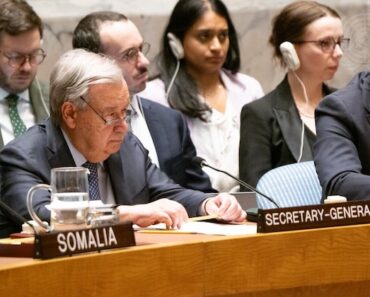
UN Secretary-General Antonio Guterres said that “February 5 was a grave moment for international peace and security.”
For the first time in more than half a century, he noted, “we face a world without binding limits on the strategic nuclear arsenals of the Russian Federation and the United States of America, the two States that possess the overwhelming majority of the world’s nuclear weapons arsenal.”
US President Donald Trump dismissed the treaty’s termination rather sarcastically when he told the New York Times last month: “If it expires, it expires,” and denounced the expiring treaty as “a poorly negotiated agreement.”
“We will make a better deal,” he promised, adding that China, which has one of the world’s fastest-growing nuclear arsenals, “and other parties” should be part of any future treaty.
The Chinese, according to the Times, “have made it clear that they are not interested.”
Currently, the world’s nine nuclear powers are the United States, the United Kingdom, Russia, France and China (all permanent members of the Security Council), as well as India, Pakistan, Israel and North Korea.
Together, they possess approximately 12,100 to 12,500 nuclear warheads, of which Russia and the United States possess almost 90% of the total, while all nine are actively modernizing their arsenals.
Jonathan Granoff, president of the Global Security Institute, told IPS that the START Treaty should be extended by at least one year through formal or informal means. Is that as good as getting a new treaty that includes China like the US administration wants? No.
“Is it as good as complying with legally required steps such as adhering to the unanimous ruling of the International Court of Justice (ICJ) to negotiate the universal elimination of nuclear weapons or fulfilling the promise of nuclear disarmament embodied in Article 6 of the Nuclear Non-Proliferation Treaty (NPT)? No.”
However, Granoff argued, to do nothing is to assert that a modest threat that reduces a step easily gained now should not be taken because there are better ways to move forward. A modest positive step is not an impediment to moving forward in other desired directions.
The complete termination of START communicates to the entire world that the United States and Russia are so diplomatically inept that they cannot be trusted to continue holding the entire world hostage to annihilation by keeping thousands of first-use nuclear weapons over everyone’s heads without adequate reasonable restraint, Granoff said.
The arguments put forward as to why nothing can be done are inadequate.
First, the United States maintains that a new agreement, a new treaty, is needed for China to embrace restraint, he said.
“A modest step of extending START for one year through mutual presidential decrees while new negotiations are underway does not negate the creation of a new treaty that would include China.”
Second, the arguments used to rationalize the new arms race do not consider the folly of producing more precise, usable and powerful nuclear weapons,” Granoff declared.
Guterres noted that the dissolution of decades of achievements could not come at a worse time: the risk of a nuclear weapon being used is the highest in decades.
“However, even in this time of uncertainty, we must look for hope. This is an opportunity to reset and create an arms control regime appropriate to a rapidly evolving context.”
“I welcome the fact that the Presidents of both States have made it clear that they appreciate the destabilizing impact of a nuclear arms race and the need to prevent a return to a world of unbridled nuclear proliferation.
“The world now looks to the Russian Federation and the United States to translate words into action. I urge both States to return to the negotiating table without delay and agree on a successor framework that restores verifiable boundaries, reduces risks and strengthens our common security,” Guterres said.
In a statement released last week, Parliamentarians for Nuclear Non-Proliferation and Disarmament (PNND), a global network of policymakers working to achieve a world free of nuclear weapons, said it is difficult to overstate the importance of the New START treaty.
“As other nuclear treaties have been repealed in recent years, this was the only remaining agreement with treaty notification, inspection, verification and enforcement mechanisms between Russia and the United States. Between them they possess 87% of the world’s nuclear weapons.”
The disappearance of the treaty will mean a definitive and alarming end to the nuclear restriction between the two powers. It is very likely to accelerate the global nuclear arms race, the PNND warned.
This was one of the key reasons why on January 27, 2026, the Bulletin of Atomic Scientists reset the Doomsday Clock to 85 seconds to midnight.
Last year, Senator Markey, co-chair of the PNND, introduced a bill in the US Senate urging the government to negotiate new post-START agreements with Russia and China. The legislation has the support of several other senators and a companion bill in the House of Representatives. But this seems to have fallen on deaf ears in the Trump Administration.
Granoff, in further analysis, told IPS that the scientific data make it clear that a full-scale nuclear war between the United States and Russia would annihilate humanity and that a limited nuclear exchange of less than 2% of the world’s arsenals would spew about five million tons of soot into the stratosphere, causing billions of deaths and the devastation of modern civilization everywhere.
“Realism reveals that the supposed need to double the arsenals of adversary nations is not necessary for deterrence. Realism also reveals that in reality there is little or no significant difference between a nation that has 600 (like China now) or more than 1,400 deployed nuclear weapons, mirroring the United States and Russia, or 30,000 nuclear weapons as Russia and the United States each had at the height of the last arms race.”
“The reality is that global devastation of a small portion of the world’s nuclear arsenals would be unequivocally unacceptable to any sane person. We could say that realism informs us that we have moved from Mutual Assured Destruction (MAD) to Self Assured Destruction (SAD). The fact is that if any of the 9 weapons states used several hundred nuclear weapons, that nation itself would also be devastated. MAD today reveals a new acronym, SAD.”
Meanwhile, a post on the US State Department website says:
Treaty structure: The Treaty between the United States of America and the Russian Federation on Measures for Further Reduction and Limitation of Strategic Offensive Arms, also known as the New START Treaty, enhances the national security of the United States by imposing verifiable limits on all intercontinental-range nuclear weapons deployed by Russia. The United States and the Russian Federation had agreed to extend the treaty until February 4, 2026.
Strategic offensive limits: The New START Treaty entered into force on February 5, 2011. Under the treaty, the United States and the Russian Federation had seven years to comply with the treaty’s core limits on strategic offensive weapons (by February 5, 2018) and are then obligated to maintain those limits for as long as the treaty remains in force.
Added limits
Both the United States and the Russian Federation met the central limits of the New START Treaty on February 5, 2018, and have remained at or below them since then. Those limits are:
- • 700 deployed intercontinental ballistic missiles (ICBMs), submarine-launched ballistic missiles (SLBMs), and nuclear-equipped heavy bombers;
• 1,550 nuclear warheads on deployed ICBMs, deployed SLBMs, and deployed nuclear-armed heavy bombers (each of these heavy bombers counts as one warhead toward this limit);
• 800 deployed and non-deployed nuclear-equipped ICBM launchers, SLBM launchers and heavy bombers.
This article was presented by IPS NORAM, in collaboration with INPS Japan and Soka Gakkai International, with consultative status with the United Nations Economic and Social Council (ECOSOC).
IPS UN Office Report
$images_for_story = ips_images_for_story(); echo $images_for_story; // story photos to display in sidebar ?>