Artificial intelligence is now everywhere in the creative industries: in the hype, in the anxiety, and in the tools themselves. But somewhere between the breathless enthusiasm and the fervent resistance, a more interesting conversation is taking place. A question about what artificial intelligence can actually do in the hands of artists and designers who refuse to take it at face value.
At the Royal Academy, this conversation is producing work that wins international awards, is exhibited at major institutions, and challenges how we think about the role of technology in creative life. Two RCA creatives—one a recent graduate and one a current student—are approaching artificial intelligence from very different perspectives. What they all have in common is a refusal to simply accept the script.
A film built on oblivion
Gregor Petrikovič is a Slovak-British artist and filmmaker who received his MA in Photography from the RCA, where he was a Burberry Design Scholar. His film Sincerely Victor Pike was recently selected for New Contemporaries and won the 2024 Colección SOLO AI Award. The film is built on the audio archive he has collected since 2016: hundreds of hours of conversations with friends and acquaintances, originally recorded to help him cope with chronic memory loss.

These recordings have been saved on old phones for years. “I haven’t seen these documents in years,” he said. “It wasn’t until I collected all my old phones and moved everything into a folder that I realized: This is totally overwhelming.”
Artificial intelligence entered the project not as a creative vision but as a practical solution. Gregor used it to transcribe audio and found himself staring at what looked like movie scripts; the files were filled with intimate, funny, and sometimes profound exchanges between people he had never met but who coexisted in his memory.
Since then, he has turned to artificial intelligence-generated visuals to bring materials to life, and was drawn to the glitchy, dreamlike quality of early generated images, which reflected how memory actually works. Over 25 years, his memory became fragmented due to undiagnosed long-term sleep problems. He explains that his brain tends to create “placeholders” for things he doesn’t remember; its own generative process.
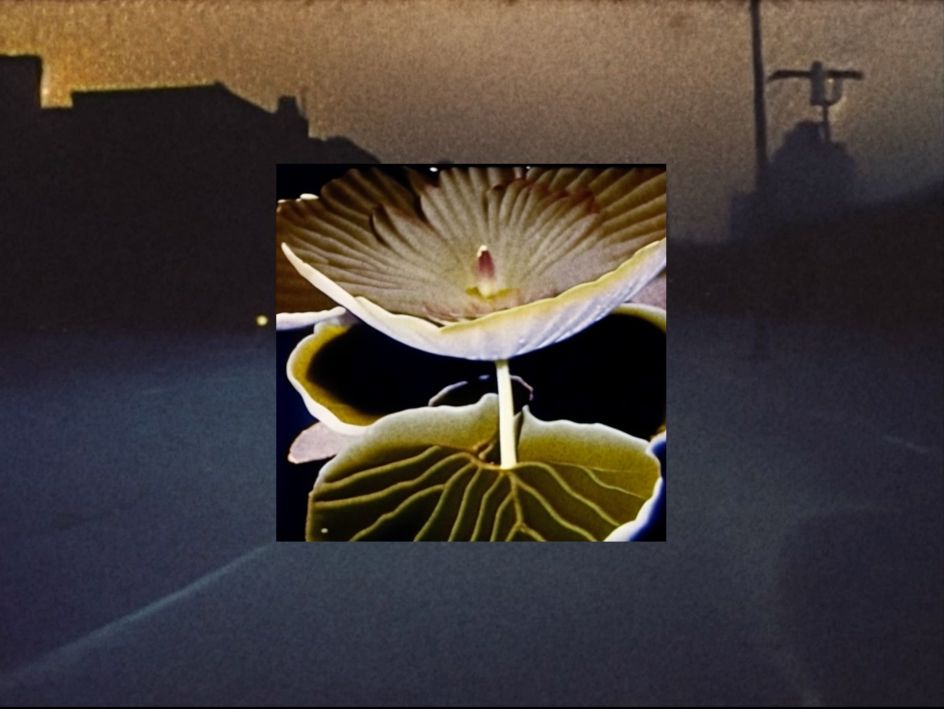


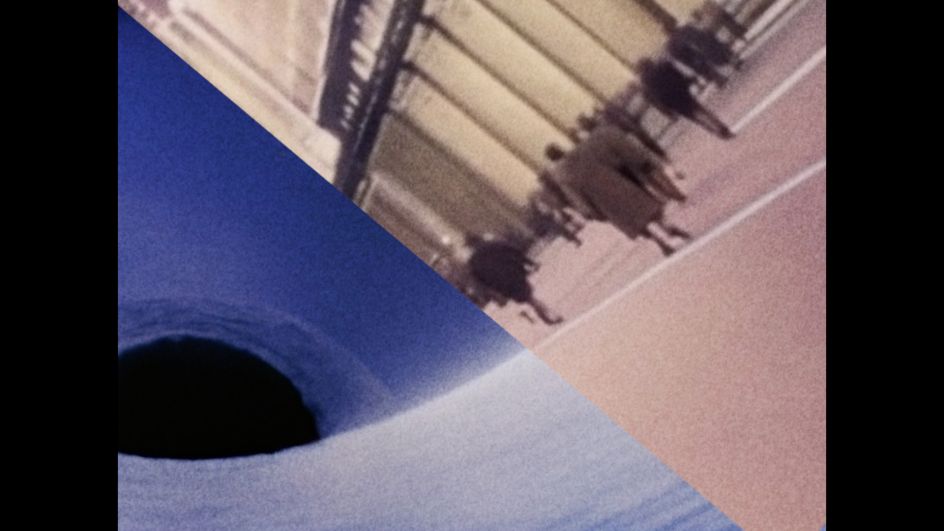
The result is a film that uses artificial intelligence but doesn’t celebrate it. Gregor fed his voiceover into the software, but interestingly, most of the time, the AI didn’t understand it at all. “It couldn’t understand the nuances of metaphor, poetry, or spoken language,” he recalls. “That was a huge realization for me: This project is about things that artificial intelligence can’t capture.”
He describes Sincerely as a “sentimental counter-practice to big data.” While surveillance technology flattens us and sells us stuff, his recordings do the exact opposite. They preserve small, funny, irreducibly human moments. “When you strip everything away and find it’s just a sound, you get all these little bits of personality and emotion emerging,” he said. “These technologies aren’t going away, but I want to figure out how to use them to actually feel something. Connection isn’t the reason these tools are built, but I think as artists, that’s what we should be using them for.”
rewrite narrative
Ramla Anshur has been entering the field of artificial intelligence from a completely different direction. She is currently a part-time student in the MDes Design Futures program and also works as an experience designer at Accenture. Her research focuses on a deceptively simple question: When communities typically by Can artificial intelligence shape it?

Her interest was sparked not by theory but by practice. As a conversational designer, she helps train natural language processing models for citizen-facing voice bots. The team quickly reached the limits of its data capture capabilities. “We are unable to take into account the range of accents, any speech impairments and the range of accessibility needs of service users,” she explains. “If models are not intentionally trained based on these differences, the consequences for an already vulnerable population will be dire.”
This experience, coupled with a design retreat that made her rethink what “success” means in technology (questioning the dominance of efficiency, speed, and profit as default metrics) prompted her to ask a bigger question. “This has sparked interest in examining what the future of alternative technologies might look like when minority groups design and manage these technologies according to their values, culture and forms of knowledge,” she said.
Ramla recently co-authored a research paper proposing a taxonomy of responses to the narrative of AI inevitability: AI adoption, driven heavily by the tech industry, is a destiny we must adapt to. This article outlines four approaches: resistance, refusal, recycling and reimagining. Essentially, it’s a framework for anyone who wants to fight back.
She spoke candidly about the pressures facing creatives in 2026. “The AI narrative is seen as an inevitable future and we have to seize this if we don’t want to be left behind,” she said. But Ramla has been tracking public reaction to AI-generated content and found that the situation is more complicated than the hype suggests. “Most people’s reaction has been one of rejection, disgust and disappointment. Many artists have begun labeling their work ‘artificial’.” The need for human artists and design remains necessary. “
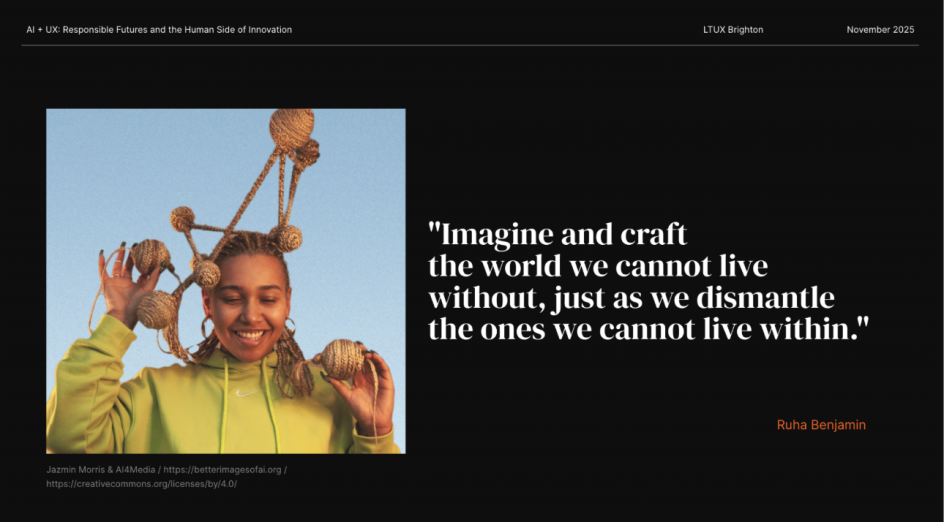

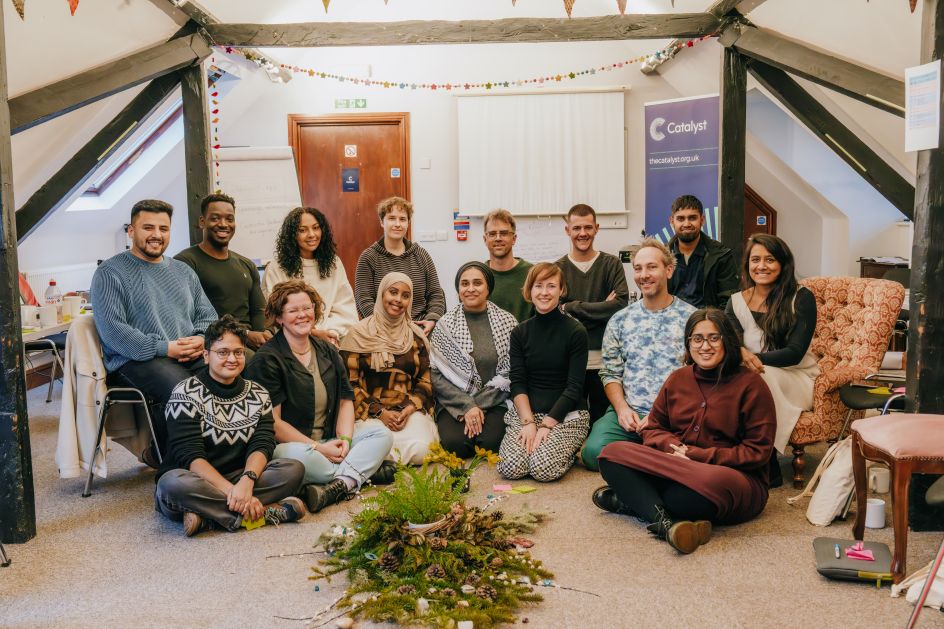
Her advice to designers and creatives who feel powerless? Get organized, stay visible, and don’t give up on the future. “Through collective organizing, we can begin to imagine and create the futures we want: ones that value human creativity, embody our culture and ancestral knowledge, and exist within planetary boundaries rather than exploitative ones.”
RCA effect
Both Gregor and Ramla credited the Royal Academy with providing the intellectual and creative foundation for this work, even if, in Gregor’s case, it looked nothing like artificial intelligence at the time.
“Interestingly, when I was at the RCA, I didn’t actually have any exposure to artificial intelligence once,” he said. “I was completely immersed in the analog world: journaling, 16mm filmmaking, experimenting with the mechanics of pre-Victorian cinema toys.” But those early experiments with imperfect, hand-made moving images attracted his interest in the flawed aesthetics of early generative video.
He added that RCA also taught him how to think in public. “I had to learn how to face criticism and talk openly about the messy work that was still in progress. My mentor helped me break away from the idea of a finished product and instead focus on the idea.”
For Ramla, more than two years of part-time study gave her room to develop further. In a standout module, “Imagining Futures,” her team collaborated with the Design Museum’s Future Observatory to imagine a future beyond humanity, including a speculative land commission that balances the needs of all residents, human and otherwise. “These prioritizing knowledge of justice, regeneration, and criticality shape my work,” she says, “leveraging technology where it is needed and useful, rather than imposing it.”
Two distinct approaches, one common belief. What are the key takeaways? Artificial intelligence is only as interesting as the questions you ask it. At RCA, problems come first.
Gregor Petrikovič studied for a master’s degree in photography. He is a Burberry Design Scholar and an alumnus of the International Studio and Curatorial Program (ISCP) in New York. His film Sincerely Victor Pike won the 2024 Colección SOLO AI Award, was selected for the New Contemporary Art Exhibition, and has been exhibited at IDFA DocLab, Tate Britain Late and Sónar+D Barcelona. He is currently a FLAMIN Fellow at the London Film School. Ramla Anshur is currently a part-time student in the Designing Futures program at MDes. She works as an experience designer at Accenture and co-authored the 2025 research paper “Resist, Refuse, Recycle, Reimagine: The Challenge of Mapping Narratives of Inevitability in Artificial Intelligence” with We and AI. Ramla was selected to participate in Catalyst’s Kindling program, which supports technology justice projects and includes an in-person retreat.