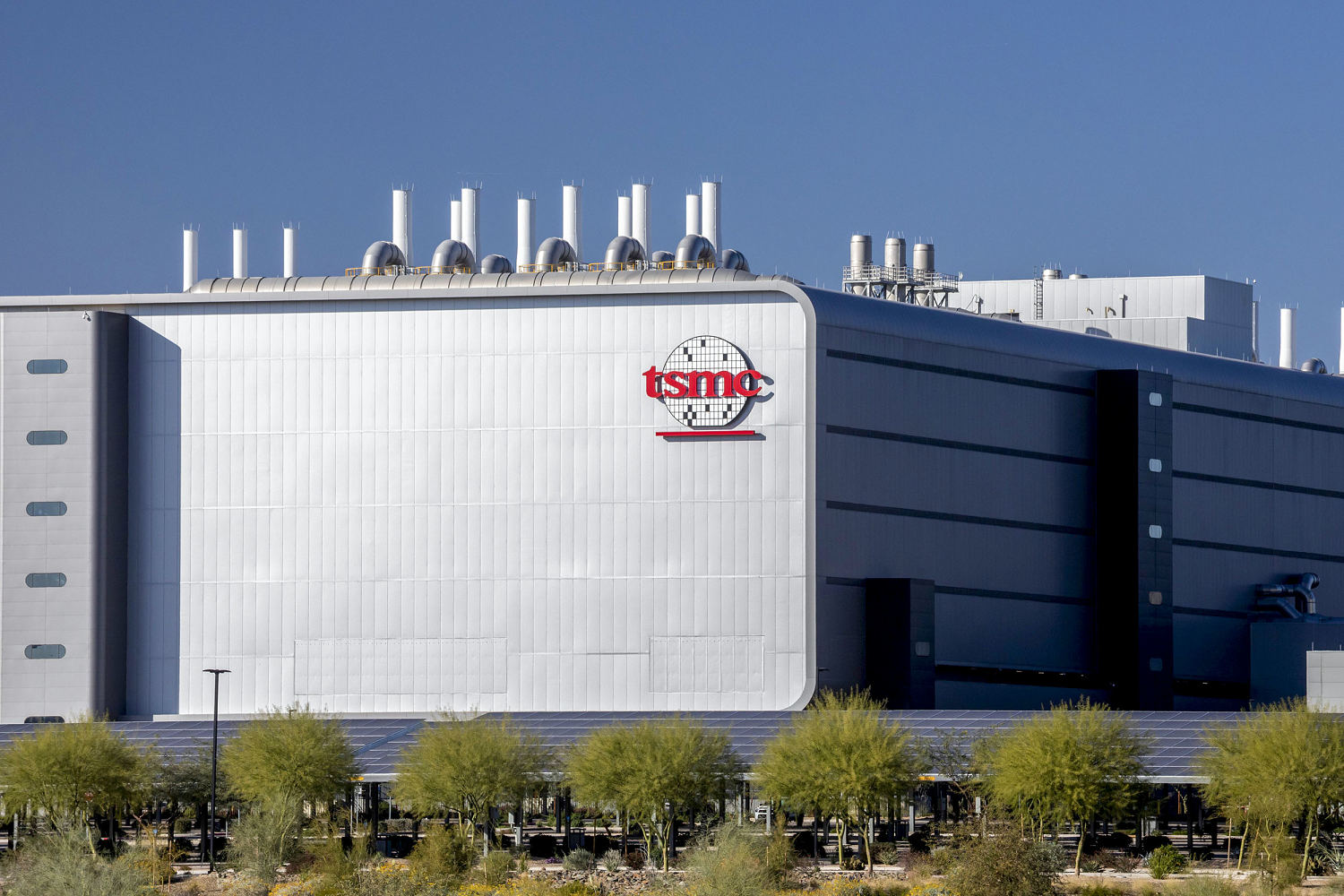
Key components produced by a major Taiwanese chipmaker have been found in a Chinese company’s powerful AI chip, according to an initial report from a semiconductor research firm that experts say could violate US export controls.
US officials were briefed on the research, according to a source familiar with the matter who requested anonymity to discuss private matters. The research explains the breakdown of an AI chip made for the Chinese company Enflame. After excluding the Enflame processor, research firm TechInsights found on its website that the major chip components are manufactured by Taiwan Semiconductor Manufacturing Co. (TSMC).
Over the past several years, the US has imposed tight restrictions on whether AI-related products can be sold to Chinese companies or companies operating in China, which is intended to maintain America’s lead in AI development. The chips provide the computing power needed to create and run AI systems, and their limited supply can act as a bottleneck for China’s AI industry.
Trade rules established by the Commerce Department determine where and how a chip can be exported, based on metrics such as the number of computing calculations it can perform per second and its computing power relative to its size.
The Enflame S60 chip will be powerful enough to be subject to those export restrictions, TechInsights appeared to conclude based on its initial analysis. Experts say the export control classification will make the sale of the chip to Chinese AI companies illegal from the end of 2022. According to several Chinese newspapers, at least one of which is state-affiliated, the Enflame S60 chips will be manufactured in 2024.
TechInsights says it classifies export control details, known as ECCNs, based on information from manufacturers or third-party suppliers or based on “information available at the time of analysis.” In the same disclaimer, TechInsights notes that its findings and conclusions are not final regulatory decisions.
Shortly after NBC News sent TechInsights its request for comment, the publicly viewable classification was changed to “TBD” before being removed entirely from the website.
“Technical analysis of the Enflame S60 is ongoing and not complete,” TechInsights spokesperson Graham Butler wrote in response to a request for comment. “We tentatively place the ECCN based on preliminary report findings. These may change as reports are finalized.” TechInsights declined to provide the full report to NBC News. TSMC told NBC News that the classification originally applied by TechInsights was incorrect.
Starting in 2022, it asserted that its export controls would apply to certain AI-related “items made using US technology, software or equipment” destined for China, even if the items themselves were manufactured outside the US, but that determination would cover essentially all AI chips because American technology was used in the machines that make the chips.
Under US export rules, which have been expanded to apply to chips destined for countries beyond China to address smuggling fears, TSMC is prohibited from shipping sophisticated chips to Chinese companies for AI purposes without specific export licenses.
TSMC makes the majority of the world’s AI chips because of its expertise with the unique and complex manufacturing techniques required to create semiconductor-dense chips.
“We have reviewed a specific third-party analysis report that states that a particular chip manufactured by TSMC is classified as a controlled AI chip,” a TSMC spokesperson wrote in response to a comment on the new research regarding the Enflame S60.
“Based on its technical features and applications, this chip does not meet the criteria for classification as a regulated AI chip, and the report has been corrected and the erroneous claim removed. TSMC is a law-abiding company and we are committed to complying with all applicable rules and regulations, including applicable export controls.”
Asked about TSMC’s assertion that TechInsights’ classification for the Enflame chip was incorrect, a TechInsights spokesperson reiterated that the technical analysis is “ongoing and not complete.”
Enflame did not respond to requests for comment.
TSMC has previously been accused of violating export controls related to making chips found in AI processors from major Chinese tech company Huawei, according to Reuters.
In April, Reuters reported that Sophgo, a company already banned by export controls from receiving TSMC-made AI chips, had launched an investigation into TSMC over how its chips appeared in Huawei processors, and said TSMC could face fines of $1 billion or more. At the time, a TSMC spokesperson said the company was committed to complying with the law and that it was cooperating with the Commerce Department.
Asked about the existence and status of the Huawei investigation, Commerce Department spokeswoman Lauren Weber Holley wrote in an email: “The Commerce Department does not comment on active enforcement matters or confirm or deny the existence of any pending investigations.”
Asked about any potential investigation into the Enflame chip, Hawley wrote: “The Commerce Department does not comment on active enforcement matters or confirm or deny the existence of any pending investigations.”
Measures introduced in November 2023 further restrict the types of chips and countries to which semiconductor manufacturing companies using American technology can export chips for AI purposes. The Enflame S60 chip, manufactured by TSMC, is powerful enough to meet these stringent regulations, according to details previously viewable on TechInsight’s website.
Jacob Feldgois, a senior data research analyst at Georgetown University’s Center for Security and Emerging Technology, who had access to separate data on the chip, said he was inclined to believe TechInsights’ initial determination that the chip was powerful enough to fall under the rules.
Because of fierce global AI competition and fears that Chinese companies could divert advanced chips to the Chinese military, the Commerce Department rarely issues such licenses. According to a senior Commerce Department official, Enflame has not received the license in 2023, 2024, or 2025.
“If this is a large AI chip designed for data center use and produced at TSMC, it is an export control violation similar to the Huawei-Sophgo incident,” said leading semiconductor expert Lennart Heim, who has not seen the chip and needs more details to reach a firm conclusion. The Commerce Department did not comment on the existence or status of a Huawei-related investigation or confirm whether the incident constituted an export control violation.
“Enflame is basically Tencent’s outsourced AI chip designer. It’s not some random independent startup — it’s closely tied to one of China’s biggest tech companies,” Haim told NBC News in written comments. “It’s a significantly smaller event than Huawei-Sofgo in terms of how many chips were produced — but it shows that chips shouldn’t be sourced through TSMC.”
According to Chinese newspaper reports, Enflame has deployed tens of thousands of S60 chips in data centers and similar infrastructure. Critical to AI development and use.
In recent months, the Trump administration has approved the sale of high-powered chips to China that exceed the performance capabilities of the Enflame S60 chip. However, the State Department has reportedly slowed the approval process by pushing for stricter rules on how chips like Nvidia’s H200 series are used based on national security considerations.