Introduction
Proteins are among the most essential macromolecules in living organisms. They perform a wide range of biological functions, including structural support, catalysis of biochemical reactions, transport of molecules, immune defense and cellular movement. At the molecular level are proteins polymers made of amino acids linked together by peptide bonds.
Understand how proteins are built, how amino acids interact, and how environmental factors such as pH influencing protein structure is fundamental in fields such as e.g biochemistry, molecular biology, medicine and biotechnology.
This article explains the structure of proteins, the role of amino acids, formation of peptide bonds, protein folding and the effect of pH on amino acid behavior.
Proteins are long chains of amino acids connected through peptide bondsform complex macromolecules that perform various biological functions.
The terms protein and polypeptide are sometimes used interchangeably, but they have slightly different meanings:
-
Polypeptides: Chains of amino acids with molecular weight less than 10,000 daltons
-
Proteins: Larger molecules with molecular weights greater than 10,000 daltons
Shorter chains of amino acids are known as:
Although polypeptides form the backbone of proteins, functional proteins require proper folding into a three-dimensional structure.
A newly synthesized polypeptide chain does not immediately function as a protein. Instead, it must be folded into a specific three-dimensional formknown as native structure.
The native structure is the biologically active form of a protein and is stabilized by several types of interactions between amino acid side chains.
These interactions include:
The side chains (R groups) of amino acids largely determines how proteins fold and maintain their structure.
If the original structure is disrupted (a process known as protein denaturation), the protein can lose its function.
Proteins are built from amino acidssmall organic molecules that share a common structure.
Each amino acid contains four components linked to a central carbon atom called alpha carbon (α-carbon):
-
Amino group (–NH₂)
-
Carboxyl group (–COOH)
-
Hydrogen atom
-
Side chain (R group)
The R group is what distinguishes one amino acid from another. It determines the chemical properties of the amino acid and affects how proteins fold and interact with other molecules.
The genetic code in eukaryotic organisms specifies 20 amino acids which is used in protein synthesis.
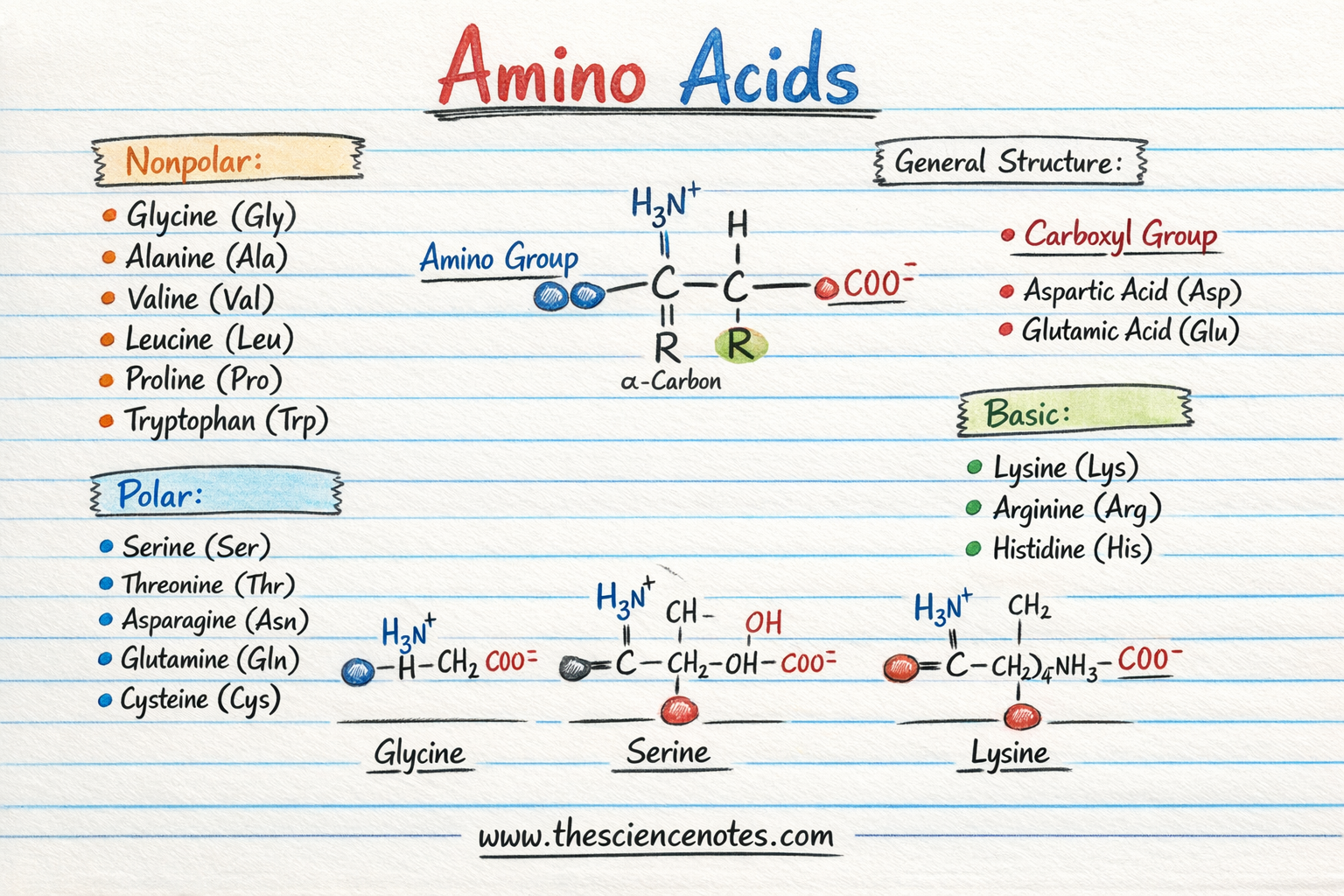
Each amino acid has:
Examples include:
| Amino acid | Three-letter code | One-letter code |
|---|---|---|
| Glycine | Glee | G |
| Valina | Choice | V |
| Proline | Pro | P |
| Alanine | Alas | ONE |
| Serine | Looking | S |
Despite sharing the same backbone structure the diversity of R groups allows proteins to perform thousands of different biological functions.
Amino acids are often grouped according to their chemical properties side chains (R groups).
1. Acidic amino acids
Acidic amino acids contain a the carboxyl group in the side chain.
Examples include:
-
Aspartic acid
-
Glutamic acid
These amino acids tend to donate hydrogen ions and therefore behaves as acids at physiological pH.
2. Basic amino acids
Basic amino acids contain amine groups in their side chains.
Examples include:
They tend to accept hydrogen ions and therefore functions as bases.
3. Polar (hydrophilic) amino acids
Some amino acids are polar but uncharged.
These amino acids:
Examples include:
-
Serine
-
Threonine
-
Asparagine
Their hydrophilic nature allows proteins to interact with aqueous cellular environment.
4. Non-polar (hydrophobic) amino acids
Non-polar amino acids have hydrophobic side chains which repels water.
Examples include:
-
Glycine
-
Proline
-
Tryptophan
-
Valina
-
Leucine
These amino acids are usually localized inside the folded protein structureaway from water.
Hydrophobic interactions play a major role in protein folding and stability.
Protein synthesis involves linking amino acids together through peptide bonds.
ONE peptide bond forms between:
During this reaction:
Because water is released, this reaction is called a dehydration reaction (also known as a condensation reaction).
The resulting chain of amino acids is called a polypeptide.
Polypeptide chains have directionalwhich means they have two distinct ends.
N-terminal
The N-terminal contains free amino group (–NH₃⁺).
This is the starting point of the polypeptide chain.
C terminal
The C terminal contains free carboxyl group (–COO⁻).
This marks the end of the protein chain.
Protein sequences are always written and read from:
N-terminal → C-terminal
This direction is important below protein synthesis and molecular biology studies.
When amino acids join together, they form a repeating pattern of atoms called polypeptide backbone.
This backbone consists of repeating units of:
The R groups extend outward from the backboneso that they can interact with each other and the surrounding environment.
These interactions determine final folded structure of the protein.
Amino acids contain both acidic and basic functional groupsmeaning they can function as either acids or bases depending on the environment pH.
This property is known as amphoteric behavior.
Low pH (acidic environment)
At low pH levels (approx pH 2):
Under these conditions, amino acids behave more like bases.
High pH (alkaline environment)
At high pH levels (approx pH 13):
In this environment, amino acids behave more like acids.
Physiological pH (neutral environment)
In most biological systems, the pH is approx 7.4.
At this pH:
This creates a molecule called a zwitterion.
ONE zwitterion carries:
-
One positive charge
-
One negative charge
This property allows amino acids to be formed hydrogen bonds and ionic interactionswhich are critical for protein folding and stability.
Proteins have an enormous diversity structure, composition and function. This diversity arises from the different combinations of 20 amino acids arranged in unique sequences.
Some important biological functions of proteins include:
Structural proteins
Structural proteins provide support and strength to tissues.
Example:
Contractile proteins
Contractile proteins allow muscle contraction and cellular movement.
Examples include:
These proteins interact to generate muscle movement.
Enzymes
Many proteins act as enzymeswhich act as biological catalysts.
Enzymes:
Examples include:
-
DNA polymerase
-
Amylase
-
Proteases
Transport proteins
Transport proteins help move molecules across cell membranes.
Examples include:
-
Ion channels
-
Carrier proteins
These proteins regulate the movement of substances such as:
Immune defense proteins
Proteins also protect organisms against pathogens and foreign substances.
Example:
Antibodies recognize and bind to specific antigenshelps the immune system eliminate infections.
One of the most important principles in biology is:
Protein structure determines protein function.
Even a small change in amino acid sequence can affect protein folding and alter function.
For example:
Therefore, it is important to understand the protein structure in:
-
Drug design
-
Molecular biology
-
Biotechnology
-
Medicine
Proteins are complex biological macromolecules consisting of amino acids connected by peptide bonds. The sequence of amino acids determines how a protein folds into its own natural three-dimensional structurewhich ultimately defines its biological function.
The 20 amino acids encoded by the genetic code provides an enormous structural and functional diversity. Their side chains, chemical properties and interactions with water and other molecules drive protein folding and stability.
Environmental factors such as pH affect amino acid charge states and contribute to the formation of zwitterionshydrogen bonds and other interactions that shape the protein structure.
From structural support and muscle movement to enzyme catalysis and immune defenseproteins are indispensable for life. A deeper understanding of protein structure and amino acid chemistry continues to drive progress biochemistry, medicine and biotechnology.
LEARN MORE: Proteins and Amino Acids: Structure, Function and Biological Significance – The Science Notes