Kyiv, Ukraine – As Washington’s allies in the Middle East use American-made Patriot air defense systems to shoot down Iranian missiles and drones, Ukraine is about to face a serious shortage of ammunition for them.
Experts have told Al Jazeera that Russian President Vladimir Putin will surely exploit the shortage of expensive guided missiles that truck-mounted Patriots launch at machine-gun speed to shoot down Russia’s pride and joy, the ballistic missiles he once declared were “indestructible.”
Recommended stories
list of 4 itemsend of list
The Patriots were developed in the 1970s to shoot down Soviet missiles whose modifications Russia still rains down on Ukraine.
Their supply to Ukraine began in 2023 and was initially limited to several batteries stationed in the capital kyiv. The location of the systems was constantly changing to protect them from Russian attacks.
The Patriots “have certainly been the most important defense element, especially for cities with more than a million inhabitants, kyiv in particular, although they were not able to intercept all Russian missiles,” Nikolay Mitrokhin of the German University of Bremen told Al Jazeera.
But the shortages highlight a deeper problem: the poor defense of Ukraine’s infrastructure, including power generation and transmission stations, against Russian attacks, he added.
With or without guided missiles, Ukraine’s energy infrastructure is “doomed,” because while Russia would not dare attack Ukrainian nuclear power plants, the Patriot systems cannot protect all key transmission lines, he said.
“The key question is how to prevent Russia from manufacturing and using missiles, not how many more guided missiles or Patriot systems Ukraine needs,” he concluded.
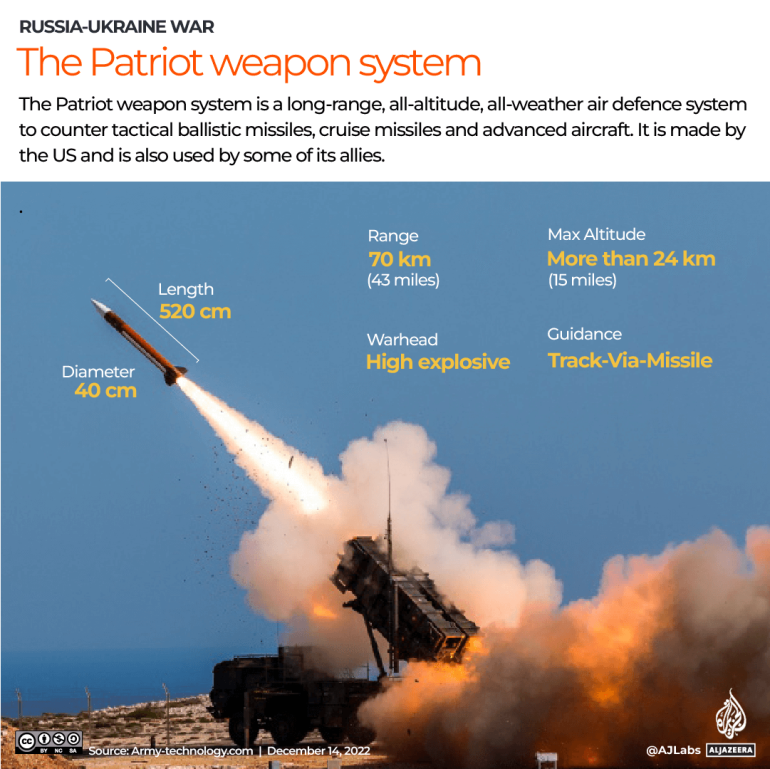
The Patriots use advanced radars to detect targets flying at supersonic speeds and launch their guided missiles with a sound that resembles super-fast electronic heartbeats: up to 32 missiles per minute.
But the noise — along with thunderous shock waves that follow bright split-second explosions — made Ukrainians feel safe during the harrowing hours-long Russian strikes that have targeted civilian areas and involved hundreds of drones and dozens of missiles.
Within weeks of their deployment, the Patriots intercepted Russia’s Kinzhal (Dagger) ICBMs, which are launched by supersonic fighter jets and fly in the Earth’s stratosphere.
The interceptions refute Putin’s earlier claims that the Kinzhals rendered any Western air defense systems “useless.”
Security, however, came at a high price: each Patriot guided missile costs several million dollars and its production never exceeded 900 units per year.
‘The problem of tomorrow’
Some 800 guided missiles have been used to repel Iranian airstrikes in just three days after Tehran began launching its missiles and drones on nearly a dozen nations, Ukrainian President Volodymyr Zelenskyy said Thursday.
“Ukraine has never had so many missiles to repel attacks,” Zelenskyy said, reiterating his willingness to send Ukrainian experts and drone interceptors to help Gulf nations counter attacks.
However, the shortage of guided missiles is not immediate and may occur over several weeks.
“This is not today’s problem, it is tomorrow’s problem,” Volodymyr Fesenko, think tank director at the Kyiv-based Center for Applied Political Studies (Penta), told Al Jazeera.
But the problem can be catastrophic.
In recent days, Moscow has stopped attacking Ukraine with drones and missiles, a sign that it is stockpiling them for massive strikes in the near future, Fesenko said.
“Russia’s most obvious actions would be to bleed Ukraine’s Patriot missile stockpile to inflict maximum damage on us through massive missile strikes,” he said.
kyiv already faces a less critical problem with a shortage of missiles for the Western-supplied F-16 fighter jets that have proven effective in shooting down Russian missiles.
“The problem is less critical, but also vital for us,” Fesenko said.
Ukraine has previously experienced a shortage of Patriot missiles.
Last summer, when the United States and Israel attacked Iranian nuclear facilities, the Pentagon halted the supply of Patriot missiles while it was “auditing” its own stockpile.
The suspension of Patriot interceptors and HIMARS multiple rocket launchers left Ukrainian civilian infrastructure, including thermal power plants and transportation hubs, more vulnerable to Russian attacks.
Russian tactics of indiscriminate airstrikes have been proven over the past four years.
Moscow begins an airstrike with drones and decoy drones to get Ukrainian air defense units to use as many Patriot missiles as possible.
It then launches several more waves of attack drones and ballistic and cruise missiles.
As for the next attacks, “the thing is that this time it will not be the energy infrastructure, but any other target that the Kremlin wants to choose,” kyiv-based analyst Igar Tyshkevych told Al Jazeera.
He referred to the devastating attacks on central heating and power facilities that left millions of Ukrainians without electricity and heat this winter, causing health problems and deaths from hypothermia.
Russia already attacks sites not protected by patriots: military expert
Meanwhile, Israel and European nations that have promised to transfer their Patriot missile stockpiles to Ukraine are reluctant to do so now.
“Given the general instability, I don’t think many countries will open their reserves and pass them on to us,” Tyshkevich said.
Since supplies of the Patriots began, the technological battle between the United States and Russia has continued, according to the former deputy chief of the General Staff of the Armed Forces of Ukraine, who for decades specialized in air defense.
“There is a confrontation in engineering,” Lieutenant General Ihor Romanenko told Al Jazeera.
“The Russians change something, the Americans, together with our experts, change something else, because staying at the old (technological) level means losing the battle before it begins.”
Russian engineers “modified the software so that the (Iskander-M) missiles could maneuver in the air, and the modernization greatly complicated the operation of the few Patriot systems we have to destroy them,” Romanenko said.
The Patriots, however, have not become an all-Ukrainian aegis against Russian attacks.
Ukraine has fewer than a dozen batteries, while kyiv said it needed at least 25.
The Russians “already know that we have only a few Patriot batteries against their ballistic missiles, so they were attacking sites that had not been covered by the Patriots, or where they had not been deployed,” Romanenko said.
Luckily, Ukraine has an alternative.
A handful of Franco-Italian SAMP/T systems with solid-fuel anti-aircraft missiles have been deployed in Ukraine since 2023 and have demonstrated the advantages of their radars and “engagement logic” with high-speed targets.
While a Patriot battery requires up to 90 military support and takes half an hour to deploy, SAMP/Ts require around a dozen.
But its ability to shoot down modified Russian missiles will have to be tested in battle, Romanenko said.
Meanwhile, Ukraine’s increasingly bold drone and missile strikes inside Russia destroy or damage its weapons depots and plants that produce drones and missiles.
In recent weeks, they have attacked the Admiral Essen, a Russian frigate capable of launching Kalibr cruise missiles from the Black Sea, nine air defense systems in Russian-occupied Donetsk and Crimea, and Russia’s only plant producing fiber optic cables for drones.