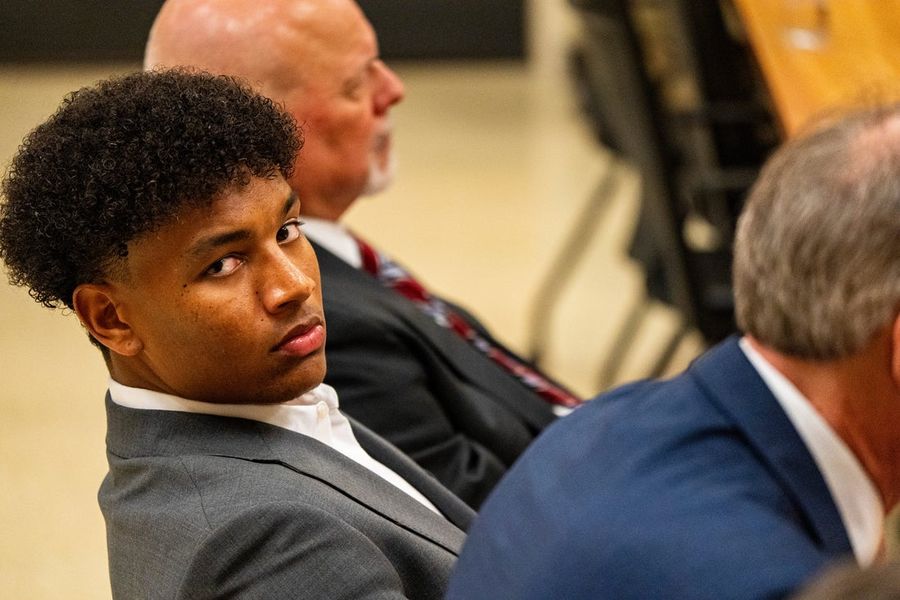
 Ole Miss quarterback Trinidad Chambliss looks on with members of the media during Chambliss’ hearing in his lawsuit against the NCAA at the Calhoun County Courthouse in Pittsboro, Mississippi, Thursday, Feb. 12, 2026. Chambliss was granted a preliminary injunction against the NCAA.
 The Mississippi Supreme Court took Ole Miss quarterback Trinidad Chambliss’ fate in its hands Thursday after an appeal of his eligibility status.
The NCAA is objecting to a February ruling by a Pittsboro, Mississippi, judge that granted Chambliss an injunction extending another year of college eligibility in 2026 because he took a medical redshirt from Ferris State in 2022.
The NCAA’s request to expedite the ruling comes as NFL prospects complete another step in their draft preparation. The 658-page appeal asks the court to dismiss the injunction that gave Chambliss the opportunity to return to college instead of remaining in the 2026 NFL Draft.
“NCAA members and student-athletes will suffer irreparable harm without a midterm review,” the NCAA filing reads. “The preliminary injunction provides additional eligibility (Chambliss) not available to other student-athletes under NCAA bylaws. Under the trial court’s order, UM will benefit from having a star quarterback on its roster who is no longer eligible to compete. This outcome is unfair to DI schools that would have to follow the rule and compete against UM in the 2026-2027 DI football season or could be excluded from postseason competition by UM.”
Chambliss, who finished eighth in the 2025 Heisman Trophy race while leading the Rebels to the College Football Playoff semifinals, had his appeal to play in 2026 denied for the first time by the NCAA on Jan. 9.
He was selected as the No. 3 quarterback in the 2026 NFL Draft by Field Level Media analysts before receiving an apparent holdover for his sixth season of eligibility.
Attorneys filed for an injunction granted by Lafayette County Chancery Court Judge Robert Whitwell. The University of Mississippi is located in Oxford, the county seat of Lafayette.
But the NCAA argued in its response Thursday that Ole Miss had put itself at risk.
“The injunction risks harm to UM as it risks being sanctioned under the NCAA’s indemnification rules by listing ineligible quarterbacks,” it reads.
The February order appears to have banned the rules the NCAA references.
Whitwell spoke for more than an hour before declaring in February that Chambliss would receive a restraining order. He declared that the NCAA showed “malice” in denying Chambliss’ appeal by ignoring evidence presented by Ferris State doctors.
Chambliss spent his first four years of college at Ferris State. He redshirted as a freshman in 2021, played in just two games in 2022 due to injury (sparking the belief that he was eligible for a medical redshirt) and threw just 33 passes as a backup in 2023 before sending Ferris State to the Div. Won the 2nd national competition in 2024.
The Grand Rapids, Mich., native transferred to Ole Miss in 2025 and became the team’s quarterback in Week 3 after starter Austin Simmons suffered an injury. Chambliss led the Rebels to a 13-2 season that ended with a 31-27 Fiesta Bowl loss to Miami on January 8.
Chambliss completed 66.1% of his passes for 3,937 yards, 22 touchdowns, and just three interceptions. He also rushed for 527 yards and eight scores.
He signed a lucrative NIL contract to return to Ole Miss, but was put in jeopardy when his waiver appeal was denied.
The NCAA may appeal Thursday’s decision, so there is no guarantee that Chambliss will be in uniform when Ole Miss opens the 2026 season against Louisville on September 5 or 6 in Nashville, Tennessee.
The NCAA released a statement shortly after the injunction was granted.
“This decision by the state court illustrates the impossible situation created by various court decisions that undermine rules agreed upon by the same NCAA members who later challenged them in court. We will continue to defend the NCAA’s eligibility rules against repeated attempts to deprive future generations of the opportunity to compete in college and experience the life-changing opportunities that only college sports can create. The NCAA and its member schools are making changes to provide greater benefits to student-athletes, but it is a mixed bag of inconsistent and conflicting court decisions with state law. “Working with Congress is essential to provide stability for current and future college athletes.”
–Field level media