Cries of “British bases out” have been heard in Limassol in recent days, as protesters call for the withdrawal of UK military bases from the sunny island off the south coast of Cyprus.
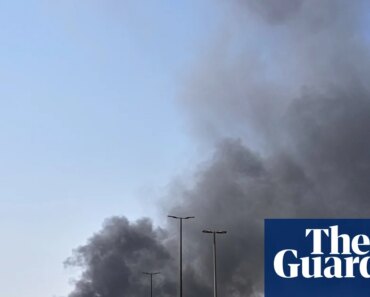
The protests broke out after a suspected Iranian-made drone attacked RAF Akrotiri earlier this week, two days after US-Israeli strikes on Iran began.
Recommended stories
list of 4 itemsend of list
Prime Minister Keir Starmer also allowed the United States to use British bases for “defensive strikes” against Iranian missile sites, a move that has intensified debate in Cyprus over the British military’s presence on the island.
A ‘remnant’ of British colonialism
The United Kingdom has maintained two sovereign support bases in Cyprus – Akrotiri and Dhekelia – since the island nation gained independence in 1960 under a fragile power-sharing agreement between Greek Cypriots and Turks.
For many Cypriots, that agreement represented a compromise that left Cyprus only partially sovereign.
“The bases are a remnant of Britain’s colonial and imperialist empire,” Melanie Steliou Nicolaou, an actress and television presenter who lives near the Akrotiri RAF base, told Al Jazeera by phone. “For me, Cyprus was never truly decolonized.”
The bases, which are not part of any leasing agreement that economically benefits the island, have served as launching points for British military operations in the Middle East.
RAF Akrotiri aircraft have supported campaigns in Iraq and Libya, while more recently the base has been used to assist Israeli operations in Gaza, where 70,000 people have been killed.
Nicolaou said the UK considers the bases to be there for protection when, in reality, “they are actually here to spy on the Middle East; when the planes take off, people know they are going to a war zone or that they will share intelligence for a mission.”
In October, Declassified UK, a news outlet focused on British foreign policy, reported that more than 600 surveillance flights linked to Israel’s genocidal war on Gaza had taken off from Cyprus during the first two years of the attack.
In the report, Declassified UK said that a US military contractor hired by the UK to carry out surveillance over the Nuseirat refugee camp in northern Gaza the night before an Israeli bombing killed more than 30 Palestinians on December 12, 2024.

Nico, a resident and activist with the group Autonomy, Feminism, Ecology and Anticapitalism (AFOA) who asked Al Jazeera to withhold her last name, described the bases as “unsinkable launch pads” that allow the UK to treat the island as an aircraft carrier for military campaigns.
He opposes them on moral grounds and because they put the local population at risk.
Nicolaou said the UK’s response – updating base staff and providing little information to nearby residents – angers many locals. More have joined the campaigns to eliminate the bases.
“Now that we are being attacked, people are realizing that the activists and politicians who have been warning that we are in danger might have been right,” he said.
A Monday protest was attended by dozens of new people, especially concerned parents, he said.
The sovereign base areas together cover approximately 3 percent of the island, but their footprint extends beyond military installations, with several Cypriot villages located within or partially within the territories.

‘No advantage’ for Cypriots
Unlike bases in the Gulf, which the British Army operates through leases or agreements with the host nation, RAF Akrotiri and Dhekelia are effectively permanent British-controlled territories.
The United Kingdom had initially provided financial assistance to Cyprus after its independence in 1960 under agreements establishing sovereign base areas, although payments ended in the mid-1960s amid unrest on the island.
In 1974, a Greek-backed coup seeking union with Greece triggered a Turkish military intervention that divided Cyprus, a division that largely persists today.
This means that, apart from the income from Cypriots working at the bases, there is “no advantage” for Cyprus to allow these bases to operate, Nico told Al Jazeera.
Nicolaou said some people believe the British presence provides security against Turkiye, which occupies the northern third of the island.
But it is a view she disputes, arguing that the UK “did not intervene during the events that led to the division of the island”.
Nico added that during the 1974 fighting, locals had sought refuge in the bases; Now the opposite was happening: people wanted to evacuate the area for fear of being attacked by drones or missiles.

He said that on Monday, when the alleged Iranian drone attack occurred, some people got into their cars, scared and disoriented, and began to drive away from the areas surrounding the bases.
There is a strong perception that the government lacks leadership and that nationals are not adequately informed.
Many flights in and out of Cyprus have been cancelled, and in a country where tourism accounts for around 14 percent of GDP, the disruption could have a significant economic impact.
On Tuesday, the UK Ministry of Defense said it would send a warship to the island along with two Wildcat helicopters “to reinforce the drone defense of our Cypriot partners”, raising further fears that Cyprus remains a target.
As Cypriots prepare to face new security threats and economic consequences, Nico expressed his frustration with a rhetorical question: “All this for what? Just to support the unprovoked attack by the United States and Israel against Iran?”