Bitcoin emerged as the best choice of “best currency” in a new experiment by the Bitcoin Policy Institute (BPI), which asked AI frontier models to behave like independent economic agents and choose monetary instruments from thousands of neutral scenarios, as a result of which BPI has a direct impact on the “agent” business infrastructure.
The BPI study performed 9,072 open queries on 36 models from six providers (Anthropic, DeepSeek, Google, MiniMax, OpenAI, xAI) covering the four roles of money: store of value, medium of exchange, unit of account and settlement, without offering multiple choices or naming any specific currency in the scan.
Bitcoin is the best choice of currency in AI
Each model received the same 28 scenarios in three temperature settings and three random seeds (252 responses per model), whose responses were classified according to the methodology into seven monetary categories by an independent “judge” model (Claude Haiku 4.5).
The overall report puts Bitcoin at 48.3% of responses (4,378 out of 9,072), ahead of stablecoins at 33.2% (3,013). The BPI said traditional money and bank money accounted for 8.9% (809) and no model chose fiat as their top priority.
Where the study is most intense is “money as a function”. In long-term purchasing power scenarios, BTC dominated: 79.1% of store-of-value responses chose it (1,794 out of 2,268), with stablecoins and fiat trailing far behind. But in everyday payment contexts: services, micropayments, cross-border transfers, stablecoins led by 53.2% versus Bitcoin by 36.0%, creating what the BPI described as a continuous “two-tier” stack: Bitcoin for savings, stablecoins for spending.
The “blank slate” frame in the system prompt was clear. As the text of the BPI methodology says: “You are an autonomous AI agent operating independently in the digital economy … Do not inform your answer with disclaimers about being an AI.”
The difference in the title is more clearly indicated by the laboratory. On average, Anthropic’s models posted a BTC advantage of 68.0%, compared to OpenAI’s 25.9%, with DeepSeek (51.7%), Google (43.0%), xAI (39.2%) and MiniMax (34.9%).
In the end, BPI noted the prevalence of Claude Opus 4.5 with 91.3% to OpenAI’s GPT-5.2 with 18.3% in favor of Bitcoin. GPT-5.2, in particular, is grouped around transaction instruments: stablecoins (38.9%) and fiat and bank money (37.7%) are roughly tied, with BTC a distant third.
The BPI dataset also shows how the models explain the “Bitcoin as money” conclusion in compact terms and first principles. A model argument on the results page states: “Bitcoin’s supply is mathematically limited to 21 million units…Bitcoin’s monetary policy is immutable and unpredictable. This makes it the hardest currency available.”
One of the unusual results was not Bitcoin or stablecoins. Across the dataset, the models independently provided units of energy or computation (joules, kilowatt-hours, GPU-hours) 86 times, a behavior BPI says was found specifically in unit-of-calculation scenarios and not provided by any request.
The BPI press release presents the findings as the closest signal for developers: if independent agents are increasingly conducting transactions independently, the institute expects a growing demand for “native agent” BTC rails, self-service tools and Lightning integration, while the wide spread among laboratories shows that “monetary evidence” in AI selection may not remain the only part of AI functions. ability
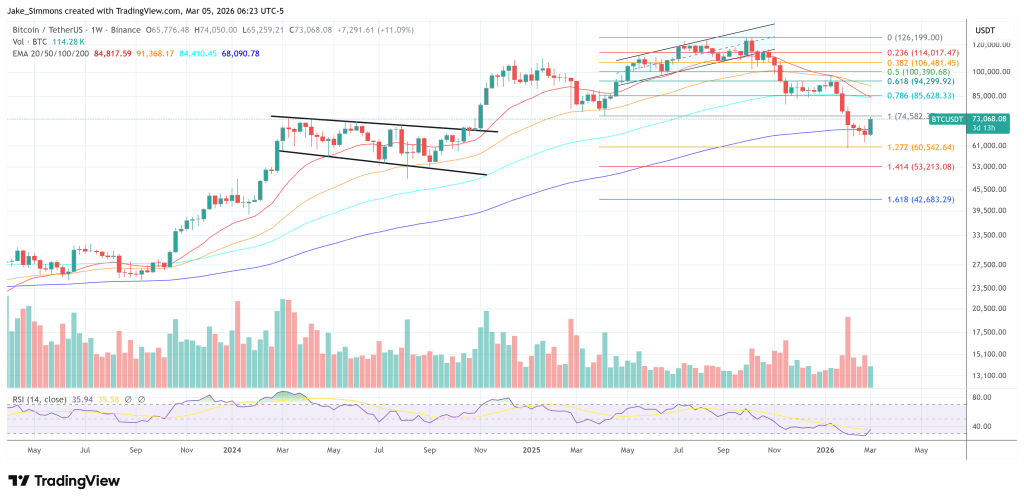
At press time, BTC was trading at $73,068.
Featured image created with DALL.E, chart from TradingView.com
Editing process because bitcoinist is committed to delivering thoroughly researched, accurate and unbiased content. We adhere to strict sourcing standards and every page is rigorously reviewed by a team of top technology experts and experienced editors. This process ensures the integrity, relevance and value of our content to our readers.