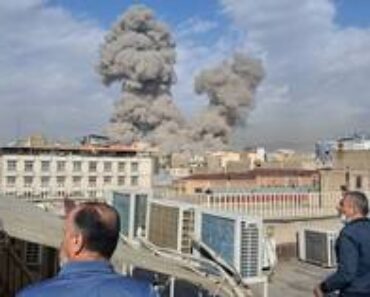
In a post on its official X account yesterday, the Israeli Ministry of Foreign Affairs directed a message towards the Hague Group — a growing coalition of sovereign states — including South Africa, Colombia and Malaysia — that is meeting in an emergency session in The Hague to discuss international law enforcement and accountability for actions in Gaza. The Israeli ministry posted a photo of the 40 assembled nations along with a photograph of thick black smoke rising from the alleged sunk Iranian ship earlier in the day. Part of the headline reads: “We can expect the outcome of the Hague meeting to be as successful as Iran’s navy.”
The post was published on an official government account and has not been retracted. It refers to an active military operation. In announcing the strikes, President Trump told the Iranian people that the government would be “yours” once the bombing ends.
In that case, the juxtaposition of a sinking warship with the imagery of diplomats and experts is more than an abstract stimulus. Comparisons are being made between meeting participants for military goals and upholding international law.
The Hague Group represented a significant shift in global South diplomacy. Established on January 31, 2025, it was established by eight core countries: Bolivia, Colombia, Cuba, Honduras, Malaysia, Namibia, Senegal and South Africa, with the express mandate of coordinating state action to enforce the provisional measures of the International Court of Justice (ICJ).
The coalition clearly frames what it is doing as a compliance with the existing international legal framework, not a departure from it. Israel, in contrast, responded by comparing the diplomatic meeting to a military target. That choice of response reveals itself. This reflects a disregard for due process, for participants, and for legal liability to apply equally to all states.
By March 2026, far from being an isolated “fringe” group as portrayed by Israel in its post, the Hague Group’s influence had expanded significantly, with 40 nations including G20 members such as Brazil and Saudi Arabia meeting – along with European states such as Spain and Norway – to discuss concrete measures to ensure the enforcement of international law.
In the final statement of the March 4 emergency meeting, the 40 nations present proposed a broad package of concrete measures to move “from rhetoric to action”. It included a complete ban on the importation of settlement goods and halted the transfer or shipment of all weapons, military fuel and dual-use items to Israel. A notable new measure included the implementation of disclosure requirements for travelers using Israeli documents. Individuals who have served in the Israeli military may now be subject to “secondary screening at ports of entry” under national war crimes admissibility rules. The group emphasized that these steps are necessary to meet “third-state obligations” as determined by the July 2024 ICJ Advisory Opinion. He argued that states should actively prevent any assistance in maintaining illegal employment.
An Israeli ministry tweet dismissed the coalition as a “corrupt regime” of “hatred”. But the group’s legal standing is bound up with a history that Israel cannot so easily dismiss.
At the height of the apartheid era in South Africa, when the world began to isolate the white-minority government in Pretoria, Israel remained one of its staunchest allies. It is a deep strategic partnership involving nuclear collaboration and advanced military technology. The instruments of state violence that administered apartheid were often developed or refined with Israeli expertise. Evidence of this alliance includes the widely documented 1979 “Vela incident”, believed to be a joint nuclear weapons test by Israel and South Africa in the South Atlantic that bypassed the Nuclear Non-Proliferation Treaty.
This history does not resolve the legal questions before the ICJ. But it complicates the structure of the current coalition Israel. The nations now pushing to enforce international law are, in many cases, the same nations that spent decades accepting Israeli-backed impunity.
The present moment adds another layer of historical irony. The February 28 attacks on Iran have given new prominence to Crown Prince Reza Pahlavi, the heir to the Pahlavi dynasty, who thanked Donald Trump for “hitting a monstrous regime” in what he referred to as “humanitarian intervention”. In April 2023, during an official visit to Israel organized by the Israeli intelligence minister, Pahlavi spoke of reviving the “ancient bond” between the people of Israel and Iran and promoted “Cyrus agreements” to restore relations between them.
Under his father’s rule, Iran was one of apartheid South Africa’s major economic partners. By 1978, Iran supplied more than 90 percent of South Africa’s crude oil imports, neutralizing the Arab oil embargo that had been one of the international community’s primary instruments of pressure against Pretoria. Shaw’s father died in exile in Johannesburg in 1944.
It is precisely this history – where legal frameworks have been selectively enforced and international isolation applied to some states but not others – that the Hague Group was designed to address. The Hague Group’s March 4 statement names what that history implies: the choice facing states between complexity and compliance.
The group warned that unless states act now to “give international legal teeth”, the legal framework governing the global order “will not be worth the paper it is written on”. Indeed, if the outcome of a meeting defined by compliance with international law is to be measured in terms of the “success” of the bombing ship by Israel and its allies, the concept of international law has already been ignited.
Now is no more urgent moment to bring to account the arsonists of the statutory order.
The views expressed in this article are the author’s own and do not reflect the editorial position of Al Jazeera.
(tags for translation)opinions